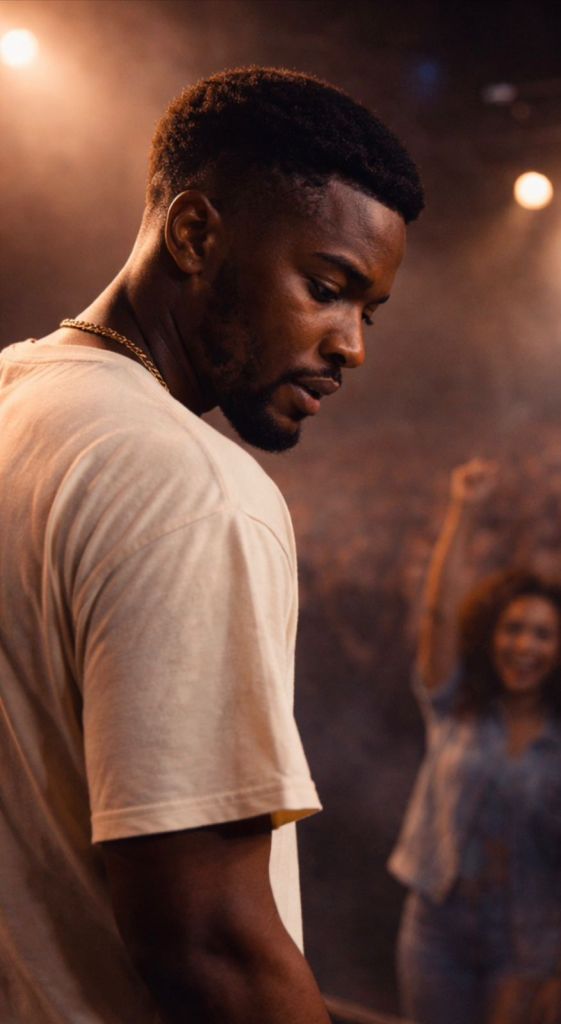
A rainy March day. Toadbury Hall Hotel. Laduma Ngxokolo’s MXS Kulture Festival is in full swing — the kind of event where creativity hangs in the air like expensive cologne and every corner holds someone worth talking to. Maxhosa – MXS is part of culture , is culture and a movement.
I’m standing with a group of gifted artists, the kind of company that makes you feel like you accidentally wandered into the right room. From a few meters away, two women are waving at us. Not casual waves. Frantically animated, full-body, groupie-coded waves — smiles, giggles, the works.
In our group stands a man who is, by any honest measure, unfairly handsome. Tall. Golden voice. The kind of good-looking that makes you squint just to recalibrate. So I lean over and ask him:
“Are those ladies waving at you?”
He turns, narrows his eyes slightly — and I’ll be honest, even that small squint made him look better. Like some kind of advanced Black-Asian aesthetic upgrade. BlackAsian 3.0, if you will.
Now here’s something cisgender men don’t say out loud but absolutely know to be true: we see good-looking men. We just have a whole unspoken agreement to pretend we don’t. We act collectively blind until a woman announces,
“He is so hot” — at which point we smile, nod vaguely, and keep it moving. We are not about to volunteer that opinion unprompted. Not in this climate. Someone might start questioning our postcode on the social justice map.
Speaking of which — that map has gotten crowded. The alphabet now has new landlords. Out of 26 letters, a significant portion has been claimed, rebranded, and assigned new meaning. Five vowels, 21 consonants — and at last count, two of those vowels and five consonants are fully occupied territory. The cisgender community still has access to 19 letters and can timeshare on the remaining seven rainbow ones. We manage.
Back to the festival.
The two women eventually make their way over — and walk directly to the handsome artist. Their question carries a familiar edge of wounded expectation:
“Why are you ignoring us?”
He smiles. Warm. Gracious. Disarming.
“I am very sorry. I genuinely did not see you.”
Then — and this is the part that stopped me — he adds:
“Honestly, these days I’m scared to look at women. In case I get accused of eye harassment. Apparently that’s a thing now. You can get cancelled just for making eye contact.”
He wasn’t bitter about it. Just… tired in a quiet, almost philosophical way.
“These days,” he said, “it’s better to be Stevie Wonder and Steve Kekana. Just move through the world with your eyes safely pointed inward.”
Then, with a small laugh that held more weight than it let on:
“Kunzima these days to have men’s eyes.”
And that line sat with me.
Kunzima — it is heavy, it is hard — is not a word you throw around lightly. It carries the full weight of Zulu or Nguni expression. And when a man as confident and magnetic as this artist uses it to describe the simple act of seeing, something worth paying attention to is being said.
We have arrived at a strange and uncomfortable junction where men — particularly Black men already navigating a hundred other invisible social tripwires — are now anxious about their gaze. Not their hands. Not their words. Their eyes.
There is a real conversation to be had about the difference between a predatory stare and a human glance. Between harassment and existence. Between accountability and overcorrection. That conversation is worth having carefully — because getting it wrong in either direction costs someone something real.
But perhaps the most honest thing that happened at a festival celebrating African creativity and culture was this: a beautiful man, surrounded by art, admitted that he no longer trusts himself to simply look.
Kunzima, indeed.
Where is the line between safety, accountability and overcorrection?
 Between Thoughts - Intellectual Musings
Leave a comment