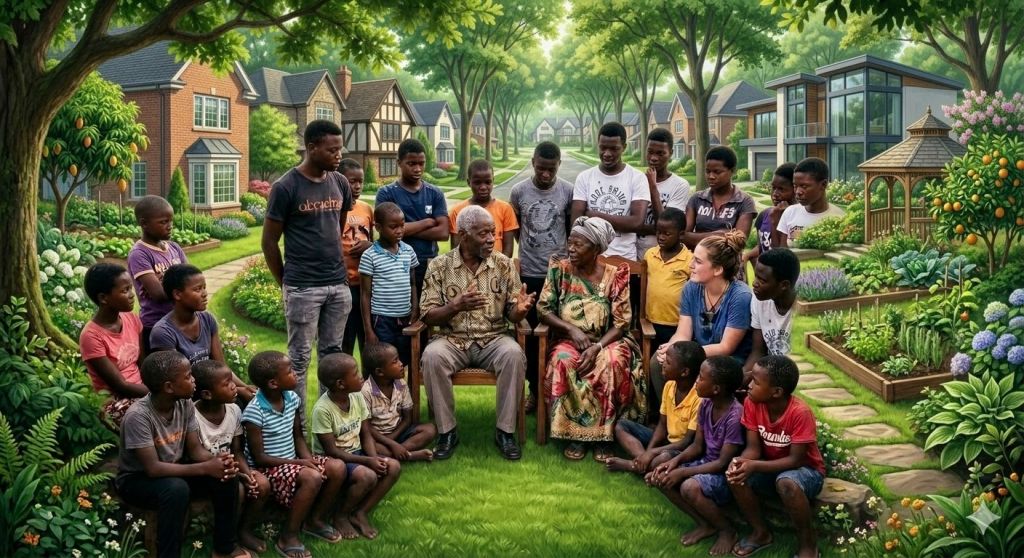
There is a particular kind of confidence that only youth (2k) can manufacture — the kind that has never been stress-tested by reality, never met its own shadow in a dark corridor at 3am, never had to choose between principle and survival when the stomach is crying, the family is hungry, and the offer on the table is just slightly outside the rules.
2k had that confidence. Beautiful. Unbroken. And completely dangerous.
The List
After watching Madlanga Commission with the grannies. He recited his list like a creed. Like a man who had memorised the Ten Commandments and confused memorisation with obedience.
I will never be corrupted like ANC politicians.
I will never steal.
I will never lie.
I will never commit adultery like my father.
I would have never supported apartheid.
I would rather die.
Mkhulu (Grand Father Nature) said nothing. He had lived long enough to know that silence is sometimes the most devastating response. He had seen WW2, Dutch and British colonizers, Die Stem, apartheid fall.
He had watched idealists become the very thing they despised – from comrades to sell outs to billionaires. He had watched good men — deeply, genuinely good men — slowly negotiate away their goodness, one reasonable compromise at a time. Falling deep into Dante’s inferno.
Makhulu (Grand Mother Nature) , ninety nine years old and made entirely of grace and truth, looked at her twenty-fifth grandchild with tender eyes. Then she opened her mouth and said the most loving thing an elder can say to a young person:
“Then you do not know you yet.”
The Architecture of Untested Virtue
Here is what nobody tells the young and righteous:
Virtue is not a personality trait. It is a performance under pressure.
2k had never been offered a bribe so large it would change his mother’s life. He had never been in a room where everyone around him — people he respected, people he loved — was doing the wrong thing and calling it the right thing. He had never been desperate enough, hungry enough, cornered enough, humiliated enough for his shadow to introduce itself.
Makhulu knew this. She had watched Qamata and the ancestors quietly curate his path — shielding him, as grandmothers do, from the crucibles that reveal character rather than build it. She knew that money, power, and alcohol are revealers of shadows lurking in our abyss. Shadows so sober, so dormant, waiting for an opportunity to be triggered by firewater to come out and play.
She quoted Morgan Freeman playing God:
“When you pray for courage, God does not give you courage. God gives you an opportunity to be courageous.”
The key word is Opportunity.
My dear grandson,
You are only as faithful as per your Opportunity, Chris Rock once said before he was slapped by Will Smith. Makhulu laughed – “I am funny!”.
2k’s list was not a character reference. It was a wish list. A menu of the man he hoped to be — assembled in the absence of the very conditions that would determine whether he could be that man at all.
Jung’s Warning From the Shadow
Makhulu loved Carl Jung. Not as an academic exercise, but because Jung had said the truest thing she had ever heard about human beings:
The shadow does not disappear when you refuse to believe in it. It grows. Jung argued that inside every person — saint, revolutionary, idealist, prophet — lives a dark twin. A shadow self. A dormant capacity for the very evil we denounce most loudly. And here is the uncomfortable mathematics of that truth:
The louder the denouncement, the deeper the denial.
The deeper the denial, the more volatile the shadow.
The more volatile the shadow, the more catastrophic its eruption — when the right conditions finally arrive.
Those conditions have a name: mass psychosis. Collective moral collapse. The epidemic of insanity that swept through ordinary Germans in the 1930s. That captured ordinary Rwandans in 1994. That turned neighbours into informants under South Africa’s apartheid. That transforms principled politicians into the very looters they once condemned — slowly, incrementally, one rationalisation at a time.
Jung called these moments “shadow projections” — when the darkness we cannot acknowledge in ourselves gets externalised, weaponised, and unleashed on the world. Under those conditions, said Jung, anyone could become,
The murderer.
The adulterer.
The apartheid lover.
The slave owner.
The liar at the Madlanga commission.
The man reciting blatant nonsense on national television without blinking.
Anyone.
Including the boy with the beautiful list.
The Zondo & Madlanga Commission were Full of People Who Had Lists
This is the part that should make us all sit down.
The men and women who appeared before the Zondo or Madlanga Commission — spewing lies, deflecting, performing amnesia — were not born corrupt. They had mothers. They had dreams. Some of them had lists of their own, once. They too, in their youth, had said: I will never.
I will never
Then life offered them an opportunity. Not an opportunity to be courageous. An opportunity to be corrupted. And they took it. Not all at once — that is not how it works. They took it in installments. A small concession here. A reasonable compromise there. A silence that protected the wrong person. A signature that shouldn’t have happened. A rationalisation so elegant it almost felt like wisdom.
By the time the shadow was fully in control, the original person — the idealist with the list — had been so gradually replaced that even they did not notice the transition.
This is not a South African problem. This is a human problem.
What Makhulu Was Really Saying.
Makhulu was not crushing 2k’s idealism. She was doing something far more important. She was initiating him into the only form of integrity that actually holds — not the brittle certainty of the untested, but the humble, vigilant, eyes-open commitment of someone who knows what they are capable of and chooses, daily, deliberately, to be otherwise.
She was saying: Know your shadow. Name it. See it. Wrestle and Rumble with it. Do not pretend it isn’t there.
Because the man who knows he is capable of corruption is far more dangerous to corruption than the man who believes he is immune to it. In moments of violence, a man who can expertly wield a gun or knife and deliberately and intentionally chooses not to use it – is far more dangerous.
The Takeaways
For the 2k’s among us — the young, the righteous, the list-makers:
1. Your ideals are not your identity — yet. They are your intention. The gap between intention and identity is filled by choices made under pressure, in the dark, when no one is watching.
2. Humility is not weakness. It is the beginning of real integrity. The most dangerous person in any organisation is the one who believes they cannot be compromised. They stop watching themselves. And the shadow takes over undetected.
3. Pray for opportunities — and tremble slightly when they come. Every situation that tests your “never” is a gift. Not a comfortable gift. But a necessary one. The man who has been tested and held is worth ten who were never tested at all.
4. Know your shadow. Do the inner work. Therapy. Honest mentors. Hard conversations. The examined life is not just philosophically superior — it is functionally safer for everyone around you.
5. The distance between you and the man on TV lying at the commission is not in character. It is a circumstance. Reduce the circumstance gap by building the character deliberately, daily.
The Final Word — From Makhulu to All of Us
She did not say you will fail.
She said: you have not been tested yet. You have not been presented with an opportunity you cannot resist.
There is a profound difference.
The first is a verdict. The second is an invitation — to stop performing virtue in safe rooms and start cultivating it in the conditions where it actually counts.
2k listened. And for the first time, his confidence shifted — from the arrogance of innocence to something quieter, older, more durable.
The beginning of wisdom.
Which, as it happens, is exactly what ninety plus years of living looks like.
“The most terrifying thing is to accept oneself completely.”
— Carl Jung
“Intonga ayigobi ngokuzibona.”
A stick does not bend by seeing itself.
— Zulu proverb
From;
Between Thoughts — Intellectual Musings | Dr. Mzi Masito
 Between Thoughts -Intellectual Musings
Leave a comment