There is a quiet shame that runs through developing nations when they look at the gap between where they are and where they want to be. A shame that whispers: you are behind. And in response to that shame, two equally dangerous paths emerge — blind imitation that erases identity, or stubborn rejection of outside influence dressed up as pride.
Both are wrong. Both are expensive.
History offers a third path. A proven one. And every nation that has closed the gap — truly closed it — has walked this same road:
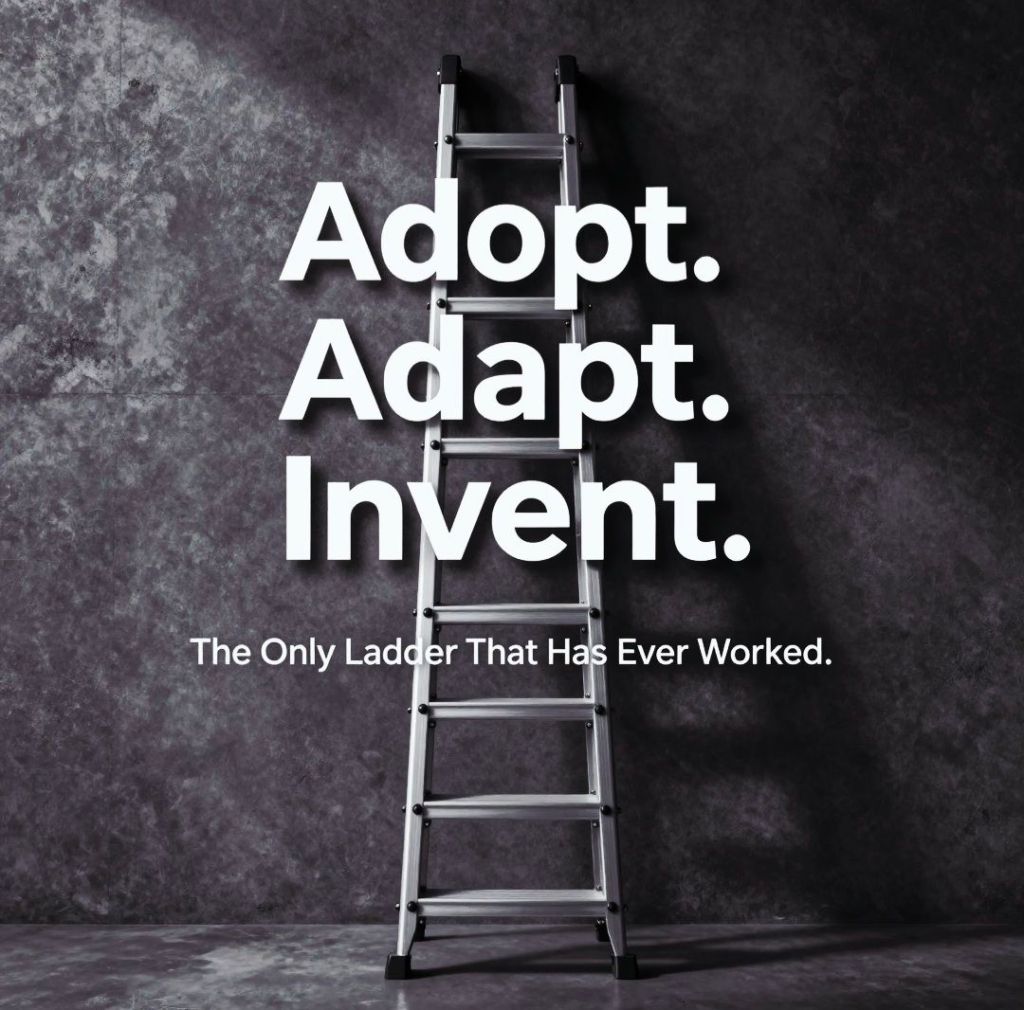
Adopt. Adapt. Invent.
Not as three equal choices. As a sequence. As a ladder.
The Architecture of the AAI Model
Adopting is copying. Deliberately. Unapologetically. When Japan first encountered Western industrial machinery in the Meiji era, they didn’t debate whether it offended their heritage. They sent delegations across the world to study, document, and bring back everything that worked. Adoption is not weakness — it is the highest form of intellectual efficiency. Why solve a problem someone has already solved? Imitation, done consciously, is the fastest vehicle for closing distance.
Adapting is where identity and culture re-enters the equation. It is the act of taking what works and running it through the filter of your own PESTEL conditions — your political realities, your economic constraints, your social fabric, your technological infrastructure, your environmental context, your legal architecture. It factors in your customs, your cultural logic, your communal values. Adapting is not diluting. It is localising truth. It is asking: how does this work here, for us, given who we are?
Inventing is what becomes possible once you are no longer in survival mode. When cognitive bandwidth is no longer consumed entirely by catching up, when institutions are stable enough to take long bets, when your people have internalised enough of the world’s best thinking to synthesise something new — then invention emerges. Not from nowhere. It emerges from the compound interest of adoption and adaptation done well.
The nations that leapfrogged did not skip steps.
They accelerated through them.
Five Countries. One Proof.
Japan
Adopted: In 1868, the Meiji Restoration triggered one of history’s most deliberate acts of national learning. Japan adopted Western legal codes (largely German), its navy modelled on Britain’s, its army on Prussia’s, its postal system on America’s. They sent thousands of students abroad — not tourists, students — with explicit instructions to bring back what works.
Adapted: Japan filtered Western industrialisation through its own cultural operating system. The result was kaizen — continuous incremental improvement — rooted in Japanese values of collective responsibility, precision, and long-term thinking. Toyota’s Production System was not American Fordism. It was Fordism adapted through a culture that values the worker’s mind, not just their hands.
Invented: Sony. Honda. Nintendo. The Shinkansen. Japan did not just catch up — it set new global standards in electronics, automotive manufacturing, and precision engineering. It invented an aesthetic of product design — minimal, purposeful, enduring — that the world now aspires to.
China
Adopted: Post-Mao, Deng Xiaoping looked at what capitalism had produced in the West and made one of the most consequential decisions in modern history: adopt the market mechanism without adopting the political system. Special Economic Zones were laboratories of deliberate adoption — Western capital, Western management practice, Western supply chain logic, absorbed at industrial scale.
Adapted: China never surrendered state architecture. It adapted market economics into a model of state-directed capitalism — controlling the commanding heights while liberating the productive base. It adapted Western e-commerce infrastructure into something more deeply embedded in daily life than anywhere else on earth. WeChat is not WhatsApp. Alibaba is not Amazon. They began as adaptations and became originals.
Invented: China now leads in 5G infrastructure, high-speed rail, solar panel manufacturing, battery technology, and increasingly in AI. It has invented entirely new consumer behaviour patterns — live-stream commerce, super-app ecosystems — that the West is now studying and copying. The student has become the teacher in several critical domains.
South Korea
Adopted: Post-Korean War, South Korea had a GDP per capita comparable to Ghana. It adopted American industrial policy thinking, Japanese manufacturing discipline, and Western financial systems — consciously, structurally, through state-directed industrial strategy.
Adapted: The chaebol model — large family-controlled conglomerates backed by state policy — was not a Western invention. It was an adaptation of Western corporate structure fitted to a Korean cultural logic of hierarchical loyalty, national pride, and long-term relationship economics. Samsung and Hyundai were not accidents. They were adapted blueprints.
Invented: K-Pop is perhaps the most underanalysed soft power achievement of the 21st century. South Korea took the Western pop music industrial complex, ran it through Korean cultural values of collective perfectionism, aesthetic discipline, and group identity, and produced something entirely new — a global cultural export that is now reshaping music, fashion, beauty standards, and language learning worldwide. BTS did not adopt American music. They invented a new genre of global belonging.
Vietnam
Adopted: After decades of war and a failed command economy, Vietnam launched Đổi Mới (Renovation) in 1986 — deliberately adopting market mechanisms, foreign direct investment frameworks, and export-led growth models from its Asian neighbours, particularly South Korea and Taiwan.
Adapted: Vietnam adapted these models within a one-party political structure, maintaining socialist governance while opening the economy — a tightrope walk that required constant contextual recalibration. It adapted global manufacturing supply chains to its own labour economics, geographic position, and infrastructure realities, becoming the world’s second largest exporter of textiles and electronics assembly.
Invented: Vietnam is now developing original technology companies — VinGroup, VNG Corporation — and is building toward semiconductor manufacturing capability. But more than products, Vietnam invented resilience as economic strategy: the art of adapting fast enough that geopolitical disruption becomes competitive advantage rather than catastrophe.
India
Adopted: India inherited and then deliberately retained British institutional infrastructure — common law, parliamentary democracy, the English language, an administrative civil service. What could have been purely a colonial scar became, in the hands of visionary adoption, a global competitive advantage.
Adapted: India did not adopt the Western tech economy wholesale. It adapted it through the filter of its own engineering education system, its diaspora networks, its cost structure, and its cultural appetite for abstraction and systems thinking. Infosys, Wipro, TCS — these were not copies of IBM. They were adaptations of the outsourcing model through Indian intellectual capital and a relationship-based business culture.
Invented: India’s Unified Payments Interface (UPI) is arguably the most sophisticated real-time digital payments infrastructure on earth. Built on public digital infrastructure, it has processed billions of transactions and is being studied and adopted by other nations — including in the West. India invented a new model of public stack — open, interoperable digital infrastructure as national commons — that is now a global export. The Aadhaar biometric identity system similarly represents genuine invention with global consequence.
What Africa must do with AAI
Here is the honest truth: Africa has been shamed out of the first two steps – AA ( Adopt & Adapt).
By colonialism, which reframed adoption as assimilation and adaptation as betrayal. By a certain strain of post-colonial intellectual pride that confused originality with isolation. By development discourse that positioned African nations as passive recipients rather than active learners. By the romanticisation of pre-colonial tradition as the only legitimate reference point.
The result? Africa has often skipped adoption and adaptation — not out of strategy, but out of confusion about what is owed to the past — and then wondered why invention has not emerged spontaneously.
It does not work that way. It has never worked that way.
There is no shame in AA before you I. First a country or even a human being must Survive in order to have a chance to Thrive. AA allows for Survival to pave way for Thriving. Dead countries and dead people do not prosper nor thrive.
Toyota needed Ford before it could build the Prius. Samsung needed Sony before it could build the Galaxy. China needed Western capital before it could fund CATL. The sequence is not a hierarchy of worth. It is a ladder of capability.
What Africa must do is this:
Adopt without apology. Mobile money worked in Kenya because Safaricom looked at what existed, saw the gap in African financial infrastructure, and implemented something that already existed elsewhere. M-Pesa is often celebrated as African invention. The truth is more instructive: it began as adoption, became adaptation, and in its local execution became something the world had never seen. That is the model.
Adapt with ferocity. Africa’s PESTEL conditions are distinct. Its communal social architecture, its oral tradition, its relationship-based economic logic, its demographic youth curve, its linguistic diversity — none of these are obstacles to adaptation. They are the material of adaptation. When Africa builds business models that work, they will work because they factored these things in, not despite them.
Invent when bandwidth permits — and build for that bandwidth deliberately. Invention is not a gift. It is a condition. It requires leadership, educational infrastructure, stable institutions, capital markets that take long bets, and enough psychological safety for people to fail publicly and try again. Africa and African leaders must build those conditions intentionally — not wait for them to appear.
The continent that is the cradle of the human species has given the world more than it has been credited for. The next chapter is not about reclaiming the past. It is about writing a future so original, so distinctly African in its logic and so globally significant in its impact, that no one will need to footnote it.
But that chapter begins, as all great leaps do, with the humility to learn — and the wisdom to know what to do with what you have learned.
Adopt. Adapt. Invent.
In that order. At pace. Without apology.
Between Thoughts – Intellectual Musings
Where uncomfortable questions have a seat at the table.
___________
Between Thoughts – Intellectual Musings. Dr. Mzamo Masito
Where the uncomfortable questions have a seat at the table.
 Between Thoughts -Intellectual Musings
Leave a comment