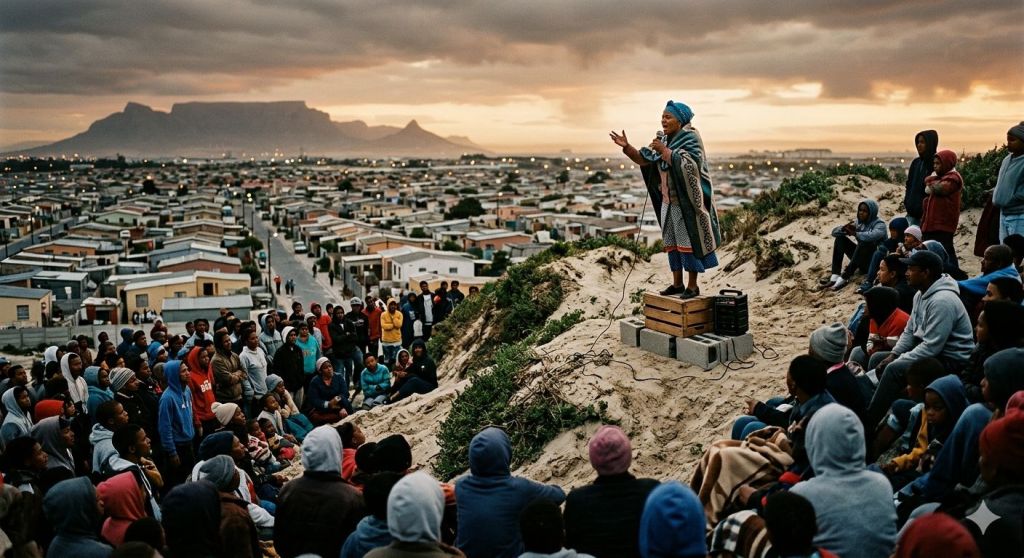
Mitchells Plain. A progressive church. A banner that read “Be Rooted in Christ” — Colossians 2:7.
They invited me to be one of the speakers and also join a panel: social workers, pastors, counselors, therapists. One speaker covered girls and women. I covered boys and men. Between us, we had the full catastrophe.
I arrived with a book tucked under my arm and a question lodged in my chest: What does Easter have to say about boys and men who are failing, falling behind, and suffering in silence? . Why are Christians and the church celebrating while boys remain entombed?
I asked the Holy Trinity. The answer came in three movements.
Good Friday is what happens when a society decides a boy’s suffering isn’t worth preventing.
Easter Sunday is what happens when God disagrees.
Easter Monday — Bright Monday, Renewal Monday, as the Orthodox, Catholics, and Anglicans call it — is the reminder that even in Jesus’s cry of “Father, why have you forsaken me?”. God was already working on a restoration that would change everything.
That cry matters. Because boys in this country know that they cry by heart. They’ve screamed it into the silence of absent fathers, absent mothers, absent communities — and heard nothing back.
Nature abhors a vacuum. So does Lucifer.
He sends a gang leader. A pedophile. The manosphere. The red pill brotherhood. They arrive not with horns but with a hug — or the counterfeit of one — to fill the abandonment wound that simply longs to hear:
“I love you. I see you. You matter.”
The demons always enter where the wound of absence lives. Lucifer never lets a crisis we create go to waste. He is, if nothing else, operationally excellent.
Easter Monday is for those boys. For men who feel forsaken by the church, by their fathers, by the state — men carrying the weight of events too shameful to name out loud: sexual abuse by a family member, a neighbour, a stranger. Prison molestation. Violations that shrink a man into silence for decades while the world calls his silence strength.
To those men, We must say this plainly: Do not lose faith. Keep the faith.
Scripture says faith is the substance of things hoped for. Which means hope is the fuel. Hope keeps you asking, knocking, moving, planning, executing. Faith without action? Dead on arrival — and God does not do funerals for things that were never meant to die.
uJesu ufika ekuseni. Joy comes in the morning. Eventually. The Bright Light never fades.
I was then asked to talk about – Why I wrote the Book?
My book is called This Country Hates Our Men (Boys) — subtitled Boy, You Are On Your Own.
It exists for four reasons or intentions.
1. Poverty & Inequality.
Let’s begin with the inconvenient biological truth nobody wants to say in polite church company: boys’ brains develop slower than girls’. The prefrontal cortex — the part that governs judgment, consequence, and the ability to answer the question “what were you thinking?” — is still under construction well into a boy’s mid-twenties. Meanwhile, testosterone has already taken the keys and is doing donuts in the parking lot.
Now add poverty. Poverty traumatises and compromises the boy’s psychological immune system (PIS). Neuroimaging studies consistently show that children from low-income households often have lower volumes of gray matter—the tissue critical for processing information—compared to their higher-income peers. These differences typically emerge around age two and include:
Reduced Gray Matter Volume: Children in poverty often have lower volumes of gray matter in the frontal and temporal lobes. These areas are critical for “executive functions” like planning, problem-solving, and impulse control.
Smaller Hippocampus: This region is essential for learning and memory. Studies show that the hippocampus is particularly vulnerable to the toxic effects of chronic stress hormones like cortisol.
Heightened Amygdala Activity: The amygdala, which processes emotional reactions and threats, may become hyper-reactive. This “rewiring” can lead to hypervigilance and difficulty regulating emotions.
Reduced Cortical Surface Area: Higher family income is positively correlated with a larger surface area in the cerebral cortex, specifically in regions supporting language skills and reading.
Beyond PIS. Poverty stunts innovation and invention.
A child from an upper- or middle-income home has roughly a 1-in-1,000 chance of creating something patent-worthy. A child born below the median income line? 1 in 10,000. You cannot invent Tesla, Capitec, or Discovery when your head is underwater — drowning in hunger, a leaking shack, clothes that don’t cover the shame, a school that gave up before you did. There is no Silicon Valley without Maslow’s basic needs. No innovation without dignity.
The poverty trap closes fast and it closes hard. The poor die young and if born in poverty, you are likely to die in poverty.
Born Poor – Die Young – Die Poor
Poor at 12 to 16? Over 60% chance you die in poverty. Poor at 20 to 25? Over 90%. Poor people die 15 years earlier than wealthy people. The revolving door is not a metaphor. It is a sentence — handed down at birth, with no appeal process. The serf live 7 to 15 years less than the have lots. A boy born in a high-income country (or a wealthy enclave in SA) can expect to live to 82, nearly 19 years longer than a boy born in a low-income environment. Wealthy individuals over 50 can expect to enjoy 8 to 9 more healthy years than the poorest people. Those living in poverty face a significantly shorter and more precarious existence.
Poverty leads to heuristics, and more prone to misinformation. For example,
In schools: boys are more likely to believe education is pointless, to vanish at Grade 10, to fall behind in literacy, numeracy, and science.
Nearly 7 out of 10 South African university graduates are women. That is not a victory to be dismissed. It is a quiet alarm going off in an empty room — and nobody is running toward it.
Then comes inequality — relative deprivation — pouring salt into every wound poverty already opened. Inequality breeds comparison. Comparison breeds aggression. Aggression breeds violence. And suddenly humans who should be building together look like crabs in a barrel, pulling down anyone who dares to climb. We built the barrel. We filled it. We are surprised by the crabs.
Colonialism and Apartheid built the tomb. Let’s be precise about that. They didn’t stumble into inequality — they engineered it. Meticulously. Institutionally. With legislation, land theft, and the particular cruelty of what scholars call social death — the systematic erasure of a people’s economic humanity, generation by deliberate generation.
The architects knew exactly what they were building. That is what makes it unforgivable.
But here is where the eulogy gets complicated.
The ANC inherited the tomb in 1994. Thirty years later, the question is no longer who built it. The question is: why are so many people still inside it?
Thirty years. That is not a transition. That is a tenure. And the ANC’s track record on poverty and inequality is, at this point, a masterclass in squandered potential — delivered with extraordinary confidence and very little shame.
Colonialism stole the silver. Apartheid burned the house. The ANC, bless them, has spent three decades rearranging the deck chairs on the Titanic — and issuing press releases about the view.
Inequality has not improved. It has worsened. South Africa remains one of the most unequal societies on the planet — not despite thirty years of democratic governance, but alongside it.
Poverty has not been defeated. It has been administered. There is a difference. One requires courage. The other requires only a budget line and a committee.
The boys at the centre of this conversation — Black boys, Coloured boys, boys born into shacks and broken schools and fatherless homes — were promised a different country. They were promised that the stone would be rolled away.
Instead, somebody lost the paperwork.
Hold colonialism and apartheid accountable — fully, without apology. And then, in the same breath, hold the ANC accountable too. Justice does not do exemptions. Neither does data.
2. My Two Brothers
One brother is a man of extraordinary uprightness. My brother’s keeper — in every sense of that word.
The other hanged himself.
Before he died, he hanged his son. My nephew. Eight or nine years old. He left a two-page suicide note. Addressed directly to me.
Men complete suicide at five times the rate of women. The words that appear most often in the notes they leave behind are not rage. Not accusation. They are two words:
worthless and useless.
Accompanied by three psychological suicidal states researchers have named with devastating precision: thwarted belongingness, perceived burdensomeness, and provocative painful events — the accumulated belief that you belong nowhere, that the people you love would be better off without you, and that the life you have lived has been an injury to everyone in it.
I carry my nephew everywhere I go. I carry my brothers too.
Some weight you don’t put down. You just learn to walk differently.
3. African Men Care NPC — 21 Years
For 21 years being part of African Men Care NPC. AMC observed;
We live in an era that has taken the word masculinity — a word that should carry complexity, nuance, and the full weight of human experience — and flattened it into a slur. A global study asked boys aged 12 to 17 what they associate with the word. Their answers were not subtle:
“It’s toxic — all I hear is that masculinity is toxic.”
“Men are trash.”
“Men must die.”
And in isiXhosa, with the particular poetry of mother-tongue contempt: “Utata yikaka yomntu” ( your father is a piece of excrement)
Utata yinja.” (your father is a dog).
This is what we are feeding boys about themselves at breakfast, lunch, and dinner. And then — hand on heart, eyes wide — we are shocked when they internalise it.
Here is a pattern worth naming carefully: when Dr. Nandi — the good doctor — commits a Luciferian act, society attributes it to her. To her alone. When a policewoman kills eight family members for the insurance payout, that malevolence belongs to her. When a mother kills or abandons a child, it is her act. We do not say abafazi zi- xyz anything. We do not collectivise women into a verdict. We protect the individual. We honour the nuance.
But amadoda? We collectivise effortlessly. We problematise with ease. We move them from subjects to objects. Daily. With moral confidence. With what is called Virtuous Verbal Violence (VVV) — the harm we inflict while feeling entirely righteous about inflicting it. Collective judgment delivered with the calm certainty of the self-appointed court.
Here is what neuroscience says, since we are in polite company: physical violence and verbal violence hit the same part of the brain. Semantic pain is still pain. Sticks, stones, and words — all of them hurt, all of them in the same neighbourhood of the nervous system. We have decided to only treat one kind of injury while cheerfully administering the other.
Language is not neutral. Watch what you say. Watch who is listening.
The other observation is Dad Deprivation. Absent Biological Fatherhood and at times Motherhood is a national crisis.
7 out of 10 Black boys in South Africa have no father at home. 5 out of 10 Coloured boys. Single parenting is heroic — genuinely, breathtakingly heroic — and its average outcomes for children are, on the data, not good. There are over 50 documented negative outcomes for boys raised without their biological fathers. Fifty. We don’t discuss them because discussing them feels like blaming mothers. It is not. It is burying boys quietly and calling the silence compassion.
4. Mzamo. Me-Search | Auto-ethnography.
The final intention is the one I tried to avoid the longest. The one that kept clearing its throat while I looked the other way.
An absent biological father.
Then a present step father — violent, a womaniser, eventually taken by HIV/AIDS, which has its own kind of commentary on life.
A mother who stayed inside intimate partner violence.
A boy watching all of it. Absorbing all of it. Becoming a vessel for everything he witnessed — because boys have nowhere to put what they see, so they become it. He becomes hypervigilant, conflict avoidant, nervously and never securely attached, a runner when the going gets tough.
Two failed marriages. When love gets hard, he hits the road. Just like his daddies.
That which we avoid grows — and we shrink.
I needed to stop shrinking. I needed to meet my inner demons, wrestle with them — and as Paul writes to the Ephesians — put on the full armour of God. Not just the outer armour. The interior armour. The armour of the soul. The breastplate you wear on the inside.
This is what auto-ethnography demands: the researcher becomes the researched. The man who writes about suffering must admit, on the record, that he is writing about himself.
It is the most exposed I have ever been. It is also the most free.
The Bottom Line
The message is not complicated. It just requires courage to say out loud:
Boys — mainly Black and Coloured boys — are failing and falling behind. Men are suffering.
Gender equality is not a zero-sum game. We can lift women and catch boys. God loves us all equally — and somehow we have built a justice framework that doesn’t.
The church, the state, the community: none of them get to pick favourites and call it justice.
Good Friday was preventable. We made those choices — in policy, in language, in silence, in the absence we normalised and the wounds we left unfilled.
Easter Sunday was not preventable. God made that one.
The question — the only question that matters as you walk out of this building today — is which story you are choosing to live inside.
Because Easter Monday is not just a holiday.
It is an instruction.
 Between Thoughts -Intellectual Musings
Leave a comment