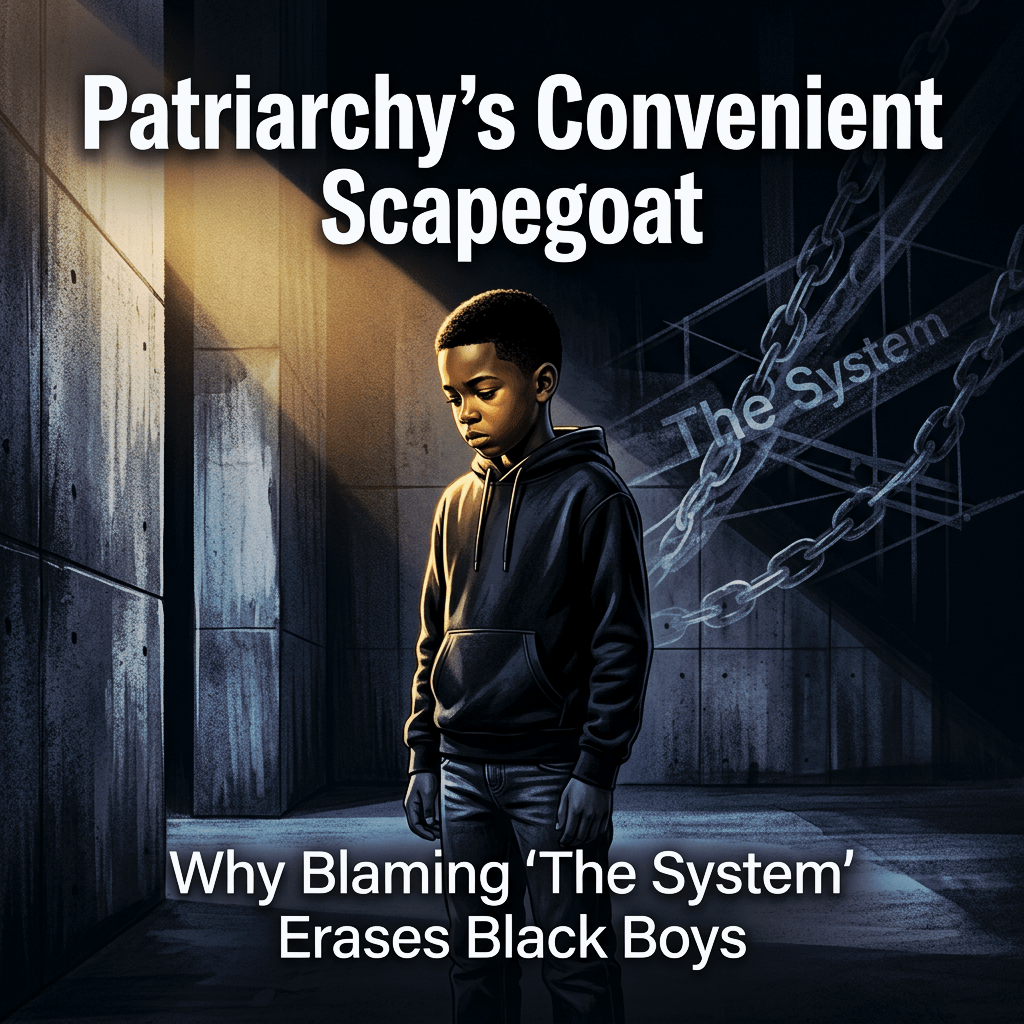
Patriarchy’s Convenient Scapegoat: Why Blaming “The System” Erases Black Boys
Between Thoughts — Intellectual Musings
I recently encountered a letter circulating on WhatsApp, allegedly written by an 8-year-old girl, titled “Is The Boy Child Being Left Behind?” The piece was eloquent, morally assured, and concluded:
“The South African boy child is being left behind by the very system that once favoured him: the patriarchy.”
The letter continued: “Patriarchy is a system designed by men and for men… This system offered a safety net and even rewarded average behaviour and efforts… But times have changed and so have the rules of success…. Our black boys lack ambition, support and comfort.”
It’s well-written. Thoughtful. And fundamentally incomplete.
I found myself asking: Who told this 8-year-old it’s patriarchy? How did she reach that conclusion? More troubling: What critical analysis did the adults, teachers around her fail to provide?
The letter reflects a dangerous pattern in South African gender discourse: the invocation of “patriarchy” as a monolithic explanation for Black male failure—without interrogating whether Black boys were ever beneficiaries of the system being blamed.
This isn’t a defense of patriarchy. It’s a challenge to intellectual dialectical laziness – monism and reductionism.
The Patriarchy Paradox: When the Oppressor Is Also the Victim
Let me be blunt: How is the Black boy who grew up in squalor, fatherless, in a country ruled for 400 years by white colonial and apartheid patriarchs, a beneficiary of patriarchy?
The narrative that “patriarchy” is the sole or primary cause of Black male failure is reductionist and monistic—it collapses centuries of racial capitalism, colonial dispossession, apartheid brutality, unfree cheap labour that died in the mines and ongoing structural exclusion into a single-variable explanation: gender. Side note – to honour the dead men who are ‘beneficiaries of patriarchy’ – “since the discovery of major minerals in South Africa in the late 19th century, it is estimated that at least over hundreds of thousand miners have died in the line of duty, with the vast majority being Black men. Due to the historical migrant labour system and poor – deliberate record-keeping during the early colonial and apartheid eras, an exact cumulative total specifically for Black men is not officially tracked”. It could easily be in millions -may their souls rest in eternal peace – maybe there is a patriarchal heaven.
Collapsing male pain into a single-explanation: gender.
This is bad science. It’s also bad ethics.
What Is Patriarchy? (The Textbook Definition)
Patriarchy, in feminist theory, describes a social structure where men hold primary power in political leadership, moral authority, social privilege, and control of property. The term originates from the Greek patriarkhēs—”rule of the father.”
Feminist scholars like Sylvia Walby define patriarchy as operating across six structures:
– Household production (unpaid domestic labor)
– Paid work (occupational segregation)
– The state (institutionalized male dominance)
– Male violence (systemic use of force)
– Sexuality (compulsory heterosexuality, control of women’s bodies)
– Culture (representation and ideology)
Bell hooks, in The Will to Change: Men, Masculinity, and Love, argues that patriarchy is not just a system of male dominance over women—it’s a system that damages men by enforcing rigid, hierarchical, emotionally repressive masculinities that demand dominance, stoicism, and control.
R.W. Connell’s theory of hegemonic masculinity adds nuance: not all men benefit equally from patriarchy. Hegemonic masculinity—the culturally exalted form of masculinity (white, wealthy, heterosexual, able-bodied)—subordinates other masculinities, including Black, poor, queer, and disabled men.
This is the critical insight feminism offers: Patriarchy is not a conspiracy of all men against all women. It’s a hierarchical system where some men dominate other men and women.
So the question becomes:
Which men hold patriarchal power in South Africa? And which men are crushed beneath it?
The South African Reality: Patriarchy’s Uneven Distribution
Who Holds Power?
Let’s examine the data from the 25th Commission for Employment Equity (CEE) Annual Report (May 2025) & Stats SA Household Survey:
Top Management by Race:
White individuals: 62% of top management roles (despite being ~7.7% of the workforce)
Black Africans: 16.9%
Indian: 11.2%
Coloured: 4.8%
Top Management by Gender:
Men: 73.5% (predominantly white men)
Women: 26.5%
JSE Top 40/50 CEOs (2024):
Women CEOs: 10–11%
Black/Coloured/Indian CEOs (combined male and female): ~20%
Wealth Distribution:
The richest 10% own 86% of South Africa’s wealth; the top 1% own 55%
50% of White adults own wealth of at least R250,000
3% of Black adults own wealth of at least R250,000
White household income is more than 3x higher than Black African household income
How about “It’s my House – Ku Kwam Apha – Yindlu Yam le!
In South Africa, women have recently overtaken men as the primary buyers and owners of residential property, while men still lead in car purchases and overall insurance coverage values. Women are currently the dominant force in the South African housing market. As of 2025, women are involved in approximately 70% of all residential property transactions, whether as sole owners or in partnership. Solo female buyers account for about 39% of all property transactions, significantly outperforming solo male buyers at 31%. This shift is largely driven by women under 40, who represent 53% of female home loan applications.
The picture is clear: South Africa’s patriarchy is racialized. The “safety net” the 8-year-old’s letter describes—where men were rewarded for “average behaviour”—never existed for Black boys.
That safety net was white. It was designed by white men, for white men, during colonialism and apartheid. Black men were not the architects. They were the “unfree cheap black labour”, famously used and arguably coined by South African academic, economist and writer Solomon Johannes ‘Sampie’ Terreblanche – author of numerous economics books and was most famous for History of Inequality in South Africa, 1652–2002.
Intersectionality: The Missing Framework
Kimberlé Crenshaw’s groundbreaking work on intersectionality (1989) provides the analytical tool feminism needs but often ignores when discussing Black men.
Intersectionality reveals that oppression is not additive—it’s multiplicative. A person’s experience of power or marginalization is shaped by the intersection of race, class, gender, sexuality, ability, and nationality.
A wealthy white man’s experience of patriarchy is fundamentally different from a poor Black boy’s-men’s experience. The former lives at the apex of multiple systems of dominance (race, class, gender). The latter lives at the intersection of multiple systems of exclusion (race, class, broken homes, absent parents) while being blamed for a gender privilege he never accessed.
Patricia Hill Collins, in Black Feminist Thought, argues that Black men experience “dual oppression”: they are simultaneously oppressed by racism and complicit in gender oppression. But Collins is careful: the complicity is not equivalent to the white male power structure. Black men’s patriarchy is often reactive, imitative, compensatory—an attempt to reclaim dignity and authority stripped by white supremacy.
bell hooks echoes this in We Real Cool: Black Men and Masculinity: “Black men have never been able to assume the dominant role in the patriarchal family. Racist oppression has continually undermined Black male access to patriarchal power.”
When you’re told “be a man” (provider, protector, head of household) but denied the economic means to fulfill that role—what happens? You get what Connell calls “protest masculinity”: hyperaggressive, compensatory performances of manhood that harm everyone, including the man himself.
The Colonial and Apartheid Genealogy of Black Male Emasculation
To understand Black boys’ current crisis, we must trace the historical destruction of Black manhood in South Africa.
Colonialism: The Structural Emasculation
Frantz Fanon, in Black Skin, White Masks, writes: “The Negro is not a man.” Under colonialism, Black men were denied social recognition as men. They were “boys”—regardless of age. The colonial economy depended on Black male labor but denied Black men the patriarchal privileges afforded white men: property ownership, political franchise, legal authority over family.
Migrant labor systems (mining, agriculture) forcibly separated Black men from families for 11 months a year. Fathers became ghosts. Masculinity became absence.
Pass laws criminalized Black male movement. Black men needed written permission to exist in “white” spaces. This was not patriarchy—it was state-enforced infantilization.
Apartheid: The Perfection of Dispossession
Apartheid didn’t just segregate—it systematically destroyed Black family structures.
Group Areas Act forcibly removed Black families, scattering kinship networks
Bantu Education Act crippled Black boys’ educational futures
Influx Control prevented Black men from living with their families in urban areas
Mass incarceration of Black men for “petty” offenses (pass law violations, tax arrears)
70% of Black South African children today grow up without resident fathers—not because Black men “choose” absence, but because apartheid engineered fatherlessness as policy.
Steve Biko captures this in I Write What I Like: “The most potent weapon in the hands of the oppressor is the mind of the oppressed.” Black men were taught that their inability to provide, protect, or lead was personal failure—not structural design.
Reductionism and Monism: The Intellectual Failure
The feminist argument that attributes Black male failure solely to “patriarchy” commits two errors:
1. Reductionism
Reductionism simplifies complex, multi-causal phenomena into single-variable explanations. Attributing Black boys’ struggles to “patriarchy” ignores:
400 years of colonial dispossession
Apartheid’s engineered fatherlessness
Ongoing economic exclusion (33% unemployment)
Educational system failure (boys expelled at higher rates)
Mental health crisis (male suicide rates 4x higher than women)
Violent masculinity as survival strategy in contexts where formal economy is closed
Reducing this to “patriarchy failed them” erases the architects of failure: colonialism, apartheid, racial capitalism.
2. Monism
Monism insists on a single ultimate cause for all phenomena. When feminists declare “it’s all patriarchy,” they flatten the intersectional matrix of domination into one axis: gender.
This is what Oyèrónkẹ́ Oyěwùmí, Nigerian feminist scholar, critiques in The Invention of Women. She argues that Western feminism universalizes gender as the primary site of oppression—but this is a Eurocentric imposition. In many African societies pre-colonialism, seniority, lineage, and community standing mattered more than gender.
Patriarchy, as Africans experience it today, is often a colonial import—not an indigenous structure.
The Crisis of Black Masculinity: When Roles Become Traps
Feminists are correct that patriarchy harms men. But the harm isn’t distributed equally.
R.W. Connell and Michael Kimmel (in Guyland) document how rigid gender roles create “masculinity traps”: cultural scripts that demand men be:
– Providers (but Black men face 35%+ unemployment)
– Protectors (but Black men are themselves unsafe—highest homicide victims)
– Stoic (but Black men carry unprocessed trauma)
– Dominant (but Black men are structurally subordinated)
When these scripts are impossible to fulfill, men don’t just fail—they fracture.
South African data confirms the crisis:
– Male suicide rates: 4x higher than women
– Homicide victims: 80%+ male
– Incarceration: 90%+ of South Africa’s prison population is male; majority Black
– NEET (Not in Employment, Education, or Training): Disproportionately young Black men
– Substance abuse, gang membership, intimate partner violence: All higher among men
– School drop out rate – predominantly males
– Poor outcomes in numeracy, reading for meaning, literacy and science – predominantly males starting from age 4+
This isn’t “patriarchy working.” This is patriarchy collapsing—and taking Black men with it.
African Epistemologies: What Our Proverbs Know
African wisdom has always understood what Western feminism sometimes forgets: suffering is not an Olympic competition. Oppression of one does not negate oppression of another.
Zulu proverb: “Umuntu ngumuntu ngabantu” — A person is a person through other people (ubuntu). We become human together. Liberation of women is intrinsically linked to the liberation of men. It cannot come at the expense of abandoning boys or girls.
Xhosa proverb: “Umntu akalahlwa” — A person is not to be thrown away. Even when a boy fails, we do not discard him. We ask: What failed him first? What happened to him not What is wrong with him?
Shona proverb: “Chara chimwe hachitswanyi inda” — One finger cannot crush a louse. Individual blame (patriarchy, boys’ lack of ambition) cannot address structural failure. We need all fingers working together.
Akan proverb (Ghana): “Sɛ wo were fi na wosankofa a yenkyi” — It is not wrong to go back for that which you have forgotten.
We must go back—before colonial imposition, before apartheid engineering—and ask: How did African communities raise boys into men? What did we lose?
The Letter’s Blind Spots: What the 8-Year-Old Wasn’t Told
The letter states: “Our black boys lack ambition, support and comfort.”
Let’s unpack this:
“Lack Ambition“
This is victim-blaming dressed as analysis. It echoes apartheid-era narratives that Black failure was cultural, not structural.
Boys don’t “lack ambition.” They lack:
– Fathers (70% fatherless)
– Schools that don’t expel them (boys suspended/expelled at far higher rates). Schools with male teacher presence.
– Economic opportunity (65%+ unemployment)
– Mental health support (counseling stigmatized, unavailable)
– Rites of passage (traditional structures collapsed; boys invent harmful substitutes)
Ambition without infrastructure is cruelty.
“Support and Comfort“
Correct. But who withdrew support?
Not boys themselves. Policy did. Billions fund girls’ programs. Boys receive nothing. There is no national strategy for boy development in South Africa.
Communities did. Boys are feared, not nurtured. Seen as threats and a problem, not children.
Families did. Fathers are absent (by death, migration, incarceration, choice). Mothers are absent and overburdened. Boys raise themselves.
“Actions Are Rarely Challenged and Seldom Met with Real Consequences”
This contradicts the data:
Boys are expelled from school at vastly higher rates
Boys are incarcerated at 90%+ of prison population
Boys are killed (80%+ of homicide victims are male)
Boys face brutal consequences. What they lack are developmental interventions before the consequences.
The Intersectional Feminist Response: A Way Forward
Not all feminism erases Black boys. Intersectional feminism—rooted in the work of Crenshaw, Collins, hooks, Audre Lorde—offers a path.
Key principles:
1. Acknowledge Dual Realities
Black men can be both victims of racism and perpetrators of sexism. These truths coexist. Naming one doesn’t erase the other.
2. Refuse Oppression Olympics
Audre Lorde: “There is no hierarchy of oppressions.” Women’s liberation and boys’ development are not zero-sum. We can address gender-based violence and Black male abandonment. Both. Simultaneously.
3. Contextualize Masculinity
Raewyn Connell: Toxic masculinity isn’t innate—it’s learned, performed, enforced. If we want different men, we must raise different boys. That requires:
Fathers who stay
Schools that develop, not discard
Communities that care, not fear
Economic pathways, not dead ends
Emotional literacy as non-negotiable
4. Center African Feminism
Oyèrónkẹ́ Oyěwùmí, Amina Mama, Nkiru Nzegwu remind us: Western feminism is not universal. African feminisms prioritize collective liberation, not individual autonomy. They ask: How do we free everyone together?
Ubuntu feminism says: If boys are failing, we are all failing. Because umuntu ngumuntu ngabantu.
Conclusion: Patriarchy Didn’t Fail Black Boys—We Did
The 8-year-old’s letter is half-right. Patriarchy is implicated in Black boys’ crisis. But not because it gave them too much. Because it promised everything and delivered nothing.
Patriarchy norms told Black boys: “Be a man. Provide. Protect. Lead.”
Then colonialism, apartheid, and racial capitalism ensured they couldn’t.
The result? Boys internalize failure. Communities fear them. Policy ignores them. Feminism blames them.
This is not justice. This is compounded abandonment.
If we want different outcomes, we need different questions:
Not: “Why are boys failing?”
But: “What systems failed boys first?”
Not: “How do we hold boys accountable?”
But: “How do we raise boys who don’t need to harm to feel human?”
Not: “Is it patriarchy?”
But: “Which patriarchy? For whom? At what cost?”
Patriarchy is not a monolith. It’s a hierarchy. And Black boys were never at the top.
They were at the bottom—told they were kings in a system that treated them as disposable.
The real question isn’t whether patriarchy failed Black boys.
The question is: Will we continue to use patriarchy as an excuse to abandon them?
Umuntu akalahlwa. A person is not a thing – not to be thrown away.
Not even boys. Especially not Black boys.
This doesn’t excuse Black male violence, misogyny, or harm. But it contextualizes it.
The toxicity many Black men enact is not proof of patriarchal privilege—it’s often a symptom of patriarchal failure.
Between Thoughts – Intellectual Musings| Dr. Mzamo Masito
Where the uncomfortable questions get a seat at the table.
 Between Thoughts -Intellectual Musings
Leave a comment