Let me tell you about a Saturday in Cape Town.
Over a hundred young males — 18 to 27 years old — gathered in one room. Forms completed. Postal codes submitted. And right there, in those four digits, a story told itself without a single word spoken. In South Africa, a postal code is not just an address. It is a socioeconomic autobiography. It tells you which side of the historical fault line someone lives on, which school they attended, what their parents drive, and what kind of future the system has already quietly pre-assigned them.
These young men were from the privileged side of that fault line. Private schools. Model-C institutions. The kind of English that carries a certain *twang* — educated, aspirational, wanting desperately to be street but landing somewhere between Clifton beach and a TikTok comment section. Their slang was its own sociological exhibit: “rizz, aura points, glazing, cooked, drip, zesty, chopped.” I learned that “chopped” means unattractive. I learned that ‘Menty B’ is a casual abbreviation for mental breakdown — said the way you’d describe a mildly inconvenient Tuesday. I learned that referencing your ancestors is now called your ‘Underground Gang.’ That ‘FAFO’ — a philosophy as old as consequences themselves — has been compressed into four letters. That ‘No Cap’ is already a dinosaur. That I, a grown man with a PhD, was the most uncool person in the room.
I felt like an alien. A very educated, very confused alien.
But here is what I also noticed.
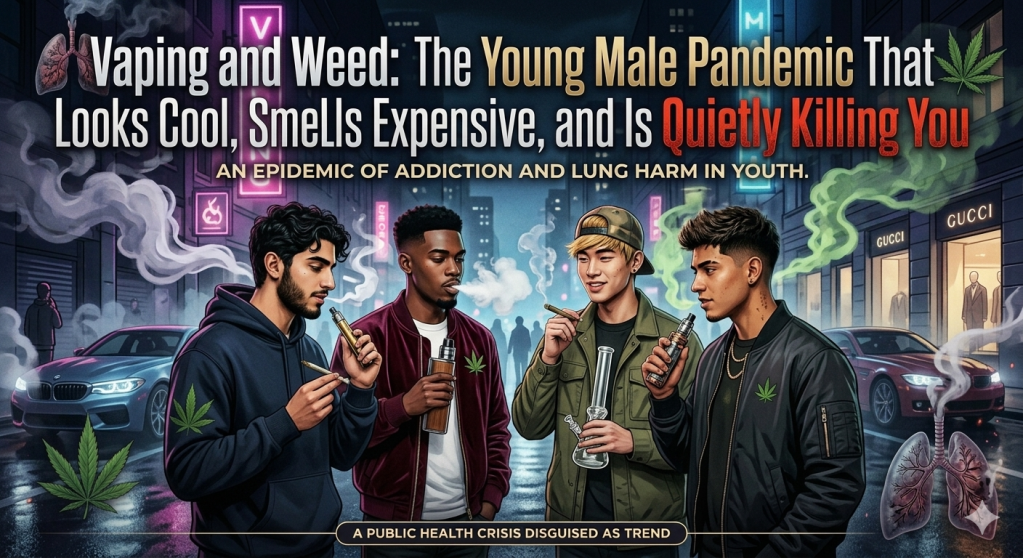
Every hour, on the hour — like a liturgical ritual — the boys congregated outside. Vapes in hand. The smell of weed following them like a second shadow. Clouds of what they would assure you is just water vapour, hanging in the air like a collective delusion. And in between the *yanos* and the *tlof-tlof* references and the Amapiano references and the SASSA jokes, one young man — proud, chest forward, performing for his audience — told the group about his recent flight to London.
He had vaped on the plane. Smuggled weed on board in a *bankie.* Took a pull at altitude. Nothing happened. The smoke detectors didn’t trigger. And the group — his peers, his mirrors, his jury — erupted in applause.
*Sheep,* I thought. *Expensive, well-spoken, well-travelled sheep.* when its cool to be a sheep.
Because here is what that young man did not know. Here is what none of them — mouths full of Gen Z, Ama2k vocabulary, pockets full of disposable vapes — could have told you in the forms they completed in messaging shorthand as though English had never been taught at their high fee-paying institutions.
What They Don’t Know Is Killing Them
I stopped the session. I had to. I asked, plainly:
Do you know what this is doing to your body and brain?
The response was a masterclass in the confidence of ignorance. Dismissals. Shrugs. “It’s temporary.” “I’ll stop.” “My father and uncle smokes, vapes , weed nerds and they are fine.”
The last refuge of every young person in denial — the anecdotal uncle and father or big brother.
So I told them. And I will tell you now.
The male brain does not finish developing until approximately age 25. This is not metaphorical. This is neuroscience. The prefrontal cortex — the part responsible for decision-making, impulse control, risk assessment, long-term planning — is still under active construction throughout the entire age range of every young man in that room. What you put into a brain that is still being built does not just pass through. It renovates. Sometimes it demolishes.
Nicotine — the active ingredient in those sleek, expensive, fruit-flavoured vapes that look like a USB drive and cost as much as a decent meal, SASSA monthly grant — disrupts the formation of brain circuits responsible for attention, learning, and impulse control. It literally rewires how synapses communicate. Not temporarily. Structurally. The brain these young men are building today is the brain they will think with for the rest of their lives.
THC — the psychoactive compound in the zol, the bud, the green, the bankie — hijacks the endocannabinoid system, the body’s own internal regulatory network for memory, alertness, and emotional balance. In a developing brain, this is not a recreational detour. It is an architectural intervention. Studies have consistently linked chronic adolescent THC use to measurable reductions in grey matter and disrupted connectivity in learning-associated brain regions.
And then there is the IQ question. Research published in the – Proceedings of the National Academy of Sciences – tracked adolescent cannabis users over decades and found measurable, persistent IQ loss — an average of eight points — in those who began using regularly before adulthood. Eight points that did not return when they stopped as adults. Eight points that no private school, no model-C education, no twangy accent can give back.
The mouths in that room began to open.
The Mental Health Emergency Nobody Is Talking About Loudly Enough
Here is the part that should terrify every parent who pays school fees, attends parents’ evenings, and believes their child is fine because they have therapy-speak in their vocabulary.
Frequent use of high-potency THC — the kind now commercially available in concentrations far higher than anything previous generations encountered — is strongly and repeatedly linked to psychosis and schizophrenia, particularly in young males aged 16 to 25. This is not correlation dressed up as causation. A landmark study published in *The Lancet Psychiatry* found that daily use of high-potency cannabis was associated with a fivefold increase in the risk of psychosis compared to non-users.
Young males — already the demographic most likely to have undiagnosed mental health conditions, least likely to seek help, most likely to self-medicate — are walking directly into this risk with a vape in one hand and a bankie in the other, calling it *a vibe.*
And the vocabulary gives it all away. *Menty B.* Mental breakdown. Said with a laugh. Worn like a badge. Normalized into slang. This generation has the language of mental health awareness and simultaneously the highest rates of mental health deterioration. They know what a trauma response is. They can identify emotional dysregulation. They just cannot connect it to what they are inhaling every hour, on the hour, in the courtyard.
This is what psychologists call “insight without integration.” You know the words. You have not felt the meaning.
The Young Male’s Body Keeps the Score — And the Score Is Not Good
Beyond the brain, the body is absorbing a slow, accumulating assault that the Instagram aesthetic of vaping has been extraordinarily successful at concealing.
EVALI — E-cigarette or Vaping-Associated Lung Injury — is a clinical reality, not a scare tactic. Vaping THC products, particularly those sourced informally, have hospitalized and killed young people. The symptoms — severe shortness of breath, chest pain, respiratory failure — do not look like the cool exhale of a fruit-flavoured cloud. They look like an intensive care unit.
Cardiovascular strain is real and measurable. THC alone can spike a resting heart rate from a healthy 70 beats per minute to over 120 beats for up to three hours after use. Add nicotine — which simultaneously raises blood pressure and floods the system with adrenaline — and you have a cardiovascular cocktail that the 22-year-old body absorbs without complaint, right up until it doesn’t.
And then there is the reproductive health data that I suspect would land harder with young men than almost anything else: heavy marijuana use is clinically linked to impaired sperm development and a specific, aggressive form of testicular cancer. “The plant that makes you feel invincible is quietly negotiating with your future.”
The ancestors — the Underground Gang, as these young men so creatively call them — did not survive what they survived so that their grandsons could slowly dismantle themselves in flavours of mango and watermelon.
The Plane Story
Let me return to the young man on the London flight.
He was proud. His peers celebrated him. In the logic of the group, he had demonstrated courage, cleverness, rule-breaking sophistication. He had *aura points.* He was not *chopped.* He had *drip.*
But here is what he had actually demonstrated: the complete capture of his risk-assessment system by social performance. His prefrontal cortex — still under construction, remember — had weighed *peer applause* against federal aviation law, public safety, potential criminal charges in a foreign jurisdiction, and long-term health consequences and had chosen applause. Not because he is stupid. Because the brain at 22, flooded with nicotine and THC and the dopamine of social validation, is not running its best software.
This is not a character indictment. It is a neuroscience description. And it is precisely why the adults in the room — the parents, the educators, the facilitators, the people who are not currently accumulating aura points — have to say what needs to be said clearly and without flinching.
Now You Know
Halfway through the session I stopped performing facilitator neutrality. I laid it out. The brain development. The IQ studies. The psychosis risk. The lung injuries. The testicular cancer data. The cardiovascular strain. The addiction pathways.
The room went quiet in a way it had not been quiet all day.
Not the quiet of boredom. The quiet of young men absorbing something they had not been told before — or had been told in ways so hedged, so careful, so worried about being *uncool* that the message never landed.
I quoted Maya Angelou — because *Saint Maya*, as I think of her, said it with the elegant simplicity that no academic paper has ever matched:
“When you know better, you do better.”
Now you know.
So do better.
Not because vaping is uncool. Not because weed makes you chopped. Not because the rules say so. But because the brain you are building right now — the one still under active construction, the one that will carry every thought you think, every decision you make, every relationship you navigate for the next sixty years — deserves better architects than nicotine and THC.
Your future self is standing somewhere in the distance, watching you make these choices. He cannot send you a message. He has no aura points to offer. He has only the consequences of what you are doing right now, compounding quietly, the way all important things do.
ISTG — that future self deserves better.
No cap.
—
Between Thoughts — Intellectual Musings | Dr. Mzamo Masito
Where the uncomfortable questions get a seat at the table.
 Between Thoughts -Intellectual Musings
Leave a comment