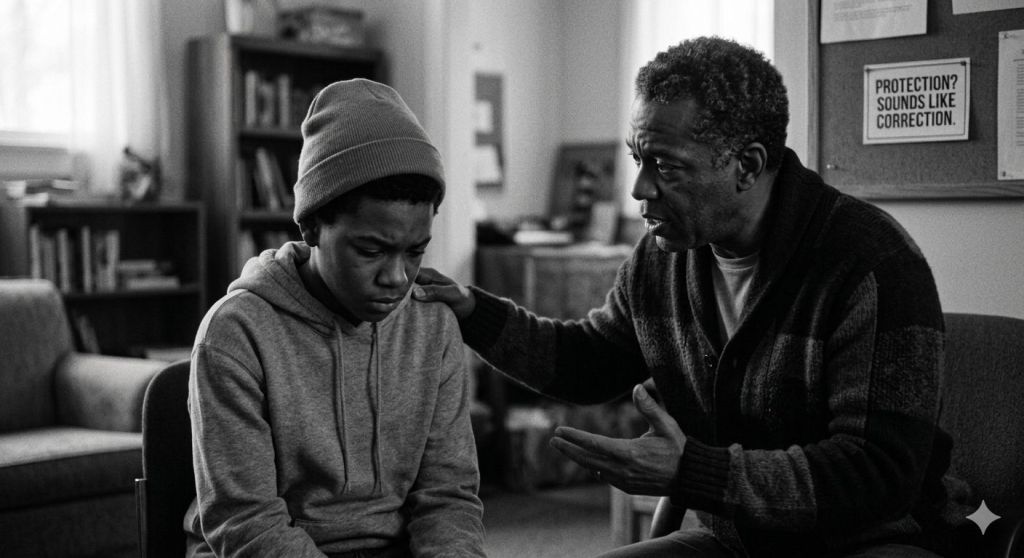
“I hope my son is not soft.”
“At least my boy is not like that.”
“I’m scared… what if I love him so much and he turns gay?”
I’ve heard versions of these lines more times than I can count — across panels, book talks, and polite post-event whispers after conversations about – This Country Hates Our Men (Boys).
They don’t come from monsters.
They come from loving parents.
Which is exactly what makes them unsettling.
— ✦ —
What Are Parents Really Afraid Of?
Let’s be precise.
Many Parents are not sitting at home plotting against their sons. They are not waking up with ideological manifestos about masculinity.
They are afraid.
Not of homosexuality itself — but of what the world does to those who fall outside its narrow definition of ‘normal.’
Because deep down, they know. They know society is not kind to difference.
Many Parents don’t fear who their sons are.
They fear what the world will do to them.
They’ve Seen This Before
There’s an old social experiment in the United States: a room full of white participants is asked — ‘Who here would like to be Black?’
No one stands.
Not because Blackness is inherently undesirable. But because the cost of being Black in that society is understood — viscerally.
Comedian Chris Rock once observed that even a poor white man wouldn’t trade places with him despite his wealth. Kanye West put it more bluntly: success doesn’t erase racism “even in a Benz – you still a nigga”. Different context. Same structure.
THE PATTERN
People don’t just fear identity. They fear the penalties attached to identity.
So when a parent worries about a ‘soft’ (effeminate) or/and ‘gay’ son, what they’re often saying is: “I know how the world treats people like that.”
Masculinity Is Not Identity. It’s Insurance.
Sociologist R.W. Connell called it hegemonic masculinity — the dominant script of what a ‘real man’ should be: tough, heterosexual, emotionally contained, unshakeable.
Deviate from this, and the penalties come early: bullying, social exclusion, violence, status loss.
Parents understand this intuitively.
Masculinity, for many boys, is not self-expression. It’s protection.
When a father says, ‘Don’t be soft,’ he may actually mean:
‘I don’t know how to keep you safe if you are.’
The Tragic Paradox
Here’s where it gets uncomfortable.
RESEARCH FINDING — FAMILY ACCEPTANCE PROJECT
Rejection from parents dramatically increases a young person’s risk of depression, substance abuse, and suicide.
Acceptance — even imperfect acceptance — reduces those risks significantly.
So the very instinct meant to protect the child often becomes the thing that harms them most.
Parents fear the world breaking their sons.
Then, unintentionally, they rehearse that breaking at home.
RELIGION: Faith or Fear Economy?
For some, the fear is spiritual. No — let me be more precise. It’s religious.
“What if my son goes to hell?”
Across Christianity, Islam, and Judaism, traditional interpretations have long framed same-sex relationships as sinful. But here’s the tension: interpretations evolve. Institutions don’t always.
And in that gap, something troubling can emerge — an economy of fear.
EMPIRICAL CONSENSUS
Psychological and sociological research is unequivocal: attempts to change sexual orientation are both ineffective and harmful.
Yet the promise persists. Because fear is profitable. And certainty sells.
“Soft” Is Not a Personality Trait. It’s a Warning Label.
The word ‘soft’ sounds harmless. It isn’t.
It carries a whole worldview: emotional expression equals weakness, gentleness equals vulnerability, difference equals danger.
This is how boys are trained early — not just by parents, but by peers, schools, media, culture.
I remember growing up: at a young age we were taught not to touch a girl’s underwear, for you would surely turn ‘soft.’ Worse if you hand-washed one. Those days it was called a blumass, a gxwamsi. A garment. A portent.
PSYCHOLOGY — GENDER ROLE STRAIN
When boys are forced into narrow definitions of masculinity, the outcomes are predictable:
Emotional suppression. Increased aggression. Fragile self-worth. Poor relational capacity.
In trying to avoid raising ‘soft’ boys, we often end up raising damaged men.
So Is It Homophobia?
Partly. But that’s too simple — and too convenient. Same vibes as “ it’s Patriarchy!”.
So say – the cisgender self elected speaker of the LGBTQAI+ parliament and President of the Patriarchy Association.
What we’re really looking at is a layered system:
A LAYERED SYSTEM
Fear of social punishment. Awareness of inequality. Desire to protect. Religious conditioning. Status anxiety. Cultural inheritance.
Parents are not just reacting to their child. They are reacting to the world their child must survive.
— ✦ —
The Hard Truth
Parents face an impossible tension:
Love your child unconditionally
— or prepare them for a conditional world.
THE FALSE CHOICE AT THE HEART OF PARENTING FEAR
Too often, they try to resolve this by reshaping the child instead of challenging the conditions.
A Different Question
Maybe the question isn’t: What if my son turns out soft?
Maybe it’s:
“Why does the world punish softness in the first place?”
Because softness — empathy, openness, emotional depth — is not the absence of strength.
It’s a different kind of strength.
— ✦ —
Many Parents don’t fear gay sons.
They fear a hostile world.
But instead of confronting that world, we’ve learned to bring its hostility into our homes — disguised as love, discipline, and concern.
And in doing so, we don’t just protect our boys from the world.
We prepare them for it by becoming it.
==============
Between Thoughts – Intellectual Musings · Dr. Mzamo Masito
Where the uncomfortable questions get a seat at the table.
 Between Thoughts -Intellectual Musings
Leave a comment