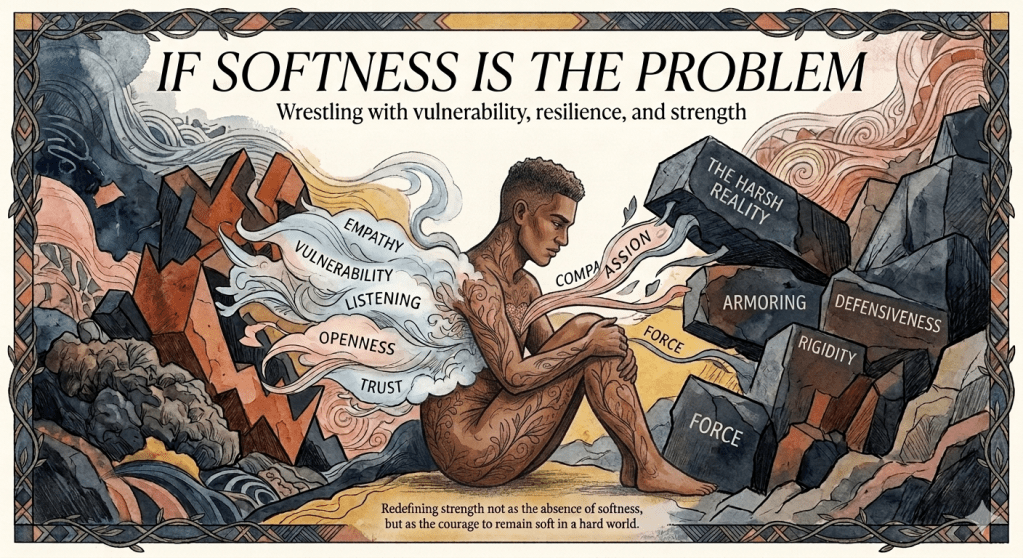
If softness is the problem, why does the world feel so short on softness?
We reward hardness, decisiveness, dominance, emotional control, yet wonder why connection is thinning out.
In psychology, cognitive and affective empathy isn’t a luxury trait; it’s foundational to healthy relationships, leadership, and social cohesion.
When boys are trained early to mute feeling, we don’t eliminate emotion, we displace it. What cannot be expressed cleanly often leaks out sideways: anger instead of sadness, silence instead of vulnerability.
If hardness is the answer, why are so many men quietly breaking?
Look at the data we prefer not to sit with. Across countries, men die by suicide at significantly higher rates than women. Global estimates from the World Health Organization show a consistent pattern: men are less likely to seek help and more likely to use lethal means. Researchers like James Mahalik have linked strict adherence to traditional masculine norm: self-reliance, emotional restriction, to poorer mental health outcomes.
The message “be strong” too often translates into “be alone.”
Maybe the issue was never softness.
Maybe it’s what we’ve been taught softness means.
We’ve coded gentleness as weakness, tenderness as risk, openness as exposure. Yet the very capacities we dismiss empathy, attunement, emotional literacy, are the same ones that predict healthier partnerships, better parenting, and more effective leadership. In other words, the traits we discourage in boys are the ones we later demand from men.
And when those capacities are underdeveloped, the consequences are not abstract. They show up in relationships that can’t hold conflict, in fathers who struggle to say “I love you,” in leaders who confuse authority with control.
Even small acts of parental rejection are associated with significantly higher risks of depression and self-harm among youth, while small acts of acceptance are powerfully protective. The difference between “softness discouraged” and “softness held” is not trivial — it’s measurable.
So we harden boys to protect them,
and then ask men to be emotionally available.
We tell them to suppress,
and later punish them for what suppression produces.
This is the contradiction.
THE REAL PROBLEM
Maybe the problem isn’t softness.
Maybe it’s a culture that mistakes numbness for strength.
Sociologist R.W. Connell described a dominant script of manhood: tough, controlled, invulnerable that sets the standard and punishes deviation. That script doesn’t just marginalise those who don’t fit it; it constrains those who do. Because maintaining hardness is labour. It requires constant performance, constant vigilance, constant editing of the self.
And performance, over time, becomes distance
from others, and from oneself.
If softness is the problem, why does every healing framework, therapy, restorative justice, even good leadership begin by reintroducing it?
Not softness as passivity.
Softness as capacity:
— The capacity to feel without collapsing
— The capacity to listen without defending
— The capacity to be open without disappearing
A DISTINCTION WORTH MAKING
That is not fragility.
That is regulated strength.
That is vulnerability with boundaries.
So perhaps we’ve been asking the wrong question.
Not: How do we make boys harder?
But: How do we make the world less hostile to what is human in them?
Because a world that punishes gentleness
will always manufacture hardness and then be shocked by its consequences.
And a boy taught to abandon parts of himself
doesn’t become stronger.
He becomes divided.
Maybe the issue was never softness.
Maybe it’s the kind of world
that teaches boys to amputate their tenderness —
and then wonders why so many men grow up
feeling like something essential is missing.
===============
Between Thoughts – Intellectual Musings| Dr. Mzamo Masito
Where the uncomfortable questions get a seat at the table.
 Between Thoughts -Intellectual Musings
Leave a comment