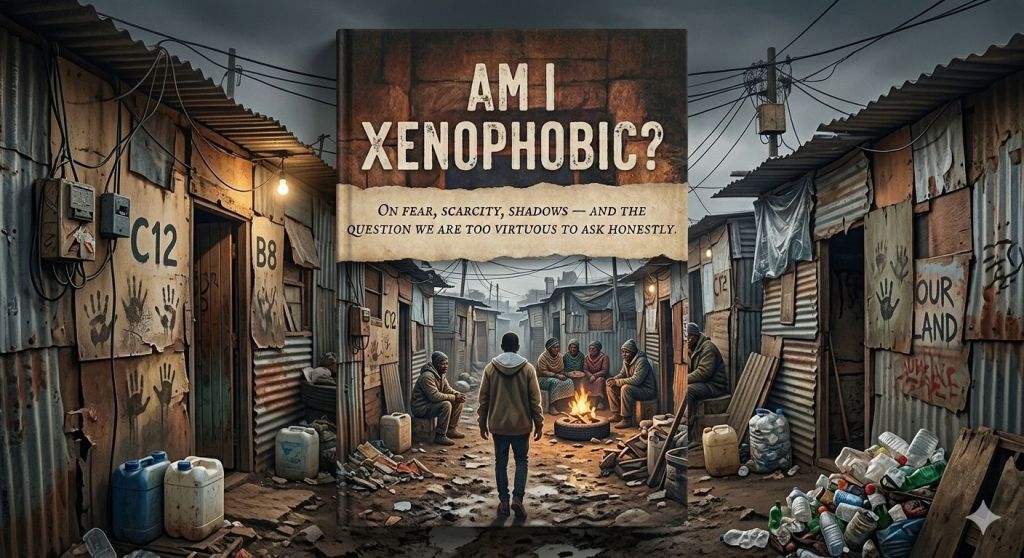
In late April and early May 2026, vigilante groups in South Africa filmed themselves stopping schoolchildren and parents in the street, demanding proof of legal status, telling them to “fix their own countries.”
The footage circulated. Outrage circulated faster. And then, as is our custom, a thousand think-pieces circulated fastest of all, each author more appalled than the last. Each author, also, quietly certain of their own innocence.
This is one of those think-pieces. But I want to try something different. I want to ask the question honestly, not perform the answer.
The easiest thing in the world is to condemn xenophobia from a Johannesburg suburb where your neighbours are Zimbabwean, Congolese, Nigerian and the biggest threat is load-shedding and property crimes.
What We’re Actually Talking About
Xenophobia. From the Greek: xenos – stranger, guest, and phobos- fear. An intense fear, hatred, or dislike of people perceived as outsiders. The word carries a clinical suffix, phobia, but carries none of the clinical innocence. It is not in the DSM-5. It is not a medical condition you are born with and cannot help. It is a learned ideology. And that matters enormously.
As a behavioural and social scientist, that distinction is the first thing I reach for. Because what can be learned can, in principle, be unlearned. What is ideology can be interrogated. What is fear can be mapped back to its source.
But first, the question I find most people are reluctant to actually sit with.
Am I Xenophobic?
My instinctive answer is NO. And I want to examine that instinct with some honesty.
Some of my real friends are Nigerian, Ghanian, Congolese, Kenyan, Ethiopian, Zimbabwean, Cape Verdean. I have visited over forty five African countries. I have been to Senegal and come back a different man. I have sat in Ethiopian jazz bars at midnight and understood, viscerally, that this continent is one living thing. No, I am not xenophobic.
You hear it now, don’t you?
The rhythm?
Some of my best friends are….
It is the exact cadence that white South Africans used and still use, to explain why they cannot possibly be racist. They name their Black colleagues. They bring them along as social credentials. As Sarah Baartman was brought to Europe, exhibited, vouched for, displayed. Proof of liberal tolerance. Decorative proximity as moral alibi.
I raise this not to indict myself, but to notice the reflex. The reflex of reaching for distance from the charge before we have actually examined it.
We are all faithful, with zero infidelity, as per our opportunities. Virtue is partly a function of what we have been given the chance to betray.
Here is what I think is actually true: I am not xenophobic partly because I have not been placed in circumstances where my xenophobic shadows would have a stage to perform on. And partly because, innately, I am not.
I grew up in Gugulethu, Valhalla Park, Khayelitsha. I know scarcity. I know what it means to compete for nothing. But God, or luck, or the accumulated graft of people who loved me, gave me a ticket out. Out of the township. Out of relative deprivation. Out of the zero-sum calculus of poverty.
My neighbours in the leafy northern suburbs of Johannesburg are Zimbabwean, Malawian, Congolese. We are in the same neighbourhood watch group. We are vigilant together against intruders, against “others” , irrespective of nationality. We have assets to protect. We are not in competition. We are in communion.
It is very easy to intellectualise pan-Africanism and African unity, when your economic freedom is not threatened by anyone. It costs me nothing to be cosmopolitan. The question I have to ask myself, that any person of privilege has to ask, is: what would I be if the conditions were different?
THE HONEST CAVEAT
I do not know what I would be if I were still in Khayelitsha, watching a foreign national earn SASSA grants, occupy hospital bed space and I am chased away for clinic is full, take the job I needed, in a country that had already failed me comprehensively. I am not certain I would be as noble. Neither are you. And anyone who is certain, about themselves, in those conditions, has not thought hard enough.
You do not know yourself!. The capacity for extreme evil isn’t unique to “monsters,” but is a dormant part of the human condition that can be activated by ideology, survival, social pressure, or desperation. You are only a saint as per your opportunities.
Are All South Africans Xenophobic?
No. And saying so commits its own form of the sin.
When you paint all South Africans with one brush, when you make sweeping claims about an entire group of people, you are engaging in exactly what you claim to be condemning. Hasty generalisation. Stereotyping. Essentialism. Reductionism. “All South Africans are xenophobic” is itself a form of prejudice dressed up as progressive outrage.
What the data shows and what honest observers have consistently noted, is more granular and more disturbing in some ways. The hostility is not directed uniformly at all foreigners. It targets Black African migrants specifically. Not the British expat in Sandton. Not even the the African American digital nomad in Cape Town and Melrose Arch. Black Africans. This is not xenophobia in its general form. It is Afrophobia and it implicates anti-Blackness, class anxiety, and the colonial sorting of human worth in ways that generic “xenophobia” does not capture.
The unemployment rate sits above thirty percent. Youth unemployment above sixty. The ANC government and government of national unity (GNU) has failed, spectacularly and repeatedly, to provide services, security, economic hope or reduce 0.63 Gini Coeffecient to between 0.25 and 0.35. In that environment, the closest visible “other” becomes the scapegoat for structural failure. This is not unique to South Africa. It is the oldest political manoeuvre in the world. Blame the stranger. Distract from the architect.
“Umntu ngumntu ngabantu.”
Nguni and Bantu Proverb: A person is a person through other people
And yet, across the same country, thousands march against the violence. NGOs like the Scalabrini Centre and Lawyers for Human Rights fight daily for migrant rights. Julius Malema, whatever you think of his politics, has stood in front of crowds and said: we are all Africans. South Africa contains multitudes. To see only the footage of the vigilantes is to flatten a complex nation into its worst moments.
Is This Uniquely South African?
It is not. And the habit of treating it as uniquely South African is its own kind of dishonesty, one that allows the rest of the continent, and the world, to point fingers while their own histories remain conveniently off the table.
In 1983, Nigeria expelled over two million undocumented migrants, primarily Ghanaians, in what became bitterly known as “Ghana Must Go.” Uganda, under Idi Amin in 1972, expelled sixty thousand Asians in ninety days. Ghana passed its own Aliens Compliance Order in 1969, forcing out hundreds of thousands. Gabon expelled nine thousand Beninese in 1978.
More recently: in Tunisia in 2024, political rhetoric about demographic change triggered mob attacks on Black African migrants. In Libya, migrants face systematic abuse and arbitrary detention — with barely a fraction of the global coverage that South Africa receives.
And then there is the West. The United States, with ICE conducting mass deportations, including of people who have lived there for decades, whose children were born there. Britain, with its Rwanda policy. France, with its annual spectacle of expelling Roma communities. The difference is not the xenophobia. The difference is the camera angle.
South Africa does not have a monopoly on the fear of strangers. It has a monopoly on global attention when Africans do it to other Africans.
The Antidote. If There Is One
There is no single chemical cure. But the research and Ubuntu philosophy, point in consistent directions.
Intergroup Contact Theory, developed by Gordon Allport, is among the most robust findings in social psychology: direct, sustained, equal-status contact with people from other groups reduces prejudice. Not exposure but contact. Not proximity but relationship. The difference matters. A person who works beside a Congolese colleague, solves problems together, shares a meal, is categorically different from a person who merely sees migrants from across a street.
Ubuntu, the philosophy that a person is a person through other people, is not simply a slogan for conference keynotes. It is a structural claim about the nature of the self. If I am constituted through my relationships with others, then the diminishment of any human being diminishes me. That is not sentiment. That is ontology. And it is the most powerful philosophical resource we have against the “us vs. them” architecture of xenophobia.
Education matters. But education in the narrow sense of curricula and classrooms is insufficient. Media literacy, the capacity to resist scapegoating narratives, to ask who benefits from the fear being stoked, is arguably more urgent in 2026 than any formal classroom intervention.
And then there is the structural. Ultimately, the antidote to the symptom requires treating the disease. Where governments provide jobs, housing, functioning healthcare, and dignity, the pressure to find a scapegoat reduces. Not disappears. Reduces. Xenophobia is not caused only by poverty, but it is powerfully accelerated by it.
ON CBT AND TRAVEL
Research cites Cognitive Behavioural Therapy for individuals with deep-seated fears, and travel as a means of broadening perspective. Both are real. Both are also profoundly class-based interventions. The person most likely to be violent against migrants cannot afford therapy and has never left their province. The antidote, to be meaningful, must be scalable.
The Honest Conclusion
I am not xenophobic, neither the majority of South Africans, probably. But I live in conditions that do not test that claim very hard. The people burning down the shops are not monsters from another species. They are people in conditions that, in different circumstances, any of us might have been shaped by.
That is not an excuse. Violence against migrants is indefensible. Stopping schoolchildren in the street to demand papers is indefensible. But understanding what produces a behaviour is not the same as excusing it and without understanding, we will keep performing outrage while doing nothing that actually changes the underlying architecture.
The question “Am I xenophobic?” is only useful if you ask it without pre-loading the answer. If you ask it with genuine curiosity about your own shadows, the fears that live in you, unexamined, waiting for the right conditions to surface.
We are all, to some degree, waiting to find out who we would be in worse conditions. The work of building a more just and humane society is partly the work of ensuring those conditions never arrive, so we never have to know.
“Motho ke motho ka batho babang.”
— Sotho Proverb — A person depends on other people to be a person
================================
Between Thoughts — Intellectual Musings | Dr. Mzamo Masito
Where the uncomfortable questions get a seat at the table.
 Between Thoughts -Intellectual Musings
Leave a comment