I left Cape Town at 21. Running.
Not only from danger, from the gaze.
The Cape Town white gaze.
It is a different species from the Gauteng white gaze. That distinction alone would take five more pages. Those who know, know.
I was what Helen Zille, then Premier of the Western Cape, called an education refugee. Her words, not mine. I stayed in Cape Town far longer than she would have wanted a “refugee” to linger. My permit, by her logic, had long expired.
But I stayed. And when you stay longer than you should in a place not designed for you, you start to notice things.
So I put pen to paper.
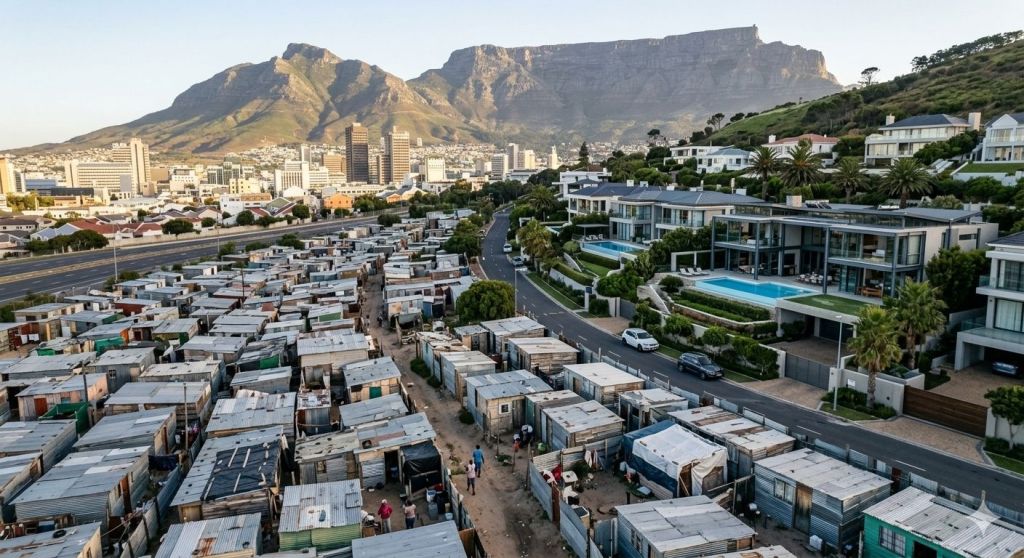
I grew up watching Table Mountain from Gugulethu, Valhalla Park, and Khayelitsha.
Not the postcard version. Not the version that greets international flights and fills the Instagram grids of tourists sipping Sauvignon Blanc in Camps Bay. I mean the mountain as I knew it, seen from Site B, through the lens of a township morning, above the corrugated iron and the smoke of coal stoves, framed by a sky that was always blue and a reality that was never simple.
Table Mountain has been there for 600 million years. It watched the Khoikhoi (Khoekhoe). It watched the Dutch arrive. It watched the British. It watched apartheid planners draw their lines – Group Areas Act lines, railway lines, highway lines – lines designed to keep Black people at a geographic and economic distance from the city’s beauty, its opportunity, its warmth. And it watches now as those lines, officially erased in 1994, remain stubbornly, defiantly, materially present.
This is not a nostalgia piece. This is a reckoning.
The Country Within the Country
Cape Town is not quite South Africa. It is South Africa’s most instructive contradiction, a city of such breathtaking beauty and such grinding inequality that to live in it is to live inside a moral argument that never resolves.
It is governed by a political party whose name contains the word Democratic and whose record on racial and spatial redress invites scrutiny that its supporters resist. The Democratic Alliance, which has run the City of Cape Town and the Western Cape province since 2006, presents itself as the competent alternative to ANC dysfunction. And on certain metrics, lower unemployment than the national average, better managed infrastructure, no potholes, no loadshedding or little of it to talk about, a functioning system, the province does outperform. The Western Cape’s unemployment rate sits at 19.6%, well below the national figure of 31.9%. Its GDP per capita exceeds the national average.
But numbers, as any behavioural scientist will tell you, are not reality. They are summaries of reality, and what they summarise depends entirely on which questions you ask and whose lives you count.
Ask who is generating the Western Cape’s economic output, and who is living at the margins of it. Ask who owns the wine farms in the Winelands. Ask who is building the hotels in Camps Bay and who is sleeping in Khayelitsha. Ask who is cycling on the cycle paths the Premier cycles on, and who is standing at taxi ranks before dawn. The numbers look different when you ask these questions.
And then there was the statement, the one that still hangs in the air of this province’s racial politics like smoke that refuses to clear: the characterisation of Black Africans migrating to the Western Cape as refugees within their own country. Not visitors. Not new residents seeking opportunity in South Africa’s most functional province. Refugees. The word, deployed in a political context, carries a specific valence. It marks people as outsiders. As problems to be managed rather than citizens to be served. As bodies that do not belong.
In the Republic of South Africa. In 2024.
The mountain watched that too.
The Number That Damns Us All: 0.63
Cape Town’s Gini coefficient is 0.59 to 0.63, depending on whose counting. South Africa 0.63 to 0.67. The Gini coefficient measures income inequality on a scale from zero to one. Zero is perfect equality, every person earns the same. One is absolute inequality, one person holds everything. The United Nations flags any score above 0.4 as a serious concern. South Africa as a whole registers 0.63 to 0.67, making it the most unequal country on earth by this measure. Cape Town matches that national score almost exactly.
Sit with that for a moment. In a country already renowned globally, structurally, academically, as the world’s most unequal, Cape Town is keeping pace.
What does 0.63 look like on the ground?
It looks like a forty to fifty minutes (offpeak) and one hour plus (peak traffic) drive separating Camps Bay from Khayelitsha excluding “amaphela” or taxi – Schumacher drivers. It looks like homes in Clifton selling for R80 million while families in Delft live in RDP houses built for two, inhabited by ten. It looks like private security armed response arriving within three minutes in Constantia, and police response times in Nyanga, Khayelitsha measured in hours, if they come at all. It looks like the same ocean, the same mountain, the same sky and entirely different life expectancies, school outcomes, health prospects, and futures.
The spatial geography of Cape Town is apartheid’s most durable legacy. The townships Khayelitsha, Gugulethu, Langa, Nyanga, Philippi, Mitchell’s Plain, were not designed for human flourishing. They were designed for labour extraction and social control. They were placed at the furthest edges of the city, far from economic opportunity, far from the sea, far from the mountain, close to nothing except each other. Thirty years of democracy have not undone this geography. The roads are there. The railway line is broken. The taxis run. The distance remains.
This is not poverty as an accident. This is poverty as architecture.
The Blood in the Streets
Cape Town is one of the world’s most violent cities. This is not hyperbole. It is data.
In 2024, Cape Town recorded a murder rate of 70.2 per 100,000 people, a figure that places it among the most dangerous cities on the planet. The 2024/25 ranking of the world’s fifty most violent cities, compiled by the Mexican Council for Public Security and Criminal Justice, included Cape Town alongside Gqeberha and Durban (PMB). South Africa as a whole recorded 26,232 murders in 2024 , averaging 72 murders every single day.
And the geography of the killing is not random. It is precise.
Delft. Mfuleni. Nyanga. Gugulethu. Khayelitsha. Philippi East. These are the precincts that anchor the murder statistics, quarter after quarter, year after year. In early 2025, Delft recorded 66 murders in a single quarter. Philippi East saw a 63.9% spike — from 36 to 59 murders — in just one year. Nyanga, long known as the murder capital of South Africa, recorded 63 murders in a single quarter, even after a slight reduction.
These are not abstract numbers.
These are fathers. Sons. Young men who grew up watching Table Mountain the way I did. Young men for whom the city promised something and delivered nothing. Young men who were recruited by gangs not out of moral failure but out of rational choice in an environment where gang membership offers the only available version of belonging, income, and protection.
The Provincial Police Commissioner has cited the causes with bureaucratic honesty: densely populated informal settlements, high unemployment, limited youth diversion programmes, illegal firearms, gang violence, taxi violence. What he describes is a system, a coherent, self-reinforcing system of abandonment that produces violence as reliably as a factory produces goods.
Eight of the nine Western Cape police stations on the national Top 30 list for contact crimes are in the City of Cape Town. Thirteen stations on the Top 30 list for murder are in the City of Cape Town. These are not outliers. They are the fingerprints of systemic neglect.
The city deploys its Law Enforcement Advancement Plan. Officers arrive. Statistics shift slightly. But Philippi East’s murder rate went up 63.9% with officers present. Because you cannot police your way out of poverty. You cannot deploy your way out of hopelessness. You cannot put enough boots on the ground to substitute for the absence of opportunity, the presence of guns, and the logic of streets that have been abandoned by every institution except the gang.
The Wound That Cannot Speak Its Name: Black and Coloured
There is a conversation that Cape Town needs to have with itself that it keeps refusing to have.
It is the conversation about Black and Coloured disunity, about the fracture within the broader non-white community that apartheid engineered and that democracy has failed to heal.
Under apartheid, the Cape was designated a Coloured Labour Preference Area. This was a deliberate policy: it excluded Black Africans from formal employment in the Western Cape, privileged Coloured workers above them in the labour hierarchy, and thus built structural resentment and competition into the relationship between two communities who shared oppression but were assigned different positions within it. It was a masterwork of divide-and-conquer. The architects of apartheid understood, with cold clarity, that solidarity among the oppressed was their greatest threat. So they manufactured hierarchy. They gave Coloured communities just enough relative privilege, above Black Africans, below whites, to create investment in the system’s distinctions.
That engineering has outlasted apartheid by thirty years.
Today, the Coloured vote in the Western Cape is predominantly a DA vote. This is not an accident of preference or alignment of values. It is, in significant part, the harvest of that historical seed of a community that experienced affirmative action as a threat rather than a correction, that perceived Black African migration into the Western Cape as competition for already-scarce housing, jobs, and services. The 2004 South African Reconciliation Barometer found that 66% of Cape Town’s Coloured community believed the government did not care about them, a figure that peaked at 86% among the lowest income groups.
That alienation is real. It is not manufactured. The ANC’s failure to speak to Coloured communities, to acknowledge their specific historical experience, their distinct cultural identity, their legitimate economic anxieties, is one of the great political failures of the post-apartheid era.
But here is the thing that must be said, gently and firmly: the fracture serves no one in either community. It serves the political formations that benefit from non-white disunity. It serves the economic structures that rely on poor people fighting each other for the crumbs rather than organising collectively for the table. The communities of Langa and Bontheuwel, Gugulethu and Manengberg, Khayelitsha and Mitchell’s Plain are separated by history and political identity, but they are united by Gini coefficients, by murder rates, by the same inadequate schools, the same broken railway, the same mountain viewed from the same distance.
Ubuntu, at its root, is the understanding that my humanity is bound up in yours.
Umntu ngumntu ngabantu. That principle does not stop at racial sub-categories bequeathed by an apartheid census. The poor of the Cape Flats and the poor of Khayelitsha are not each other’s competition. They are each other’s only real coalition.
What Cape Town Teaches
Cape Town is South Africa’s most instructive city precisely because it contains every contradiction of the post-apartheid project in its most concentrated, most visible, most undeniable form.
It teaches us that beauty and injustice coexist with remarkable ease. That a mountain can be world heritage and a community at its foot can be world poor. That political competence, as measured by service delivery metrics, is not the same as political justice, as measured by who benefits from the services delivered. That racial geography, once written into the land, does not erase itself simply because the laws that created it are repealed.
It teaches us that inequality is not just economic. It is spatial. It is psychological. It is the daily experience of knowing that the city you live in was not designed for you, that you are, in the precise sense, peripheral. That the mountain you have watched all your life belongs, in every meaningful sense, to someone else’s postcard.
It teaches us about the violence that is the natural offspring of abandonment. That when a society creates a generation of young men with no stake in its future, those men will create their own economies, underground, violent, governed by rules the formal world refuses to acknowledge but also refuses to replace.
And it teaches us, this is the hardest lesson, that the oppressed, divided against themselves, will remain oppressed. That racial sub-categories are not identity. They are instruments. And the question of who benefits from your identification with a sub-category rather than with a class, with a geography, with a shared condition of exclusion, that question is worth asking, loudly, in every community centre, every church hall, every taxi, every school governing body from Khayelitsha to Mitchell’s Plain.
A Personal Word
I grew up watching Table Mountain from Khayelitsha. The mountain did not care about my township address. It did not condescend. It did not pity. It simply stood there, magnificent, indifferent, ancient, a reminder that the beauty of this place predates every human category imposed upon it.
The Scouts taught me to leave a place better than I found it. That principle has followed me from Khayelitsha to every boardroom, every lecture hall, every stage I have stood on.
Cape Town will not be left better by pretending that its fractures are healed. It will not be left better by the comfortable narrative that good governance is sufficient for justice. It will not be left better by the Gini coefficient inching slowly downward while the spatial geography of apartheid remains intact, while 70 per 100,000 people are murdered in townships whose names the rest of the city barely registers.
Cape Town will be left better when the conversation becomes honest. About who the city is for. About what democracy actually requires of us — not just in the voting booth, but in the budget, in the spatial plan, in the school, in the street, in the fractures between communities who share far more than the category-makers want them to know.
I still see Table Mountain. Every time I return to Cape Town, every time the plane banks over the Atlantic and the mountain appears, flat-topped, enormous, unhurried, I see it with the eyes of the boy in Khayelitsha who knew, without fully knowing, that the distance between him and that mountain was not natural.
It was made.
And what is made can be unmade.
========================
Between Thoughts – Intellectual Musings| Dr. Mzamo Masito
Where the uncomfortable questions get a seat at the table.
 Between Thoughts -Intellectual Musings
Leave a comment