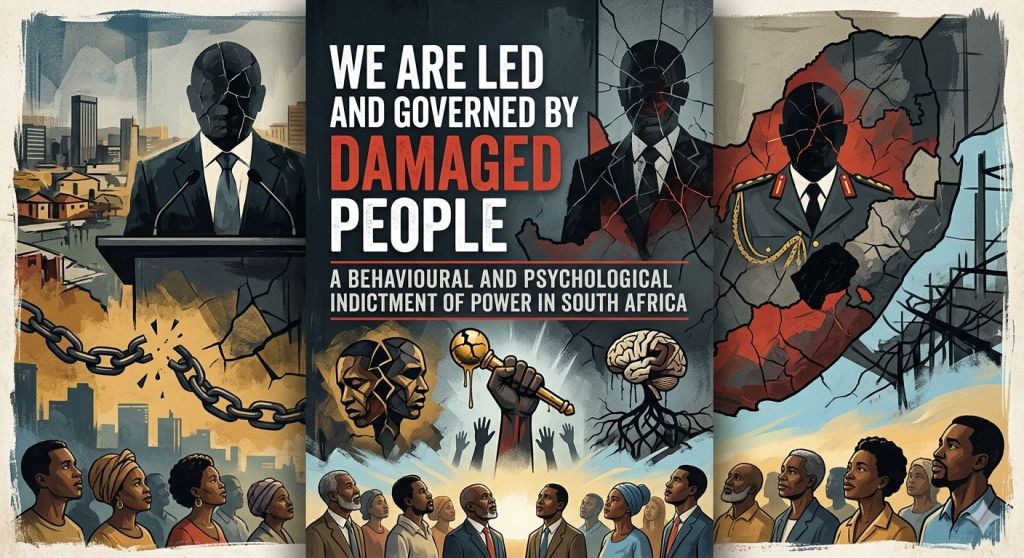
Let Us Begin With the Truth Nobody Wants to Print
South Africa does not have a governance and competence crisis.
It has a personality crisis.
The load shedding, the potholes, the tender fraud, the missing billions, the commissions of inquiry that lead to more commissions of inquiry, these are not policy failures. They are symptoms. Downstream consequences of something far more precise, far more diagnosable, and far more uncomfortable to name.
We have handed the machinery of a nation, its hospitals, its highways, its companies, its children’s futures, to a remarkably consistent psychological profile.
The behavioural sciences call it the Dark Tetrads.
The rest of us call it Dark Monday not Black Friday. While the country chases sales, these citizens endure an emotional and economic siege. Under the rule of the Dark Tetrad, every Monday is a descent into shadows.
The Profile (Let’s Be Clinical About It)
Psychology does not deal in metaphors. It deals in patterns. And the pattern is this:
Sadism. Machiavellianism. Psychopathy. Narcissism.
Not four separate pathologies scattered randomly across the landscape of power. Four overlapping, mutually reinforcing traits that cluster, with disturbing regularity, in the people who seek control over others. Research doesn’t just suggest this. It confirms it.
Power and Money attracts the Dark Tetrad. And the Dark Tetrad, once inside power and tasted the shankuras (money), it protects itself with ferocious efficiency.
Now apply this to South Africa. Not abstractly. Concretely.
The Sadist in the Corner Office
He does not carry the weapon. He never does.
He makes a call. He authorises a transfer. He nods across a table. Somewhere in a township he has never returned to, not really, a desperate man receives a number that changes his life and ends someone else’s.
A municipality manager. An auditor. A journalist. A whistleblower who made the catastrophic mistake of believing the law would protect her.
The Sadist attends the funeral. He signs the condolence book. He speaks of loss.
He is not haunted. He is satisfied.
This is not an allegation. This is a pattern so consistent across South Africa’s political and corporate landscape that it has become, appallingly, unremarkable. Hitmen hired to silence accountability. Bodies found. Cases cold. Suspects promoted.
The Sadist is not hiding. He is governing.
And in the boardroom? He restructures. He retrenches. He engineers the exit of inconvenient people with the same emotional temperature he uses to order lunch. The suffering is not collateral. It is, at some level, the point.
The Machiavellian: The Philosopher of Rot
He always says the same thing. “The ends justify the means.”
He says it with the confidence of a man who has never once interrogated the ends. Who has never asked: whose ends? Measured by what? At what cost to whom?
He is cold where others are warm. Strategic where others are sincere. He does not have allies, he has instruments. Every relationship is a transaction. Every comrade is a contingency. Every institution, the party, the church, the commission of inquiry, is simply another board to move pieces on.
He will sit before the Zondo and Madlanga Commission. He will look into the cameras. He will lie on national television, not nervously, not reluctantly, but architecturally, with the precision of a man who has rehearsed the lie until it became, for him, a competing truth. He may stutter and cry. The stutter and tears are not guilt. It is a theatre.
In the private sector, he is the CEO who manipulates the board while appearing to serve it. Who engineers the narrative around the numbers. Who survives every scandal by ensuring someone else holds the parcel when the music stops.
He has read Machiavelli. He just didn’t understand that The Prince was a warning, not a manual.
The Psychopath in the VIP Section
He is easy to like. That is, clinically, the danger.
Charming. Impulsive. Present. He buys rounds. He laughs loudly. He is exciting in the way that catastrophes are exciting, you cannot look away.
He is the Blesser. He is the procurement officer who signs off on ghost employees without blinking. He is the executive who approves the irregular and fruitless expenditure and is already three transactions ahead before the auditors notice the first one.
What makes him dangerous is not recklessness. It is the absence behind it. No remorse. No functional empathy. Consequence registers only as inconvenience, a legal fee, a reshuffling, a brief repositioning before re-emergence.
He cannot feel what he has broken. The young woman. The SMMEs never paid. The community that received a substandard road, a school with no books, a clinic with no medication. These are not people to him. They are externalities.
He will be photographed at a gala dinner this Friday. He will be wearing something expensive. He will be laughing.
The Narcissist: The Nation as Mirror
He is the most dangerous of all, because he is the most visible, and visibility, for him, is oxygen.
He does not serve the people. The people perform his narrative of serving them. Every speech circles back to his sacrifice. Every policy is his vision. Every crisis is a conspiracy against his legacy. Criticism is not feedback, it is betrayal. Opposition is not democracy, it is persecution.
He has surrounded himself, carefully and completely, with people who reflect him back at a flattering angle. Challenge him and you are reassigned. Contradict him and you are reframed as an enemy of the project. Outperform him and you become a threat that must be managed.
In thirty years of democracy, South Africa has produced a political class so saturated in narcissistic supply, the rallies, the titles, the deployments, the tenders named after their ideals, that governance has become indistinguishable from self-celebration.
The private sector version sits in the chairman’s seat of a company his competence did not build, extracting value his vision did not create, accepting awards for transformation he did not deliver. He confuses proximity to success with its authorship.
The Dunning-Kruger Dividend
Here is the crowning indignity.
Almost all of them, the Sadist, the Machiavellian, the Psychopath, the Narcissist, operate under a cognitive bias so precise it deserves its own chapter in this country’s post-apartheid history.
The Dunning-Kruger effect: the less you know, the more certain you are that you know enough.
The politician endowed in Illusory Superiority an Organic Intellectual, who cannot read numbers and the budget, presents it with the ‘confidence’ of an economist. The minister drowning in The Lake Wobegon Effect, who has never run anything larger than a political caucus, accepts a department of 40,000 people and diagnoses its problems by the end of week one. The SEO CEO who suffers from an Illusion of Explanatory Depth and Overconfidence Effect, deployed by political favour rather than competence mistakes the deference of subordinates for evidence of his brilliance.
They do not know what they do not know. Even Jesus’s – “Bawo baxolele abayazi into abayenzayo” – does not apply. And what makes this catastrophic, what makes it specifically South African in its consequences, is that the systems designed to reveal incompetence have been systematically dismantled by the same people whose incompetence they were meant to expose.
The auditor-general qualified audit is ignored. The treasury directive is circumvented. The parliamentary oversight committee is captured. The journalist and whistle-blower are dead. More SIU proclamations that go nowhere slowly.
Dunning-Kruger is not just a cognitive inconvenience in a boardroom. In South Africa, it is architecture. It is how the rot is sustained from the inside.
The Reckoning: Solutions That Do Not Apologise
Naming the pathology is not enough. Science demands intervention.
1. Psychometric Dark Tetrads, accountability, mandatory, public, binding.
Every candidate for public office above municipal level should undergo peer-reviewed psychological screening for Dark Tetrad traits. This is not radical. Pilots are screened. Surgeons are evaluated. The people managing R2 trillion in public resources should face no less scrutiny. Corporate boards hiring executives at the C-suite level, the same standard applies. If the industry won’t self-regulate, legislation must mandate it. Call it what it is: a minimum competency threshold for power.
2. Structural conflict-of-interest architecture, with teeth.
Machiavellianism thrives in opacity. The instrument is transparency: real-time public disclosure of all financial interests, contracts, and political relationships for all public officials and board-level corporate leaders. SARS lifestyle audits, mandatory before office and random lifestyle audits yearly. Not annual declarations buried in a PDF. Live. Searchable. Auditable. Any deviation, criminal prosecution, not a fine. The ends do not justify the means when the means are the public purse.
3. Whistleblower infrastructure built like a fortress.
The Sadist operates because the cost of exposure is death and the probability of protection is near zero. Invert that equation. Whistleblowers deserve anonymity, legal indemnity, financial protection, and where physical threat is credible, state protection equivalent to that afforded to state witnesses in organised crime cases. Because that is precisely what this is.
4. Citizens as the final audit.
Institutions have been captured. That leaves the citizens. But a citizen armed with nothing but outrage is manageable. A citizen armed with behavioural literacy, legal standing, and digital tools is dangerous, in exactly the way accountability requires. Civic education must include psychology. South Africans must be taught to recognise manipulation, grandiosity, and the markers of Dunning-Kruger incompetence, not as abstract theory but as survival skills. Community scorecards. Participatory budgeting. Ward-level accountability structures with real consequence. The ballot is not enough. The ballot is the floor, not the ceiling.
5. Hire on competence and character. Pay well. Build something that lasts.
No country was ever built on comradeship. No one buys a product simply because it says Proudly South African. People buy great solutions.
Lee Kuan Yew understood this at a national scale.
His core counsel to African (including ZA since it is in Africa) leaders was blunt: a nation’s survival depends on the quality and integrity of its leadership, not its sentiment, not its solidarity, not its symbolism. Singapore didn’t succeed because its people were exceptional. It succeeded because its leaders chose competence over comfort, and built institutions that outlasted any single administration.
On hiring, he was unambiguous. African nations struggle not because their citizens are uniquely corrupt, but because their leaders are uniquely compromised, by loyalty, ethnicity, and political debt. Singapore chose differently: intelligence and discipline over background and connection. Merit, not membership.
On pay, he was equally direct. A government that tries to acquire talent cheaply will get a cheap government and a cheap government will fail its people. Pay market rates. Attract incorruptible minds. Demand performance. Remove political interference. The logic is simple: you cannot preach integrity while creating the conditions that make corruption rational.
The broader lesson Africa rarely absorbs: Singapore had no natural resources. Its only asset was the quality of its people’s minds. Africa has resources in abundance and still underinvests in the minds that could multiply them.
The difference between Singapore in 1965 and today is not geography or luck. It is better choices made deliberately, in a single generation.
That option remains open. The question is whether the people making decisions are the right people to make them.
A Final Word That Is Not Gentle
South Africa is not failing because its problems are uniquely complex.
It is failing because we have normalised the abnormal. Because we have extended grace to the graceless. Because we have used the language of political loyalty, racial solidarity, Rainbow Nation and transformation to protect the precise people most committed to destroying the thing transformation was supposed to build.
The Dark Tetrad does not care about your struggle credentials. It co-opted them.
It does not care about your community. It photographs itself in front of it.
It does not feel your pain. It has never felt anyone’s pain. That is, clinically, the definition.
We are not governed by bad people who occasionally do good things.
We are governed, with striking consistency, by damaged people who have built systems to ensure that damage is never diagnosed, never named, and never removed.
This piece is the psycho diagnosis.
The treatment is yours to demand.
=============
Between Thoughts — Intellectual Musings | Dr. Mzamo Masito
Where the uncomfortable questions get a seat at the table.
 Between Thoughts -Intellectual Musings
Leave a comment