And Someone Has to Say Something About the Elephant.
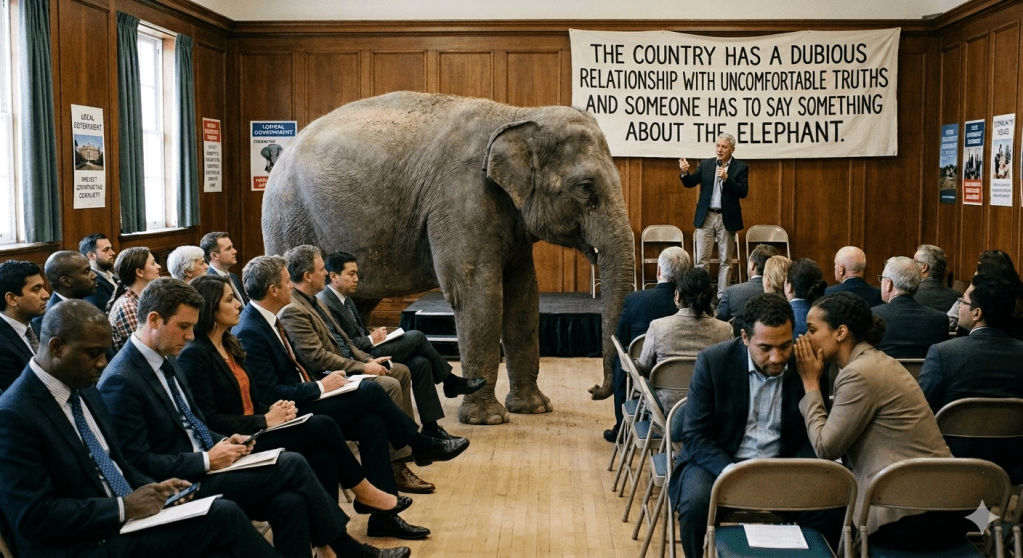
“The country has a dubious relationship with uncomfortable truths… the truth stares us in the face.”
— Advocate Muzi Sikhakhane SC, Pretoria High Court. Author _ Odyssey of Liberation
Four white-owned legal firms are challenging the BBBEE legal sector codes at the Northern Gauteng High Court. I am not a lawyer. This essay is not about that case. It is about what I heard Advocate Sikhakhane say in that context, that this country has a dubious relationship with uncomfortable truths.
Since he said it, the elephant has been chilling on top of the table. Someone has to say something about the elephant.
So here it is. No politeness. No diplomatic cushioning. No rainbow-nation PR.
Just the truths.
◆
UT 1: Economic Apartheid Never Ended. It Just Changed Its Suit.
South Africa remains the most unequal country in the world. Not the most unequal in Africa. Not the most unequal in the Global South. The most unequal country on the planet. That is not a statistic you use at a dinner party. That is a verdict about who we chose to become after 1994.
Wealth and land still follow racial lines with such precision that you would think apartheid was repealed last Tuesday.
72% of individual-owned farmland belongs to white South Africans. Black Africans own 4%.
That is the 2017 government’s own land audit. Not a pamphlet from a political party. Not a tweet. The government’s own data. Nearly a decade later, we are still arguing about whether land reform is necessary.
The income picture is more complicated and the complexity is the trap. Yes, there are now roughly as many Black households as white households in the top income bracket. Progress, right? Then look at what that bracket actually holds.
– R1.9M median wealth of the top 20% of white South Africans.
– R551K median wealth of the top 20% of Black South Africans. Same income bracket. A 3.5× wealth gap.
The difference is inheritance. Land passed down. Property transferred. Capital accumulated across generations while the state made it illegal for your grandfather to own anything in the city where he was born.
You cannot earn your way out of a three-hundred-year wealth gap in thirty years. The math does not work. And yet we act surprised every time the data confirms it.
“The price of a coffee in Cape Town is equal to the average daily income for a third of the South African population.”
Read that again. Not the average income. The average daily income. For a third of the country. One coffee. One day. That is not a poverty statistic. That is a moral indictment.
◆
UT 2: The Pencil Test Has a 21st-Century Version. We Are Running It on Each Other.
During apartheid, they used a pencil to determine who was Black enough to be classified and excluded. If the pencil stayed in your hair, you were Black. If it fell out, you might qualify for another classification. A pencil. To decide your humanity.
The 21st-century version uses language. The Zulu word for elbow, indololwane, has been used during xenophobic attacks to identify who is ‘authentically’ South African enough to be spared.
We are running a pencil test on Africans. With words instead of pencils. And we are calling it public safety.
When citizens take the law into their own hands, they are saying one thing clearly: the state has failed us. When people install solar panels not out of environmental conviction but out of survival, they are saying: this country cannot keep the lights on. When they sink boreholes to find water, they are saying: the pipes are broken and nobody is coming to fix them.
When citizens become the government, when they provide their own power, their own water, their own security, then the government is not underperforming. It is absent. And an absent government has forfeited its mandate. Democratically. Peacefully. It must go.
The uncomfortable truth is that South Africans have normalised a level of state failure that would have triggered a national emergency in any functioning democracy. We have adjusted. We have coped. We have bought generators and water tanks and armed ourselves. And we call this resilience instead of calling it what it is: abandonment.
◆
UT 3: State Capture Was Not Corruption. It Was a Business Model.
Let us be precise about what happened. State capture was not a group of greedy individuals stealing from the till. It was a systematic political project, deliberately designed, executed with precision, and protected by the very institutions meant to stop it.
Eskom. Transnet. SAA. The NPA. The police. These were not randomly targeted. They were chosen because they had the largest procurement budgets and the most power to enable or disable accountability. Cadres were deployed not to govern but to stand aside. To look away at the right moment. To sign the right papers.
R150B–R300B estimated annual cost of corruption in public procurement. Every year.
Think about what that number means. That is not an abstraction. That is schools not built. Hospitals not staffed. Water infrastructure not maintained. Every rand that went into a private pocket came out of a public service that a poor South African was depending on.
As of mid-2025, 218 criminal investigation recommendations are being processed. After the most thorough state capture inquiry in the country’s history. And a small fraction have reached final verdicts. The Guptas have not been extradited. The politicians implicated, remain a political force. The architects of the project are largely free.
8.7% increase in the probability of clinical depression for every increase in local violent crime. South African research.
We have a word for this. Impunity. And impunity is not a side effect of a weak system. It is what the system was redesigned to produce.
70 murders every single day. Even after the government celebrated an 8.7% decrease.
The most uncomfortable truth about state capture is not what they took. It is that the people who enabled it were elected. Deployed. Promoted. Protected. And are still embedded in the institutions we are hoping will now prosecute them.
◆
UT 4: We Live in a State of Perpetual Fear. And We Have Named It Normal.
I have lived outside this country. When I first leave, the first few weeks are the same every time. I am still hypervigilant. I am still scanning every entrance, every person behind me, every slow-moving car. My nervous system is running the same programme it runs here: threat assessment. Constant. Automatic. Exhausting.
After a few weeks outside, something happens. The amygdala quiets down. I can walk without running threat assessments. I can sit in a restaurant with my back to the door. I can think about something other than where the exits are.
That is not peace. That is what the absence of continuous traumatic stress feels like. Most South Africans have never experienced it.
What chronic fear does to the body is not subtle. The brain rewires itself:
■ The amygdala, the brain’s alarm system, becomes hyperactive and physically enlarges. You become hair-trigger reactive. You see a threat where there is none. You cannot switch it off.
■ The hippocampus, responsible for learning and memory shrinks under sustained cortisol exposure. Brain fog. Difficulty concentrating. Fragmented memory. Not laziness. Neurology.
■ The prefrontal cortex, the rational, decision-making brain, gets hijacked. It is harder to think clearly, regulate emotions, or make complex judgements when the survival brain is permanently in command.
The body pays the same price. Blood pressure stays elevated. The digestive system shuts down non-essential functions. The immune system suppresses. The body ages faster. Life expectancy shortens.
“By the end of today, South Africa will have 300 new cases of aggravated robbery and 47 new cases of murder.”
Not this year. Not this month. Today. By midnight. We have normalised this so completely that it does not even make the news unless the victim is famous or the method is spectacular.
We do not have a crime problem in South Africa. We have a trauma problem that we are refusing to name.
◆
UT 5: Violence Is Not a Crime Statistic. It is the National Condition.
South Africa is the 5th most dangerous country in the world. The most dangerous on the African continent. Cape Town has a homicide rate of 66 per 100,000 people, more than nine times the international average.
A decrease. They celebrated a decrease. The baseline from which we are decreasing is 70 murders a day. There is nothing to celebrate. There is everything to confront.
Gender-based violence was declared a national disaster in 2025. A national disaster. In 2025. Twenty-six years after the Constitution promised everyone the right to safety and dignity. The murder of women increased by 34% in some reporting periods. Roughly 950 to 1,000 women murdered every three months.
But I want to say something that the GBV conversation rarely makes space for: men are also dying in catastrophic numbers. This country has an androcide crisis. A masculicide pandemic. Men are the primary perpetrators of violence and the primary victims of it. Men are killing each other at rates that would constitute a public health emergency if they were dying of disease.
We also have an ecocide. Animals tortured for sport or frustration. Ecosystems burned or poisoned. The violence does not discriminate by species. It is pervasive. It is cultural. And it is the product of a society that has never genuinely processed its own trauma.
Public trust in the police sits at 27%. The Central Firearms Register is described by its own overseers as dysfunctional, with thousands of police-issued firearms diverted to the criminal gangs those same police are supposed to be stopping. The recidivism rate is 90%. Ninety percent. The system is not failing to stop the cycle. The system is the cycle.
R3.3 Trillion estimated annual cost of violence to South Africa’s economy — 15% of GDP. Violence is not a social issue. It is the primary economic crisis.
◆
UT 6: We Are Still Epistemically Colonised. And We Keep Paying for the Privilege.
“The most potent weapon in the hands of the oppressor is the mind of the oppressed.”
— Steve Biko
Epistemic dependency. That is the clinical term for what Advocate Sikhakhane called the state’s continued reliance on whiteness for expertise and validation. What it means in practice: we still treat white knowledge as the standard against which all other knowledge is measured. We still import frameworks designed for other markets and other minds and apply them here as if geography and history do not matter.
We do it in universities. We do it in government. We do it in business. We prescribe Kotler to African marketing students and call it education. We hire consultants from McKinsey to tell us about our own markets and call it expertise and then loadshedding. We build institutions modelled on Westminster and Bretton Woods and then act confused when they do not serve our context.
Steve Biko was killed for naming this. The apartheid government understood that you cannot maintain a system of dispossession if the dispossessed believe in their own worth. So you attack the mind first. Make them doubt their culture, their history, their language, their intelligence. Make them reach for your frameworks as the measure of validity.
Frantz Fanon said it from a different angle: the coloniser stays in power by convincing the colonised that their own culture is barbaric. Helen Zille, in her infamous tweets, essentially argued that colonialism brought civilisation. What Aime Cesaire actually showed — and what the historical record confirms, is the opposite: colonialism did not civilise anyone. It deci vilised the coloniser into a system of violence, and it decivilised the colonised into an object. Not a subject. An object.
We are still objects in the framework of epistemic dependency. Still seeking validation from institutions and individuals whose frameworks were not built for us and were sometimes built explicitly against us. And we are paying them to tell us who we are.
◆
UT 7: The Black Condition in Post-1994 South Africa Is This:
Your car was stolen. The thief now offers you a lift.
That is it. That is the metaphor. The land was taken. The wealth was extracted. The education was withheld. The dignity was stripped. And now, in the language of transformation, we are being told to be grateful for inclusion in the economy that was built on our exclusion. To celebrate a seat at the table that was built with our labour.
The TRC was not justice. It was a very expensive piece of theatre designed to calm people down. It told the truth. It named the crimes. And then it handed the perpetrators amnesty and told the victims to forgive. It produced a national narrative of reconciliation without producing material change. The wealth stayed where it was. The land stayed where it was. The psychological wounds — unaddressed, uncompensated, unhealed, stayed exactly where they were.
Rainbow Nation was a brand campaign. A beautiful one. Nelson Mandela was the most gifted brand ambassador in political history. But a brand campaign is not a structural programme. The rainbow faded the moment the cameras pointed elsewhere, and what remained was the same racial geography of wealth and poverty, just with a new flag.
What white South Africa and what white-aligned global capital, actually wants is to tolerate Blackness. Not to integrate with it. Not to transfer power to it. To tolerate it. To manage it. To ensure it does not disrupt the underlying architecture of who owns what.
And when Black people name this, when they say it plainly, without the courtesy of euphemism they are called divisive. Angry Blacks. Unhelpful. Radical. Not like Mandela as if three isonly one way to be black and non violent. Voetsek!
That reaction is itself part of the design.
◆
UT 8: The Racial Divide Did Not Survive Apartheid. It Was the Point of Apartheid.
Whites versus everyone else. Indians versus Blacks. Coloureds versus Blacks. The disunity is not incidental. It was engineered. Colonisation and apartheid built a hierarchy and then enforced it long enough that the hierarchy internalised itself. The colonised began to police each other’s proximity to whiteness. Began to compete for position within the racial order rather than dismantling the order itself.
The plan worked. The plan is still working.
We are easily triggered by racial undertones because our racial pain has not been truly, honestly, materially addressed. We cannot pray colonisation away. We cannot pray apartheid away any more than we can pray other realities of human existence away. Unaddressed pain does not heal. It metastasises. It becomes race rage that explodes at moments that seem disproportionate because the disproportionality is the entire history that preceded the moment.
Watch a Black professional lose composure after a racial insult from a white colleague. The reaction is not just about that comment. It is about every comment before it. Every ‘you only got the job because of BEE.’ Every mispronounced name. Every meeting where the ideas were ignored until a white colleague said the same thing. Every performance review that found them two competencies short of the promotion that was handed to someone with fewer qualifications.
The rage is not irrational. It is accumulated. And a society that refuses to create space for it to be heard and processed is a society that guarantees it will eventually erupt in forms nobody wants.
◆
One More. Because It Needs to Be Said.
“The oppressed will always believe the worst about themselves.“
— Frantz Fanon
Umlungu wam. Mlungu omnyama. Lirua. Ngamla. Into zabelungu. Uhlakaniphile umlungu.
These are the phrases. The phrases that praise whiteness. That locate intelligence, class, and sophistication in the proximity to white aesthetics, white validation, white approval. Success equals whiteness. This is not ancient history. This is the Instagram post where someone attributes their achievement to a white mentor. This is the corporate boardroom where the Black executive performs extra humility so the white executives feel unthreatened.
It irritates me profoundly. Not because I have taken anyone’s land or benefited from any colonial or apartheid act, I did not. But because internalisation is the most complete victory of the oppressor: when the oppressed do the oppressor’s work for them.
Steve Biko was killed for this idea. Not for burning anything. Not for armed resistance. For the idea that Black people should stop looking to white people for permission to exist. The apartheid government correctly identified that this idea, that the mind of the oppressed is the oppressor’s greatest weapon, was more dangerous than any bomb.
For my master’s thesis in 2006, Afrikaner Economic Empowerment 1890–1990 and Lessons for BBBEE. I interviewed Afrikaner intelligentsia and former Broederbond members in Stellenbosch. What I found was a textbook on how people recover from a defeat. After the South African War, Afrikaners faced a genuine inferiority complex toward the British. They were conquered. Impoverished. Culturally marginalised.
What they did next is instructive. They created the Helpmekaar Movement, help each other. They pooled small savings from ordinary Afrikaners to build Sanlam, Volkskas Bank, Rembrandt. They fought to make Afrikaans an official language and built an entire infrastructure of Afrikaans schools and universities. They staged the Centenary Trek of 1938 as a deliberate act of cultural revival, a psychological reset.
Was the vehicle of that empowerment morally corrupt? Yes. Profoundly. The same nationalist machinery was redirected to build and maintain apartheid. The method was exclusion. The empowerment of one group at the violent expense of another is not a model. It is a crime.
But the underlying mechanism, “ Volkskapitalisme”, collective pride, collective investment, cultural reclamation, language as liberator, deliberately building your own institutions rather than waiting for the dominant power to include you, that mechanism works.
Onkgopotse Tiro gave us the blueprint:
“The magic story of human achievement gives irrefutable proof that as soon as national pride — the mind — is awakened among the people and the intelligentsia, it becomes the vanguard in the struggle against alien rule.”
— Onkgopotse Tiro
The ANC failed Black mental liberation. Not because they lacked the language for it, they had Biko, Fanon, Cesaire, Tiro. They failed it because the political project of economic positioning consumed the energy that should have gone into psychological decolonisation. Freedom was operationalised as access to the existing system, not as the construction of a new one rooted in Black dignity.
So Black South Africans remain epistemically colonised, psychologically unhealed, economically marginalised and politically managed by a party that has confused its own survival with the survival of the people it was meant to liberate.
◆
Free Your Mind.
I got emotionally, spiritually, and mentally exhausted writing this. Which tells you something. This is what it costs to hold these truths steadily. This is what it costs to speak them plainly.
The country has a dubious relationship with uncomfortable truths. Advocate Sikhakhane was being diplomatic. The country has a hostile relationship with uncomfortable truths. It manages them. Dilutes them. Dresses them in the language of progress and reconciliation until they are safe enough to be ignored.
The truths listed here are not the full list. They are a fraction. I stopped at eight because I started feeling the weight of them in my body, in my chest and my jaw and the tension behind my eyes that comes from holding things that should not need holding.
Someone has to say something about the elephant. Today, that someone was me.
The elephant is still on the table.
It will be there tomorrow too. Until we deal with it.
===================
Dr. Mzamo Masito
Between Thoughts — Intellectual Musings
Where uncomfortable questions have a seat at the table.
 Between Thoughts -Intellectual Musings
Leave a comment