BETWEEN THOUGHTS — INTELLECTUAL MUSINGS
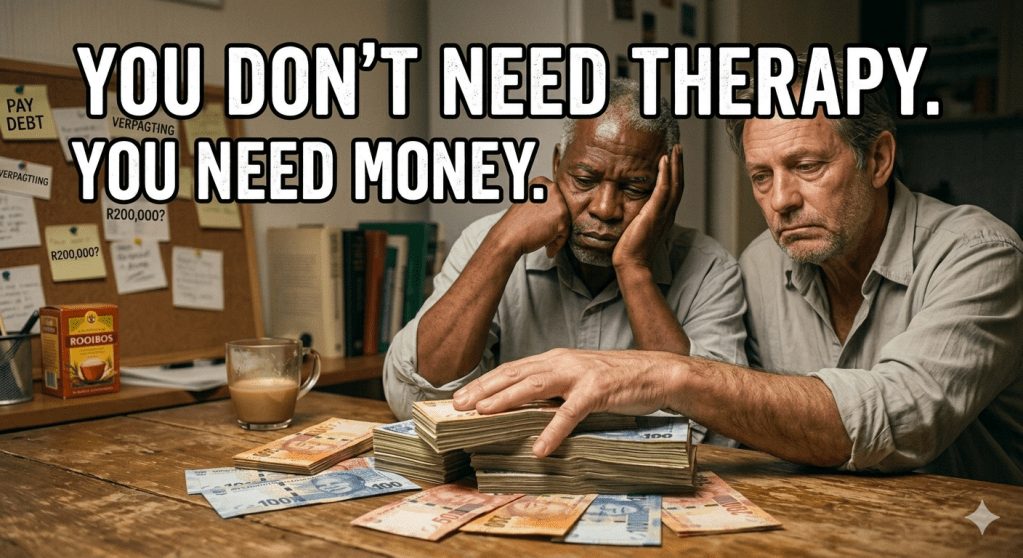
You are not depressed.
You are broke.
Your panic attack is your wallet screaming. Your anxiety is your pocket forecasting a bleak future. Your low mood is a rational response to a genuinely terrible situation. And the therapist you cannot afford to see, because therapy costs what you do not have, would agree, if they were being honest, that the diagnosis is not a disorder. The diagnosis is a bank statement.
Let me say immediately: I believe in therapy. I am pro-therapy, pro-medication where it is indicated, pro every legitimate modality from CBT to DBT to breathwork to forest bathing. This essay is not a case against any of that.
But we have developed a habit, in the therapy talk era, in the psycho-bubble age where saying “my therapist said” is now a social badge, a LinkedIn trend, a sign of emotional sophistication, of treating poverty as a symptom when it is, in many cases, the disease itself. And the modality we rarely discuss, the one that actually outperforms breathwork, meditation, mindfulness, CBT, DBT, and yes, even the occasional tree hug, is money.
The Nguni languages have a word: Imali. Madi. Machankura. Prosperity. Abundance. The medicine we do not prescribe.
The Therapy Industrial Complex
Have you noticed there are no Rolls-Royces, Maseratis, or Porsches parked outside therapists’ rooms? It is always Japanese, Korean and Chinese cars. Always mid-range. Always people who are managing.
Now: wealthy people do suffer. Money does not inoculate you against pain. In fact, once the basic Maslow needs are covered, entirely new categories of torment open up. Existential questions without easy answers, why am I here, do I matter, what is the meaning of this life, begin their assault. The brain that has been freed from scarcity suddenly has time for the questions that have no 2+2=4 resolution. That is its own particular hell. But those are expensive problems. They are not the problems of the man who does not know how he will feed his children on Friday.
And we keep prescribing the same interventions, “practise gratitude,” “be present,” “try box breathing”, to people whose nervous systems are correctly, rationally, biologically responding to a material crisis.
“Sometimes the therapy business is about practice, volume, frequency, and price, and come back, not about cure, not about wellness.”
A mortuary without dying is a dead business. A therapy practice full of cured patients is equally problematic for the revenue model. I am being sarcastic, but I am not entirely wrong, and the fact that I need therapy after writing that sentence should tell you something.
The pharmaceutical industry understood this logic early: do not cure, manage. Repeat prescriptions. Recurring revenue. The therapy sector is not structurally different. Which is not an argument against therapy. It is an argument for honesty about what therapy can and cannot reach.
What Poverty Actually Does to a Brain
The research is not subtle about this. In 2013, Sendhil Mullainathan and Eldar Shafir published their landmark work on the “scarcity mindset.” The finding is brutal in its clarity: having too little of a critical resource, money, above all, does not just cause stress. It occupies the mind so completely that it reduces fluid intelligence by the equivalent of 13 IQ points. That is roughly the cognitive effect of going a full night without sleep. Every day.
South Africa’s own Florcy Mabuza, in her work Poverty Mentality: The Root of Poverty, explored how this cognitive occupation functions, how poverty does not merely limit material options but colonises the inner life, producing a psychological bondage that perpetuates the very conditions it emerges from. When the brain cannot think beyond the immediate threat, rent, food, school fees, long-term planning becomes neurologically inaccessible. Not a character failure. A bandwidth problem.
Prof. Noel Chabani Manganyi, South Africa’s first Black clinical psychologist and one of this country’s most under-cited intellectual giants, gave us the framework in 1973. In Being-Black-in-the-World, he argued that alienation is not merely a political condition but a psychological one, that the material dispossession of apartheid produced a particular form of psychic dislocation that went far beyond what Western therapeutic frameworks were equipped to address. His 1977 work Alienation and the Body in Racist Society put it plainly: apartheid invented Soweto, and Soweto produced a specific kind of psychic wound. What Manganyi identified in apartheid South Africa, the daily cognitive and emotional tax of living in structured deprivation, is what the scarcity research now confirms with data.
“Poverty does not merely limit material options. It colonises the inner life.”
— Florcy Mabuza, Poverty Mentality: The Root of Poverty
The specific effects are measurable. Financial stress depletes mental bandwidth, the cognitive fuel needed for planning, self-control, and complex decision-making. The amygdala, in perpetual threat-response, suppresses the prefrontal cortex. You cannot think clearly when you are drowning. This is not metaphor. It is neuroscience.
Chronic financial deprivation also elevates cortisol levels, increases blood pressure, compromises immune function, and accelerates physiological ageing. Problems do not land softly when you are broke. They land on concrete. The Cyril Ramaphosa’s PhalaPhala mattress, or the $500,000 cushion, means your problems find a waiting room with solutions. Poverty means the problem lands and shatters.
Science Weighs In: What Kahneman Actually Found
For years, a single study by Nobel Prize-winning psychologist Daniel Kahneman and economist Angus Deaton sat at the centre of every conversation about money and happiness. Published in 2010, it delivered a finding that journalists, therapists, and motivational speakers seized upon with almost suspicious enthusiasm: emotional wellbeing plateaus at $75,000 per year. Beyond that threshold, more money adds nothing to your day-to-day joy. Cue the wellness retreat bookings.
There was just one problem. The finding was wrong. Or at the very least, dangerously incomplete.
The 2010 Finding: Comfort for Those Who Already Had Enough
The original Kahneman-Deaton study drew on Gallup survey data from over 450,000 Americans. It separated two distinct measures of happiness: day-to-day emotional wellbeing, how often you feel joy, stress, sadness, or anger in your actual daily life and life satisfaction, the broader evaluative judgment of how your life is going overall.
Their finding was nuanced but quickly flattened in popular retelling. Life satisfaction, they found, continued rising with income at every level, there was no ceiling. But day-to-day emotional wellbeing appeared to plateau at around $75,000. The headline wrote itself: money can’t buy happiness. People nodded. TED talks multiplied. Therapists took notes.
“The question of whether money buys happiness has an answer and it is more complicated than the bumper sticker version we have been sold.”
The 2021 Revision: Kahneman Gets Corrected, By Data
In 2021, Matthew Killingsworth, a happiness researcher at the University of Pennsylvania, published a study in the Proceedings of the National Academy of Sciences that challenged the plateau finding directly. Using a smartphone-based experience sampling method that captured real-time emotional states rather than retrospective surveys, he tracked over 33,000 employed adults across a wide income range. His finding: happiness continued rising with income well beyond $75,000. There was no plateau. At all.
Kahneman, to his immense credit, did not retreat to reputation. He collaborated with Killingsworth on a follow-up analysis. What they found together, published in 2023, is the most textured and honest account we now have. And it carries implications that should make us rethink a lot of casual wisdom about poverty, mental health, and the cost of financial distress.
What the 2023 Synthesis Actually Shows
For most people, roughly 80% of the population, happiness continues to rise with income without any ceiling effect. More money, more wellbeing. Consistently. The wealthier you get, on average, the better you feel on a day-to-day basis. The $75,000 plateau was, in effect, a myth produced by averaging across groups with very different experiences of money.
For unhappy individuals, those experiencing depression, chronic anxiety, or significant emotional distress, the picture is different. For this group, happiness does plateau at around $100,000. Beyond that threshold, more income does not meaningfully improve their emotional state. Why? Because the sources of their unhappiness are internal, clinical, psychological, relational and money, however useful, cannot reach them there.
“The psyche of Black South Africa, more than two decades after the demise of apartheid, remains blighted by the mental subjugation of white as the aspirational standard.”
— Prof. Saths Cooper
Life satisfaction, across all groups, continues to rise with income at every level. Money does not just solve immediate problems. It expands your sense of control over your life, your future, and your choices and that expansion is itself a form of wellbeing.
Money answers all things. Not some things. Not material things. All things. Solomon, who had more wealth than most of us can conceptualise, and who also wrote the most searingly honest account of meaninglessness ever committed to paper, was not romanticising prosperity. He was making a practical observation about how the physical world actually operates. In a material existence, money is the universal solvent. It dissolves problems.
The Practical Theology of Provision
This is not a prosperity gospel reading. The prosperity gospel takes verses about blessing and turns them into ATM codes. What Solomon is doing is something more honest and, in many ways, more useful: he is acknowledging that the physical domain has physical rules, and in those rules, financial resources have enormous reach.
Proverbs 10:15 frames it plainly: “The rich man’s wealth is his strong city.” It is a wall, not against spiritual attack, but against the specific and grinding assaults of material hardship. Against the bailiff. Against the school that turns away your child. Against the hospital that demands payment before treatment. Against the landlord who knows you have nowhere else to go. Wealth is a wall. Poverty is exposure.
The Apostle Paul, writing to the Philippians from prison, which is itself a commentary on the limits of money, promises that God will supply every need: “my God will supply all your needs according to his riches in glory” (Philippians 4:19). The channel through which divine provision most commonly flows is material. Harvest. Trade. Employment. Inheritance. The supernatural provision in Scripture almost always arrives with a practical address.
Where Money Falls Silent
Solomon was not naive. The same book that tells us money answers all things also tells us that the accumulation of wealth without meaning is vanity, breath, vapour, smoke. Ecclesiastes is the most psychologically sophisticated book in the biblical canon precisely because it holds both truths simultaneously without resolving the tension in either direction.
Paul’s warning in 1 Timothy 6:10 is not that money is the root of all evil, a persistent mistranslation. The text says the love of money, the worship of it as the ultimate answer, creates its own sorrows. When money becomes the object rather than the instrument, when the acquisition of wealth displaces the relationships, rest, and meaning that wealth is meant to enable, then you have simply traded one form of poverty for another. A more decorated poverty, but poverty nonetheless.
This is the distinction the text is drawing and it is the same distinction Kahneman’s data draws. For the deeply unhappy, money plateaus. Not because money is irrelevant, but because their unhappiness has roots that money cannot reach. Grief. Fractured attachment. Clinical depression. Spiritual desolation. These require something else. Something money can support the conditions for, but cannot itself provide.
“A feast is made for laughter, and wine makes merry; but money answers all things.”
— Ecclesiastes 10:19 (KJV)
“For 80% of people, more money genuinely means more happiness. The science now says so. The question is not whether money matters, it is what money cannot reach.“
— Kahneman & Killingsworth, 2023
What This Means for How We Talk About Poverty
The implications of this correction are not trivial. If happiness rises steadily with income for most people, then financial deprivation is not simply an inconvenience, it is a direct assault on wellbeing. When we tell poor people that money isn’t everything, or that happiness is a state of mind, we are not offering wisdom. We are offering a sedative. We are asking people to make peace with conditions that are measurably, scientifically degrading their quality of life.
Growing up in Gugulethu and Khayelitsha, I did not need Kahneman to tell me this. The adults around me were not unhappy because of poor mindset. They were unhappy because the taps ran dry, the rent was overdue, the taxi fare came out of the food budget, and the anxiety of not knowing how next month would look colonised every conversation. That is not a therapy problem. That is a money problem.
The science has now caught up with what poor communities have always known. Money buys more than things. It buys dignity. It buys psychological space. It buys the freedom to think beyond survival and for most of us, that freedom is the very condition of happiness.
The South African Specificity: Poverty as Historical Wound
What makes the South African version of this crisis distinctive is that our poverty is not random. It is designed. It is the accumulated outcome of 450 years of organised dispossession.
Prof. Pumla Gobodo-Madikizela, the 2024 Templeton Prize laureate and Research Chair in Violent Histories and Transgenerational Trauma at Stellenbosch University, has spent a career arguing that the wounds of apartheid were never adequately processed. In her analysis of the TRC and its aftermath, she asks whether the violence we see in post-apartheid South Africa is “ghosts from the past, the death of hope in the present, or a combination of both.” Her answer, in my reading of her work, is: yes. All of it. At once.
Prof. Saths Cooper, anti-apartheid activist, clinical psychologist, and former President of the International Union of Psychological Science, a man who organised resistance from a Durban township and then met the apartheid state’s psychologists again as his captors on Robben Island, has long argued that the psychology profession in South Africa was historically complicit with the system it should have been treating. White psychology, by his analysis, perpetuated myths of Black inferiority while the apartheid state it served was manufacturing the very conditions that would produce measurable psychological damage.
A country that colonised and then apartheided its majority population for centuries, then offered a TRC and called it healing, has a deficit in its mental health balance sheet that no amount of individual therapy can close. The wound is structural. The intervention must also be structural.
Half of our anxiety can be cured, not managed, by money. Half of our disorders are not chronic to the individual. They are caused by chronic deprivation. Fix the material conditions and you cure half the mental health crisis. That is not a retreat from psychology. That is what the psychology says.
Research on Kenyan, Uganda households found that a $1,500 cash transfer significantly reduced both perceived stress and cortisol levels in recipients. Not managed. Reduced. The “therapy” was cash. The “prescription” was money. Shankura.
What Solomon Knew: Money Answers All Things
Before we had peer-reviewed journals, before we had regression analyses and experience-sampling apps, we had Solomon. The wisest man in the ancient world, by his own account and that of every tradition that preserved his words, looked at the mechanics of human life and said something that should make the prosperity-is-spiritual crowd deeply uncomfortable.
“Solomon was not preaching wealth. He was bearing witness to reality. In a physical world, money has enormous reach. The question is not whether to pursue it, it is what you intend to do with the space it creates.”
The Access Scandal
South Africa currently has 0.97 public sector psychologists per 100,000 citizens. Less than one psychologist for every hundred thousand people. The country allocates approximately 5% of its health budget to mental health, at the bottom of all international benchmarks.
Which means the very people most damaged by poverty, the people in Khayelitsha, in Gugulethu, in Valhalla Park, in Orange Farm, in Daveyton, are the people with the least access to the mental health system.
And when they do access it, they are likely to encounter frameworks developed in Euro-American contexts, administered by practitioners who are, as Cooper has noted, predominantly white and female, and who may have limited capacity to mediate the socioeconomic and cultural reality of their Black clientele.
The dominant therapy model was not designed for people surviving on R700 a month. It was not designed for people whose anxiety is, rationally and correctly, about whether they will eat this week. Mindfulness, with respect, is a luxury good for people whose minds are not already occupied at full capacity with survival.
This is not an attack on individual practitioners. Many do extraordinary work in extraordinarily difficult conditions. This is an observation about the structural mismatch between the clinical model we inherited and the population we are trying to serve.
What Actually Works — At No Cost
The research identifies interventions that meet people where they are, at no financial cost, and that specifically target the mental health impacts of poverty and scarcity. These are not second-best options. They are, for the conditions caused by structural deprivation, evidence-based first-line responses.
Behavioural Activation is one of the most under-used tools in the public mental health arsenal. It works by breaking the withdrawal cycle that financial stress accelerates. Systematic engagement in low-cost pro-reward activities: walking, laughing, sunshine, social connection, community involvement, physically rewires the brain’s dopamine system. This is CBT’s most powerful mechanism, stripped of cost.
Peer Support is what communities did before the clinical model arrived and told them they were doing it wrong. The evidence is clear: peer support reduces isolation, validates shared experience, and improves mental health outcomes at least as well as individual therapy for many presentations. SADAG runs hundreds of free support groups across the country.
The Friendship Bench model, where trained community members provide structured brief counselling, has been proven in clinical trials to significantly reduce depression and anxiety in low-resource settings. This is task-shifting done properly.
Community and lay counselling: most public health facilities in South Africa are legally mandated to provide free, confidential mental health services. The Counselling Hub offers high-quality volunteer-driven counselling for under-resourced communities.
Digital tools: Fathers Matter Coach – Heartlines Whatsapp Group – +27 60 058 2107.
Wysa uses AI-based CBT and DBT techniques. The Healthy Minds Program, built by neuroscientists at zero cost, no ads, no subscriptions, teaches research-backed mental resilience skills. If you have a phone and data, you have access.
If You Are in Crisis Right Now
The following services are free, available 24 hours, and staffed by people who are trained to help:
SADAG Toll-Free Helpline: 0800 456 789, available 24/7
LifeLine South Africa: 0861 322 322, 24-hour crisis counselling
SADAG SMS Line: SMS 31393
Closing: The Prescription We Are Not Writing
I am going to therapy as soon as I publish this. Writing it was not therapeutic enough. Which is the point.
We need both. We need the structural intervention, the cash transfers, the land redistribution, the employment, the basic income, the housing, the water, the functioning schools, and we need the clinical one. They are not in competition. But we have been operating as though individual therapy can substitute for structural repair, and it cannot.
Manganyi told us this in 1973. Cooper has been saying it for decades. Gobodo-Madikizela has been showing us the unprocessed wound with rigorous, painful clarity. The scarcity research confirms it empirically. The Kenyan cash transfer study proves it practically. Kahneman’s revised data confirms it numerically. And Solomon said it three thousand years ago with the plain authority of a man who had tried everything else first.
Money is a therapy modality. An underrated one. A suppressed one. One that competes with existing revenue models and is therefore rarely mentioned in clinical settings.
Chankura, prosperity, abundance, the presence of enough, is not a luxury. It is, for millions of South Africans, the primary medication. And the country that refuses to prescribe it while diagnosing its victims with disorders is itself disordered.
Solve brokeness. Cure half of men’s mental health. The rest, we can talk about.
• • •
Dr. Mzamo Masito
Between Thoughts — Intellectual Musings.
Where the uncomfortable questions get a seat at the table.
 Between Thoughts -Intellectual Musings
Leave a comment