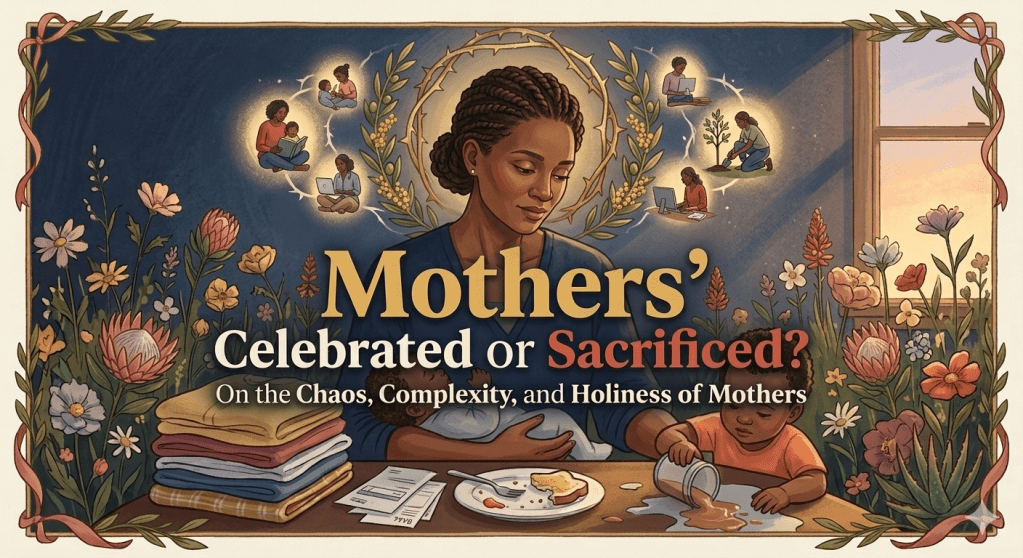
Are mothers celebrated or sacrificed?
This conversation was opened by Bra Dan, a stalwart of South African broadcasting. If broadcasting excellence had a face, one of its faces would be his. He asked a deceptively simple question as we approached Mother’s Day: are mothers celebrated or sacrificed?
The room split cleanly into two camps.
The first said: sacrificed.
The second said: both.
I sat in the second camp, not out of diplomacy, but because the evidence points there and the truth demands it.
But before we get to camps and arguments, let me say what this piece is really about. It is about complexity. It is about what Mandela and Martin Luther King both understood when they spoke about saints and sinners: that when you speak about a human being, you must honour their chaos, their light and their shadows, their simplicity and their contradictions.
There is no single Mother. There are many ways to be a mother and all of them are true at once. There is no one Mama Zanyiwe Madikizela. There are many ways to be Saint Nomzamo Winifred Zanyiwe Madikizela. Complex. Layered. Loved. Vilified. A single mother. A freedom fighter. A mother of a nation.
Mothers are a story. A narrative. A long one, told in different voices, in different rooms, at different volumes. And like all great stories, the protagonist is never just one thing.
The Three Faces: Hero, Victim, Villain
In storytelling, archetypes are not fixed identities, they are fluid positions in a drama. Karpman’s Drama Triangle tells us that in any relational system, people cycle through three roles: the Rescuer (Hero), the Victim, and the Persecutor (Villain). Sometimes in a single afternoon.
Mothers are not exempt from this triangle. In fact, they may be its most frequent inhabitants, because no human role carries more expectation, more pressure, more public scrutiny, or more private grief than motherhood.
Let us move through each face honestly. Not to judge mothers. But to see them fully, which is the only real form of love available to us.
I. MOTHERS AS HEROES: She Holds It Down
The hero archetype is the one we reach for most easily when we speak of mothers. And rightly so. There is a reason the word “Mama” carries weight across every language on earth. It is one of the first words a human mouth learns to make. The mouth knows, before the mind does, that this person is essential.
The Role Model Who Was Also Still Becoming
My mother was a domestic worker from the age of fifteen until close to thirty-five. Then she went back to school. While I was a day scholar in high school, she was doing ABET- Adult Based Education and Training, in the same season of life. She passed high school. She went to UWC and qualified as a social worker in her forties. At fifty she did her Master’s at Stellenbosch, focused on HIV/AIDS and child-headed households.
I grew up with a visible role model who showed me, not told me, showed me, that you are not your circumstances. That you have agency. That education is a ticket out, not a fantasy. She did not lecture me about resilience.
She demonstrated it. Daily. Often while tired. Often while scared. Always while moving forward.
That is the hero archetype in its truest form. Not a superhero who feels no pain. A human being who feels all of it and still shows up.
The Genetic and Intellectual Architect
Science has an interesting contribution here. The intelligence genes that operate on the X chromosome and that are most relevant to cognitive development, are more likely to be passed through the maternal line. Mothers are, in a literal biological sense, the primary architects of a child’s intellectual potential. They are also, in most households across the world, the first teacher, the first ethicist, the first philosopher a child encounters.
Before a child knows the name of God, they know the face of their mother. That face is the first cosmology. The first theology.
The Social Activist and the MacGyver
Mothers have historically wielded their “maternal authority” as political power, from the suffragettes to the mothers of the Plaza de Mayo, from South African women marching against pass laws to modern activists fighting against femicide and environmental destruction.
Motherhood has never been only domestic. It has always been insurgent.
And on the ground, in the daily emergency that is ordinary life, mothers are the original first responders. They improvise. They problem-solve. They hold things together with whatever is at hand. They are handkerchiefs, Okapi, and AK-47 in the same breath. They run through the fire.
And here is the thing about a real mother’s love that no statistic will ever fully capture: she still sees the light in her murderous, shadowy son. She still visits her scamming, shoplifting daughter. She does not require you to be cleaned up before she loves you. She loves you into the mess. After all, you are her beautiful mess. That is not a weakness. That is the most advanced emotional technology available to our species.
God’s love is Mother Love. The most unconditional thing on earth wears her face.
II. MOTHERS AS VICTIMS: The Weight They Were Never Asked to Carry
Heroism has a cost. And the bill for maternal heroism in South Africa and across the world is staggering, unpaid, and largely invisible.
The Supermom “ Imbokodo” Trap
Society has constructed a mythical standard of motherhood that no human being can satisfy: be fully present for your children and fully present at work; be a tender nurturer and a disciplined professional; sacrifice everything and still maintain your identity; be tired but never show it; be overwhelmed but never ask for help. The mother who admits she is struggling is judged. The mother who does not admit it is suffering in silence. The mother who needs a break from her children is side eyed.
The result is an epidemic of burnout, perinatal mood and anxiety disorders, and a quiet, grinding loss of self that we rarely name honestly. Social media has added a new dimension of cruelty, the relentless comparison of real, exhausted, imperfect motherhood against the curated, filtered, sponsored version of it online.
The Invisible Parent
When a child succeeds, the world asks who their father is. When a child fails, the world asks where their mother was. This asymmetry is not accidental. It is structural. Mothers are blamed for their children’s failures and rendered invisible in their children’s victories. Their labor is treated as a default, something that simply happens, like weather, rather than a daily act of will and sacrifice.
The Numbers Behind the Weight
The data on maternal burden in South Africa is not abstract. It lives in specific, nameable numbers:
Gender-based violence: South Africa records some of the highest rates of intimate partner violence globally. Women constitute the overwhelming majority of GBV victims, and a significant proportion of those women are mothers.
Crime as gender: Daily homicide averages in early 2025 show roughly 54 men and 9 women killed, but women’s vulnerability to intimate partner violence, occurring inside the home and behind closed doors, skews dramatically higher than homicide statistics reveal.
Female-headed households: Approximately 42% of South African households are headed by women, most of them mothers carrying full economic and emotional responsibility without structural support.
Post-partum depression: Studies suggest that between 25 and 35 percent of South African mothers experience post-partum depression, a rate significantly higher than the global average and the majority go untreated.
And then there is this: a woman in the IT sector was told she would not receive a promotion because she was “always at the maternity ward.” Not by a villain in a fairy tale. By a manager. In an office. In 2024. The sacrifice is not metaphorical. It is deducted, line by line, from her salary, her career trajectory, her sense of self.
III. MOTHERS AS VILLAINS: The Truths We Struggle to Say Out Loud
This is the section people will want to skip. I understand the impulse. We are a week from Mother’s Day. The flowers are almost ready. But complexity demands that we stay in the room.
Labelling a mother a villain is not an attack on mothers. It is a recognition that motherhood, under extreme conditions, in broken systems, with unhealed wounds, can produce harm. And that harm deserves to be named, not to condemn mothers, but to understand what produces it and to interrupt the cycles it creates.
Psychological Coercion and the Weapons We Do Not Call Weapons
Emotional manipulation in motherhood wears many faces: the guilt trip delivered with a sigh, the comparison designed to erode a child’s self-worth, the shame-and-blame that teaches a child that love is conditional on performance. These are not minor infractions. The brain does not distinguish between physical pain and social pain. Semantic violence, the wound delivered in words, in silence, in withdrawal, registers in the same neural architecture as a blow.
We have a cultural consensus about physical violence. We almost universally condemn it. But verbal and relational violence, the domain in which, on average, mothers tend to be more present than fathers, largely escapes accountability. Society prosecutes the fist but lets the tongue go free. Both are weapons. Both leave marks.
Parental Alienation: The Child as Weapon
One of the less-discussed forms of maternal harm is the weaponisation of children in the aftermath of relationship breakdown. Denying a father access to his child, consistently, deliberately, as a form of revenge or control, is a form of violence. Not against the father. Against the child. The research on parental alienation syndrome is contested at the edges but consistent at the centre: children who are systematically turned against one parent experience measurable psychological harm. The child did not choose the war. They were conscripted.
The Primary Perpetrators in Neglect — A Statistic the World Finds Uncomfortable
While men commit the overwhelming majority of physical violence against children, studies consistently show that mothers are statistically more likely to be the primary perpetrators of non-lethal physical abuse and neglect. The reasons are not mysterious: extreme stress, social isolation, poverty, undiagnosed mental illness, substance abuse. Context explains. It does not excuse. But without understanding context, we cannot intervene.
Approximately 21% of South African children under seventeen do not live with either biological parent. Maternal absence, while far less common than paternal absence, is not without consequence. The research links it to increased risk of developmental difficulty and, in some studies, future criminal behaviour. Not because mothers are irreplaceable in some mystical sense, but because consistent caregiving presence matters, and when it is absent, something has to fill the gap.
Fetal Alcohol Spectrum Disorders: The Numbers We Need to Face
South Africa has the highest reported prevalence of Fetal Alcohol Spectrum Disorders in the world. This is not a comfortable sentence. It is a necessary one.
A multi-site study across four provinces found an average FAS prevalence of 8.02 per 1,000 children nationally.
In the Northern Cape, reported rates reach as high as 199.3 per 1,000.
In certain Western Cape communities, prevalence has been recorded at 310 per 1,000 live births.
In Gauteng, roughly 1 in 40 children entering Grade 1 shows signs of FASD.
It is estimated that 30% of South African families are affected by some form of FASD.
FAS is the most severe form of the broader Fetal Alcohol Spectrum, a permanent, irreversible condition that shapes a child’s entire trajectory. The substance use patterns driving these numbers are shaped by poverty, trauma, addiction, and inadequate access to prenatal care. Blaming mothers without addressing those conditions is both morally dishonest and practically useless. But refusing to name the harm because we are afraid of the conversation is a form of complicity.
Abortion: The Argument That Will Not Be Resolved Here
Some argue that abortion is the taking of a life. Some argue it is the exercise of bodily autonomy, my body, my decision. This is one of the great moral fault lines of our time, and I am not going to pretend to resolve it in a paragraph.
What I will say is this: the women who face this decision, regardless of what they choose, deserve more from us than a slogan. They deserve honest conversation, genuine support, and the recognition that the choice, wherever one stands on it, is never made lightly and is never made in a vacuum.
Both. Always Both.
So. Celebrated or sacrificed?
Both. Always both. Often simultaneously. Sometimes within the same hour.
The mother who works the double shift is a hero and a victim of a system that requires double shifts. The mother who lashes out in exhaustion is a villain in that moment and a product of conditions that were never designed with her wellbeing in mind. The mother who stayed is celebrated. The mother who left is judged. Both of them were doing something, and both of them were human.
Winnie Madikizela-Mandela was Saint Nomzamo and the controversial figure and the freedom fighter and the abandoned wife and the woman who endured torture and solitary confinement and the mother who could not always be present because she was being hunted. All of those things. All of them real. None of them cancelling the others.
This is what it means to truly honour a mother: not to freeze her in a frame of perfection, but to see her whole. To see the sacrifice and the strength and the shadow and the grace. To understand that she did not arrive fully formed into motherhood. She was made into it, by history, by biology, by circumstance, by love, by fear, by the particular and unrepeatable conditions of her own life.
To know that there are no perfect mothers and perfect mothers are dangerous..
She held it down. She ran through the fire. She saw the light in you even when you could not see it in yourself. She also got things wrong. She also carried things she should not have had to carry. She was, and remains, fully human.
That is the most sacred thing we can say about any person.
Happy Mother’s Day to every woman who has loved a child, in all the complicated, imperfect, world-making ways that love takes shape.
==========
Dr. Mzamo Masito
Between Thoughts — Intellectual Musings
Where the uncomfortable questions get a seat at table.
 Between Thoughts -Intellectual Musings
Leave a comment