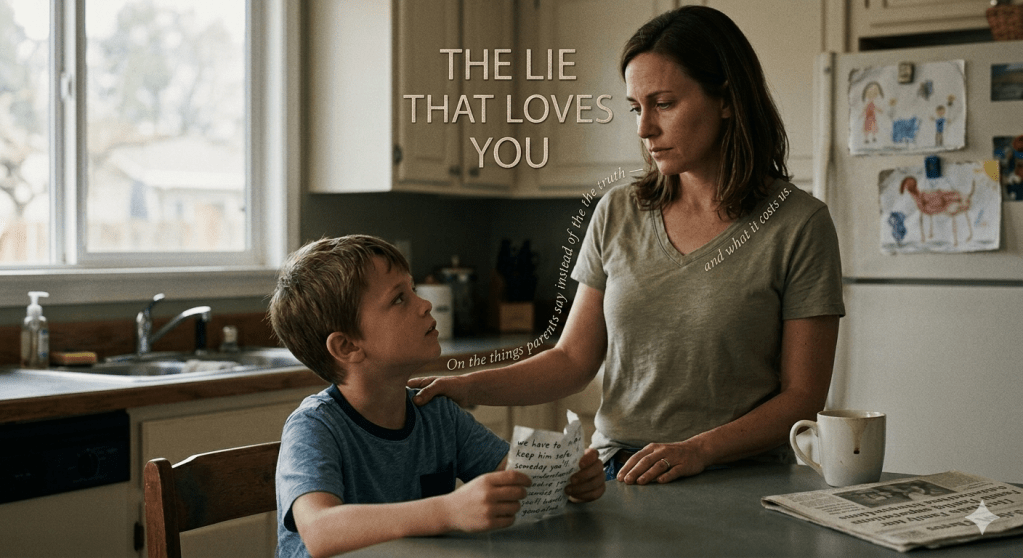
On the things parents say instead of the truth and what it costs us
I was looking for a TED Talk about talent. You know how YouTube works, you go in looking for one thing and the algorithm sends you somewhere else entirely. I ended up watching clips from a music talent show. SA’s Got Talent, Idols SA, The Voice SA, I honestly can’t remember which one. What I do remember is Neo.
Sixteen years old. Sparkly vest. A microphone stance he had clearly been practising in front of his bedroom mirror. He walked onto that stage with the confidence of a platinum-selling artist and within ten seconds, every judge’s face had shifted from anticipation to something close to physical pain.
Neo did not win the Golden Buzzer. He won the Wooden Spoon.
Later that night, watching the clip back, he turned to his parents and said: “Wait… I sound like a siren.”
His parents had told him he had a “unique, avant-garde vocal texture” that the world just wasn’t ready for yet. They had helped him choose the vest. They had coached the microphone stance. They built that boy a stage he was never ready to stand on.
Between 84% and 90% of parents report lying to their children, not out of cruelty, but out of love. That is the problem.
This is not a piece about bad parents. Most of the parents I know and most of the parent I am, want desperately for their children to believe in themselves. The question I want to sit with is this: What does a lie that comes from love actually cost a child? And what does the truth, told with care, actually give them?
The Architecture of the Loving Lie
Parenting by lying is not laziness. It is, in most cases, a form of emotional labour, the exhausting work of managing a child’s feelings in real time, with no script, no break, and no guaranteed outcome.
We threaten to leave them behind in the supermarket. We tell them their goldfish went to live on a farm. We insist that Santa is watching. We say “We’ll see” when we mean no, and we say “You can be anything you want to be” when what we really mean is: I love you so much that I cannot bear to be the first person who tells you that you have limits.
These are what researchers call prosocial lies, deceptions intended not to harm but to protect. And the research does show that they are nearly universal. But universal does not mean harmless.
The Research
Studies from the British Psychological Society and Psychology Today suggest that a pattern of parenting by lying, even well-intentioned lying, correlates with anxiety, poor attachment, and reciprocal lying in adolescence. Children who are frequently lied to are significantly more likely to lie back. The lie, it turns out, is contagious.
The Lies We’ve Dressed Up as Wisdom
Some of our most cherished parenting phrases are, on closer inspection, sophisticated lies. We pass them down because they were passed down to us. We repeat them because they sound right. We believe them because we need to.
“You can be anything you want to be.”
Possibly the most dangerous sentence in the parental vocabulary. Not because ambition is wrong, but because it confuses desire with destiny. The child who cannot sing is told they can be a singer. The child who cannot do mathematics is told they can be an engineer. When the world eventually disagrees and the world always eventually disagrees, the child does not think: maybe my parents were wrong. The child thinks: maybe I am broken.
“Practice makes perfect.”
Practice makes permanent. Without feedback, without adjustment, without someone honest enough to say “that’s still off”, practice just cements the mistake more deeply into muscle memory.
“Follow your heart.“
A heart without discernment is just an appetite. I’ve written about this before, the luxury of following your passion is exactly that: a luxury. In contexts where rent must be paid and families must be fed, “follow your heart” can be a direct route to beautiful poverty. Passion is a starting point, not a strategy.
“Time heals all wounds.“
Time does nothing by itself. Healing is active. It requires work, honesty, sometimes professional help, and the willingness to face what happened. Telling a grieving child that time will sort it out can be a gentle way of avoiding the harder conversation, which is that healing requires them to walk toward the pain, not wait for it to dissolve.
“I’m leaving without you.”
We’ve all said it. It works, in the short term. But a child who is repeatedly threatened with abandonment by the people they love most does not simply learn to hurry up. They learn, at a level below language, that the presence of love is conditional.
The most dangerous lie is the one dressed in a proverb. It arrives with authority and leaves without accountability.
The Two Paths of the Loving Lie
Here is what makes this complicated: sometimes the lie works.
There is a phenomenon I think of as the placebo musician. A child is told they have “a great ear for rhythm” despite being clumsy and uncoordinated. Because they believe it, they practice. They spend a thousand hours at a drum kit they would never have touched if they’d been told the truth early. By the time they realise the original praise was invented, they have actually become skilled, the lie provided the scaffolding long enough for the building to stand on its own.
But this is not the more common path. The more common path is Neo. The more common path is a child who reaches adulthood having never received honest feedback from the people whose opinion they trusted most and who then encounters the world’s bluntness without any preparation for it.
Two Outcomes
Path A — The Reality Shock:
The child reaches a Simon Cowell figure in the real world and is devastated, not just by the failure, but by the realisation that those who loved them most did not prepare them for it. Trust fractures.
Path B, The Placebo Effect:
The lie provides enough confidence to generate the practice that generates the actual skill. By the time the truth arrives, it no longer matters.
The problem is that you cannot know, from inside the lie, which path you are on.
The Case for Radical Candor — and Its Limits
Some parents go the other direction entirely. No softening, no metaphors, no “not yet”, just the truth, clean and direct.
“That essay is lazy. You didn’t research the topic and the logic is full of holes.”
“You’re being outrun by everyone on the field because you haven’t been training.“
“You’re being annoying. If you keep interrupting people, your friends are not going to want to be around you.”
There is something I respect about this. A child raised on direct truth develops a different relationship with failure, it does not destroy their sense of self, because their sense of self was never built on the fiction that they were already excellent. They learn resilience the hard way, which is also, arguably, the only real way.
But Kim Scott, who defined Radical Candor in the professional world, is very clear that candor without care is not candor at all, it is aggression. The difference between “you suck at singing” and real Radical Candor is the second half of the sentence: “…and I’m telling you this because I don’t want to see you humiliated at the talent show. Let’s find a vocal coach or explore something else.”
Challenging directly and caring personally, that is the formula. One without the other is either cruelty or cowardice.
The risk of pure bluntness is the shame response. A child who is told early and often that they are not good enough does not necessarily become resilient. They may instead develop the harsh inner critic, the voice that arrives, without invitation, every time they attempt something new and says: remember what they said about you.
What I Think We Should Say Instead
I am not arguing for dishonesty or for cruelty. I am arguing for something harder than both: honesty that loves.
Here is what that looks like in practice:
Replace the destination with the direction.
Instead of “you can be anything you want to be,” try: “You have real strengths. Let’s put serious work behind them and see how far they take you.” This is not a smaller statement. It is a more honest one and it keeps the door open without pretending the door is already a stadium.
Use “not yet” deliberately.
“You haven’t mastered that yet” acknowledges current reality without foreclosing the future. It is a small grammatical shift that changes everything, from verdict to trajectory.
Ask questions instead of delivering judgments.
“How did that feel when you sang it? What parts felt hardest?” This moves you from judge to coach. If the child says it felt great, you follow with: “What do you think would make it even better next time?” You are not lying. You are teaching them to listen to themselves.
Validate the passion, not just the performance.
“It’s okay if you’re not the best singer in the room. If singing makes you feel powerful and alive, that is a good enough reason to keep doing it.” This is perhaps the most important reframe of all: the child’s worth is not tied to being the winner. Neither is their joy.
Be a buffer, not a cheerleader.
If your child wants to audition for a national talent show but is not ready, you do not have to lie to protect them. You can say: “Professional singers usually train for years before they go on national television. Let’s find a local platform first, get some expert feedback, and build from there.” You are not saying they will never make it. You are giving them a road, not a wall.
The Hardest Truth About Loving Lies
The hardest thing about all of this is that there is no clean answer. Either way, parents unintentionally do damage their children. Parenting is not a controlled experiment. You cannot run both versions and compare outcomes. You are making decisions in real time, with imperfect information, under enormous emotional pressure, for someone whose entire future is, in some terrifying way, partially shaped by the things you say in the next five minutes.
What I know is this: a child who is told the truth, carefully, in a language they can hold, who is taught that failure is information and not verdict, is a child who is more prepared for the world than I was. More prepared, perhaps, than many of us were.
Neo’s parents loved him. I have no doubt about that. But love, without honesty, is just comfort. And comfort, delivered at the cost of truth, eventually becomes its own kind of cruelty.
We do not protect our children by shielding them from reality. We prepare them for it by walking them toward it, slowly, carefully, and honestly.
That is the work. Not easier than lying. Harder. But it is the work that lasts.
No perfect parents. Perfect parents are dangerous.
============
Dr. Mzamo Masito
Between Thoughts — Intellectual Musings
Where the uncomfortable questions get a seat at the table.
 Between Thoughts -Intellectual Musings
Leave a comment