The Corporate High Nobody Talks About
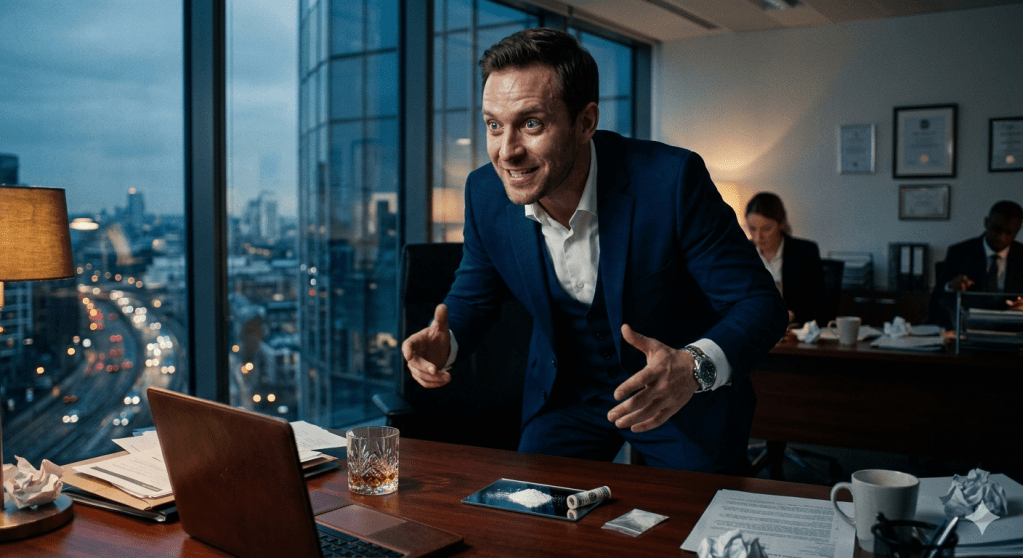
There is a kind of confidence that walks into the boardroom before you do. It straightens your tie, sharpens your tongue, and convinces you, absolutely convinces you, that you are the most interesting, most capable, most dangerous person in any room you enter. It is not confidence built from preparation, experience, or character. It is borrowed confidence. Rented from a small white line on a cold ceramic toilet surface, invoiced at a price your brain will spend years trying to pay back.
We need to talk about cocaine.
Not the cinematic cocaine of Scarface and the favelas. I am talking about the cocaine of corner offices, creative agencies, courtrooms, and conference centres. The cocaine of the Creative Brief and the Pitch Deck. The cocaine of the man who speaks the fastest in the meeting and is also, somehow, the least right. The cocaine of people who are model C and private school educated, who use big words to justify small choices, and whose excuses are so intellectually constructed that you almost admire them, almost.
The Toilet That Told Me Everything
Not long ago I attended a creative pitch presentation. Several agencies were in the room. The kind of room where the air itself speaks in a particular dialect. You know the one. The dialect of “disruptive” and “leapfrog” and “authentic storytelling.” Where someone will, with a straight face, say “marketing mix model,” “ROMI,” “rough cut,” “storyboard,” “framing,” “juxtapose,” “liminal,” “cacophony,” “acumen,” “grid system” and finish, as God is my witness, with “visual hierarchy.”
I stepped out to use the bathroom.
Two creative leads and a copywriter were at the basins. Lines had been drawn. Not metaphorical lines,. the kind drawn with a bank card on a porcelain counter.
They did not seem embarrassed. They seemed busy. Like they were doing something efficient and administrative, like checking emails or adjusting the agenda. Optimising the brief. Leveraging the synergy. I asked them what it does for them.
One of them turned to me, pupils wide open like a man who had just discovered the secret of the universe and was disappointed it was so obvious: “It’s a feeling you need to experience and hard to explain. The clarity. The confidence. You own the room. Superman confidence, no tights. No worry about f*ing up. Just an amazing confidence booster.”
Then, because the logic of addiction is nothing if not generous: “Do you want to try? Just once.”
I said no. I said my family carries addiction the way some families carry hypertension or flat feet, generationally, expensively, and without warning. I told them scientists estimate that 40% to 60% of addiction risk is genetic, and that roughly 20% of humans carry three to four risk alleles that triple their odds. I nerd out. It’s a problem.
They looked at me with eyes like malfunctioning slot machines, spinning fast, settling on nothing.
“So you’re not gonna take a hit?”
I said no. We left the toilet. They went to pitch. I went to sit down with the lowest confidence high in the room and three creative directors ready to conquer the known world.
They won the pitch, by the way. I have thought about that more than I should.
Superman Confidence With No Tights — The Science
Here is what cocaine is actually doing while your creative director is explaining why their campaign is “a cultural moment.”
Cocaine hijacks the brain’s dopamine system, the same system that rewards you for a good meal, a meaningful conversation, or finishing a difficult run. The difference is scale. A natural reward releases a measured, sustainable amount of dopamine. Cocaine blocks the reuptake process, the brain’s recycling mechanism, causing dopamine to pool catastrophically in the synaptic gaps between neurons. The signal does not just ring, it floods. What follows is the sensation of clarity, omnipotence, and social invincibility that my new toilet acquaintances were so eager to share.
The technical term for what cocaine creates is artificial euphoria. The experiential term is: you feel like you are finally, finally right about everything.
But the brain is not a passive participant in this transaction. It adapts. It begins to reduce its own dopamine production, why make something the drug provides for free? Receptors downregulate. The brain’s baseline begins to sink. What once produced joy — a good conversation, a plate of food, a moment of stillness, starts to feel flat. Insufficient. Boring. The drug has moved in and renovated the house to suit itself. You are now a tenant in your own neurology.
The crash is not just tiredness. It is a temporary but devastating form of anhedonia, the inability to feel pleasure. And so, naturally, you return to the line that returns you to yourself.
Or rather, to the version of yourself that never existed without it.
The Pandemic With a Dress Code
Cocaine addiction in South Africa is a silent pandemic, and it has a dress code. It wears a good suit. It has an MBA. It speaks English with the accent of Bishops or Rondebosch Boys, Westerford or St John’s. It tells itself a very sophisticated story about why what it is doing is different from what addicts do.
The numbers do not flatter the story.
— Recent statistics indicate that 1.8% of South Africans have used cocaine recently, a staggering increase from just 0.02% in the early 2000s.
— An estimated 350,000 people use cocaine daily in this country.
— Treatment admissions for cocaine addiction have risen from 1.5% of all rehabilitation patients in 1996 to approximately 17.5% today.
— In the 2023/2024 financial year alone, some treatment organisations reported a 32% increase in cocaine addiction rates.
These numbers live in more than one zip code. They live in Sandton, Sea Point, and the Atlantic Seaboard. They live in creative agencies in Rosebank and law firms in the CBD. They live in the green rooms of concert venues and the back-of-house corridors of fine dining restaurants. They live in hospitals where doctors who treat addiction are themselves quietly managed by substances. They are in the courthouse and the courtroom and the judge’s chambers.
In these environments, the preferred defense mechanism is rationalisation, the psychological sleight of hand by which intelligent people construct seemingly logical frameworks to justify destructive behaviour. The addict who cannot stop using cocaine is not out of control, you understand. They are optimising their performance. They are managing the demands of a high-pressure environment. They are choosing to live fully.
The intelligence is real. The rationalisation is exquisite. The addiction is still an addiction.
Steve Biko would have had something to say about a liberation generation that chose chemical colonisation over psychological freedom. He said the most potent weapon of the oppressor is the mind of the oppressed. He did not mean only political oppression. He meant every system that convinces you that you need something external to be whole.
What We Are Actually Avoiding
Here is what no one in the toilet was saying: the confidence that cocaine provides is a portrait of the confidence we do not have.
The creative director who needs three lines before a pitch is not confident. He is terrified. Terrified of being ordinary. Terrified that the idea is not good enough. Terrified that without the chemical armour, the room will see him. The real him, uncertain, talented but flawed, doing his best, like every other human being in the building.
We live in industries that have mistaken performance for capability. Where the person who speaks fastest is assumed to know most. Where the loudest voice in the creative brainstorm is the one that shapes the brief. Where confidence is currency and the market is brutal to those who seem unsure.
Cocaine does not fix this culture. It is its most honest product.
What Corporates Can Actually Do — Beyond the Wellness Wall
Before you reach for the “Employee Wellness Programme” brochure with the stock photo of a person doing yoga at sunset, let me be direct: the poster on the noticeboard is not a strategy. Neither is the anonymous tip line that no one calls because everyone knows it is not actually anonymous.
Here is what needs to happen, genuinely, structurally, without the corporate theatre:
1. Name the culture before you name the substance.
Performance cultures that reward speed, charisma, and false certainty are cocaine’s preferred habitat. The intervention that matters is upstream: redesigning how we evaluate talent, reward presentation, and celebrate the person who says I don’t know in a meeting. If your culture only values people who seem certain, you have built a market for whatever creates the appearance of certainty.
2. Psychological safety is not a workshop.
It is a leadership practice, repeated daily, made real when the CEO admits in front of the team that they had a week of self-doubt. When the creative director says the first idea was not good and here is why. When the lawyer says to a client: I need to think about that and come back to you. These small acts of intellectual honesty are the structural opposite of cocaine confidence.
3. Confidential occupational health partnerships — real ones.
Not the EAP number on the intranet that redirects to a call centre. Partnerships with clinicians who understand high-performance contexts, who can see a creative director without that director’s name appearing on a report accessible to HR. The barrier to treatment in professional environments is not awareness. It is fear. Fear of being marked as a liability. Of losing clients. Of being quietly managed out. Until organisations structurally protect the person who seeks help, they will not seek it.
4. Peer accountability structures.
In Twelve Step tradition, the sponsor relationship works because it is between equals, someone who has been where you are and chose differently. Corporate environments could create, with care, with proper clinical support, peer advisory structures among leaders who have navigated addiction or mental health challenges. Not confession circles. Not group therapy. Structured, voluntary, confidential accountability. This exists in medicine through Physician Health Programmes. It should exist in law, in advertising, in music, in technology.
What Higher Education Needs to Do — Now
We are training the next generation of professionals in environments that are, in many respects, the on-ramp to the culture described above. Medical schools, law schools, business schools, creative arts programmes, these institutions graduate people who know how to perform under pressure and know almost nothing about what to do when the pressure becomes structural, chronic, and chemically managed.
1. Curriculum is not the problem. Culture is.
Medical students know the pharmacology of cocaine. They learn it in class. They also encounter it, statistically, in the student residences and social circles around their campus. The gap is not knowledge. The gap is permission. Permission to be imperfect during training. Permission to say I am struggling without it being noted on a record that will follow you to licensure.
2. Wellbeing needs to be assessed, not assumed.
Universities run orientation weeks and mental health awareness months. These are gestures. What is needed is longitudinal tracking , not surveillance, but genuine pastoral care, of high-pressure programmes. Are your law students sleeping? Are your MBA cohorts drinking at rates that should concern us? Who checks?
3. Invite the recovering professional into the classroom.
Not as a cautionary tale but as a case study in the complexity of high performance, vulnerability, and recovery. The lawyer who spent three years managing a cocaine habit and has been in recovery for seven. The creative director who had to walk away from the industry to come back to it clean. These people exist. They are willing to speak. We are too frightened, as institutions, to provide the platform.
4. Decolonise the conversation.
In South African higher education, we have spent considerable energy decolonising curricula in terms of epistemology and authorship. We have not spent nearly enough energy decolonising our understanding of addiction. The image of the addict in our cultural imagination is racialised, class-inflected, and wrong. It excludes the Sandton attorney and the Johannesburg art director. It renders invisible the people who most need to see themselves in the conversation.
On the Confidence We Actually Want
There is a confidence that does not come from a line on a ceramic surface. It is slower. It is built from the compound interest of preparation, failure, reflection, and trying again. It does not make you own the room. It makes you present in it. It does not eliminate the fear — it teaches you to pitch while afraid, create while uncertain, lead while learning.
This confidence does not crash. It does not desensitise you to ordinary pleasure. It does not erode your gray matter or hollow out your reward system. It does not require a bank card, a rolled note, and a locked toilet door.
It is also, I will admit, much harder to acquire.
The men in that toilet were not idiots. They were talented people in a culture that had no patience for the slower, harder path. They had found a shortcut through the human condition. The shortcut was killing them, slowly, neurologically, comprehensively, but the immediate view was spectacular.
I walked back into the pitch. I sat down. I was unenhanced. Uncertain. Entirely myself.
I watched them perform.
And I kept thinking: what if the most radical thing we could do, in our boardrooms, in our universities, in our culture, is create enough space for ordinary, unaugmented, genuinely earned confidence to be enough?
What if being enough, as you are, on a Tuesday, without any chemical assistance, was considered a qualification?
That, it seems to me, would be the real disruption.
=====================
Dr. Mzamo Masito
Between Thoughts – Intellectual Musings
Where the uncomfortable questions get a seat at the table.
 Between Thoughts -Intellectual Musings
Leave a comment