What behavioural science, economics, and social psychology say about the fong kong in your wardrobe and the one in your ethics
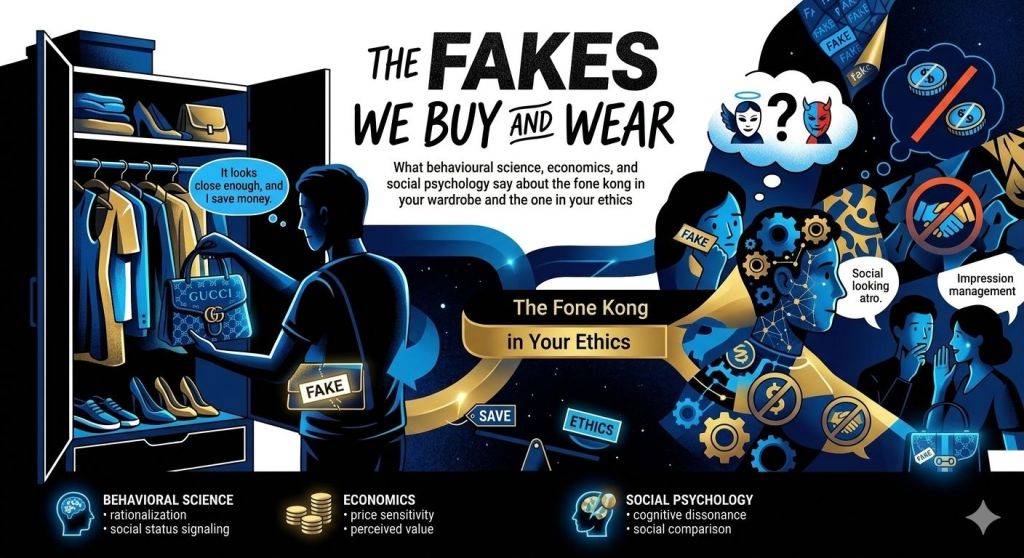
I know people who buy and wear fakes. You do too. And if you are reading this with the quiet discomfort of someone who has recently admired a spotless replica in a Sandton side street market or clicked through a suspiciously affordable ‘luxury’ listing online, then you may, in fact, be one of them.
I am not here to judge. I said that going in, and I mean it. But I am a behavioural & business scientist, and a behavioural and business scientist who sees a widely normalised consumer behaviour and says nothing is not doing his job.
So I went looking. Not for moral ammunition. For empirical evidence. What does buying a fake, knowingly, willingly, with full awareness that the Gucci label was stitched in a factory that has never been within five hundred kilometres of Florence, actually say about us? About our psychology? About our ethics?
What I found is more complicated than I expected. And more honest. Here is my report, without prejudice. You decide what to do with it.
The question is not whether you bought a fake. The question is what the purchase bought in return and whether you knew the price.
The Counterfeit Self: When the Fake Is You
The most influential psychological framework on this question comes from a study that is both fascinating and, in a very South African twist, somewhat tainted by its own counterfeit problem.
Behavioural scientists Francesca Gino, Michael Norton, and Dan Ariely ran a series of controlled experiments in which participants were randomly assigned identical designer sunglasses. One group was told they were wearing authentic pairs. The other group was told they were wearing fakes. Then they were given tasks, specifically, math problems with opportunities to overreport their performance for financial reward.
The result: the fake group cheated at significantly higher rates. Not because they were inherently less ethical. But because the internal signal of wearing something fraudulent created what researchers call a moral licensing effect, a psychological permission slip for subsequent ethical shortcuts.
They called it the Counterfeit Self Effect.
The logic runs like this:
Step 1
Knowingly wear a fake
Step 2
Internal sense of inauthenticity
Step 3
Moral relaxation / licensing
Step 4
Higher propensity to cheat or rationalise
There was a second finding that hit harder: participants wearing fakes did not only lower their own ethical standards. They also judged other people as more unethical and untrustworthy. The fake outside produced a cynical worldview inside. The world started to look like a replica of itself, everyone performing, no one genuine.
The counterfeit bag did not corrupt the person. It confirmed a story they were already telling themselves about what the world is made of.
A Necessary Caveat. On the Research Itself
Here is where it gets both ironic and instructive. Gino and Ariely, the researchers behind the Counterfeit Self Effect, have since faced severe scientific scrutiny. Multiple papers on honesty and ethics, including foundational dishonesty research, have been retracted due to discovered data anomalies and alleged fabrication. The exact metrics of the fake sunglasses experiment are now contested within academic psychology.
Which means the leading study on how fakes corrupt us may itself be ethically compromised.
The behavioural scientist in me finds this fascinating. The essayist in me finds it almost too on-the-nose.
What remains standing, however, is the broader theory of moral licensing, which is replicated across dozens of independent studies and is one of the most robust and troubling findings in behavioural economics. The specific numbers may be disputed. The underlying mechanism is not.
The Honest Balance Sheet
This is not a simple case. The research, the economics, and the sociology all produce a more nuanced picture than either the moral purists or the dupe-culture influencers want to admit. Here is the balanced ledger:
The Case FOR the Claim
The Counterfeit Self Effect erodes your moral compass, internally first, behaviourally second.
Psychological licensing: one small ethical shortcut makes the next one easier.
Lab studies show increased cheating rates when people knowingly wear fakes.
Supply chains for counterfeits often intersect with trafficking and organised crime.
Intentional deception of observers about status is the explicit goal, that is a values question.
The Case AGAINST the Claim
Economic constraint is not moral failure. Budget decisions are budget decisions.
Many buyers want the design, not the status, aesthetic appreciation is legitimate.
Luxury markup is genuinely exploitative; protest pricing is a rational response.
Contextual ethics: a fake bag does not make you a fraudster at work or a bad parent.
In many cultures and markets, replicas are legal, normal, and socially neutral.
The Money: Global Counterfeiting by the Numbers
Beyond individual psychology, there is a macro-economic case that is harder to dismiss with the language of protest pricing and corporate greed.
Economic Metric. Global Impact (2025/26). Direct Consequence
Total Global Illicit Trade
$467 billion to $4 trillion
Infiltrates legitimate e-commerce; creates shadow economies
Luxury Sector Losses
$30 billion lost annually
Capital diverted to brand protection and litigation
Tax Evasion Impact
Billions in unpaid VAT and customs
Revenue lost from public healthcare, infrastructure, schools
Labour & Safety
High correlation with unregulated factories
Funds criminal networks; exploitative and child labour
The counter-argument that luxury brands ‘don’t really suffer’ collapses when you follow the supply chain downstream. The R200 Hermès replica on the pavement outside the taxi rank was not stitched by a thoughtful craftsperson working decent hours in a regulated factory. The evidence on counterfeit supply chains is consistent: they intersect with forced labour, trafficking networks, and jurisdictions where worker safety is someone else’s problem.
Whether that matters to the individual buyer is, of course, a personal ethical calculation. But it is a calculation that should be made with full information rather than comfortable ignorance.
The Free Advertising Paradox
There is also a finding that cuts the other way and intellectual honesty requires naming it. For ultra-luxury brands, some economic research suggests that the ubiquity of cheap replicas paradoxically increases the willingness of wealthy consumers to pay for the genuine article.
The replica market creates the very status distinction the authentic buyer is purchasing. The presence of the fake makes the real thing more real.
Which means the R200 copy on the street is, in a deeply perverse way, doing brand work for the R200,000 original. Capitalism contains multitudes.
Culture, Context, and Why Ethical Judgment Depends on Your Postcode
One of the most important findings in this space is that the moral weight of buying a fake is not universal, it is cultural. And that matters enormously before we deploy any sweeping statements about character.
INDIVIDUALIST CULTURES. WESTERN EUROPE, NORTH AMERICA
Intellectual property is treated as a near-sacred individual right. Buying a counterfeit is framed as theft, of a designer’s creative work, of government tax revenue, of legitimate workers’ livelihoods. The shame is real and socially enforced.
COLLECTIVIST CULTURES. PARTS OF EAST ASIA, LATIN AMERICA
In China, the concept of Shanzhai, imitation culture, is not universally viewed as fraud. It is often read as democratic resourcefulness: clever access to styles reserved for the elite, and sometimes even as a manufacturing proving ground. In South Korea, the line between homage and counterfeit is culturally negotiated territory. The moral freight is lighter.
EMERGING AND DEVELOPING ECONOMIES. INCLUDING SOUTH AFRICA
Here the ‘protest pricing’ argument lands with particular force. A luxury handbag priced at three months of a middle-class salary, sold by a conglomerate that pays its African country managers in a currency that doesn’t touch most South Africans’ lives, the resentment behind the replica market is not irrational. It is a market response to a pricing structure that was never designed to include you.
That does not make the replica purchase ethical. But it does make it understandable. And understandable is where behaviour change starts, not where it ends.
Ubuntu tells us that I am because we are. But the counterfeit supply chain often runs through spaces where workers are because they have no other choice. That is the uncomfortable communal weight of the individual purchase.
Dupe Culture: When TikTok Turned the Fake Into a Flex
Social media has done something remarkable to the psychology of buying fakes. It has rebranded the experience entirely.
The word ‘counterfeit’ carries legal weight. ‘Fake’ implies cheapness and moral failure. But ‘dupe’, short for duplicate, carries none of that. A dupe is smart. A dupe is resourceful. A dupe is what you buy when you are too financially intelligent to be fooled by a logo markup.
The ‘haul’ video format, in which creators film themselves directly comparing a three-thousand-dollar designer bag to a forty-dollar replica, routinely accumulates millions of views. The comment sections celebrate the buyer. Paying retail is cast as naivety. Finding a perfect replica is a competitive achievement.
Gen Z, the Wealth Gap, and Visual Economics
There is something important to understand about the generation driving dupe culture. Gen Z is the first generation that grew up fully exposed to luxury lifestyle content online, while simultaneously entering an economy with declining real wages, inflated property markets, and credential inflation. They were shown the party and handed a bill they cannot pay.
In that context, the replica is not simply dishonesty.
It is a social survival strategy. When the social media reward loop runs entirely on visual appearance, when the algorithm cannot tell a real Birkin from a convincing copy, the incentive structure favours the replica buyer who knows the system. They are playing the game that was built for them. The question is what the game is building in them.
Moral Licensing: The Bigger Pattern
The fake bag is one expression of a much larger psychological phenomenon. Moral licensing, the subconscious permission we grant ourselves to do something questionable because we have recently done something good, operates across nearly every domain of consumer behaviour.
THE ECO-FRIENDLY PARADOX. GREEN LICENSING
Research by Nina Mazar and Chen-Bo Zhong found that participants who purchased organic, eco-friendly products were subsequently more likely to cheat on money-making tasks and more likely to steal than those who bought conventional products. Buying green created a moral surplus. The consumer subconsciously reasoned: I just saved the planet, this small ethical shortcut hardly registers.
THE HEALTH HALO
Choose a salad at lunch and you have licensed yourself for the double dessert. Make the disciplined budget decision to cook at home for a week and watch how quickly that accumulated virtue produces an impulse purchase. The ethical bank account fills and then gets raided.
CORPORATE CSR SLIPPAGE
This is not just an individual phenomenon. When companies heavily promote their ethical credentials, their charity partnerships, their sustainability reports, their statements of values, employees experience something researchers call organisational moral licensing. The logic: we work for a good company, so my small expense fraud or consistent time-theft is negligible in the moral accounting. The virtue of the institution becomes cover for the transgression of the individual.
The licence is not issued at the point of purchase. It is issued at the point of self-narration. The moment you tell yourself a story about why this particular shortcut is different, that is where the licence prints.
So, What Does Your Fake Say About You?
Let me be honest about what the evidence does and does not say.
It does not say that buying a fake bag makes you a fraudster, a criminal, or a fundamentally compromised human being. The slippery slope argument, that the fong kong today becomes the embezzlement tomorrow, is not supported by the evidence in any clean, linear way. People are more contextually complex than that. You can cut a corner on fashion and remain genuinely honest in every other domain that matters to you.
What the evidence does say is more subtle and more interesting. It says that the stories we tell ourselves about our purchases are not just post-purchase rationalisations. They are the raw material of character. When you tell yourself that the luxury brand deserves to be defrauded, that the rule against counterfeiting is a corporate construct you are not morally obliged to respect, that the small deception of wearing a fake is victimless, you are not just buying a bag. You are practising a mode of moral reasoning.
And practice, as every behavioural scientist knows, makes permanent.
The dupe culture rebranding is clever. Calling a fake a dupe does not change what it is, it changes the story you tell yourself about it. And the story matters. Not because one handbag determines your fate, but because the habit of comfortable rationalisation is cumulative. It compounds.
None of this is simple. The protest pricing argument has real legitimacy in a country like South Africa, where the gap between what luxury brands charge and what most people earn is genuinely obscene. The cultural normalization argument is empirically sound, your postcode shapes your moral calculus in ways that individualist Western frameworks often fail to account for. The supply chain argument cuts hard, but for most buyers it remains conveniently abstract.
You are allowed to buy the fake. You are allowed to enjoy it. But the one thing you are not allowed is the pretence that it came without a cost, to the workers who made it, to the story you are telling yourself, and to the moral accounting that runs quietly in the background whether or not you ever check the ledger.
I said I would not judge. I meant it. What I will do, as I always try to do, is give you the information and trust you to sit with it honestly.
What you do with the fong kong is your business. What the fong kong does with you is worth knowing.
==================
Dr. Mzamo Masito
Between Thoughts- Intellectual Musings
Where the uncomfortable questions get a seat at the table..
 Between Thoughts -Intellectual Musings
Leave a comment