South Africa’s six structural growth pillars and what happens when you actually mark the test
I had a teacher at business school. Prof Adrian Saville. The kind of man who makes you feel, for the duration of a lecture, that the economy is not a cold mechanical system, but a living, breathing thing that responds to choices, values, and character. He recently posted something on LinkedIn that stopped me mid-scroll.
His argument was simple but disarming: in a world obsessed with what is changing, what if we paid more attention to what is not changing? What if the fundamentals, the deep structural levers of national growth, are far more stable than the disruption headlines suggest?
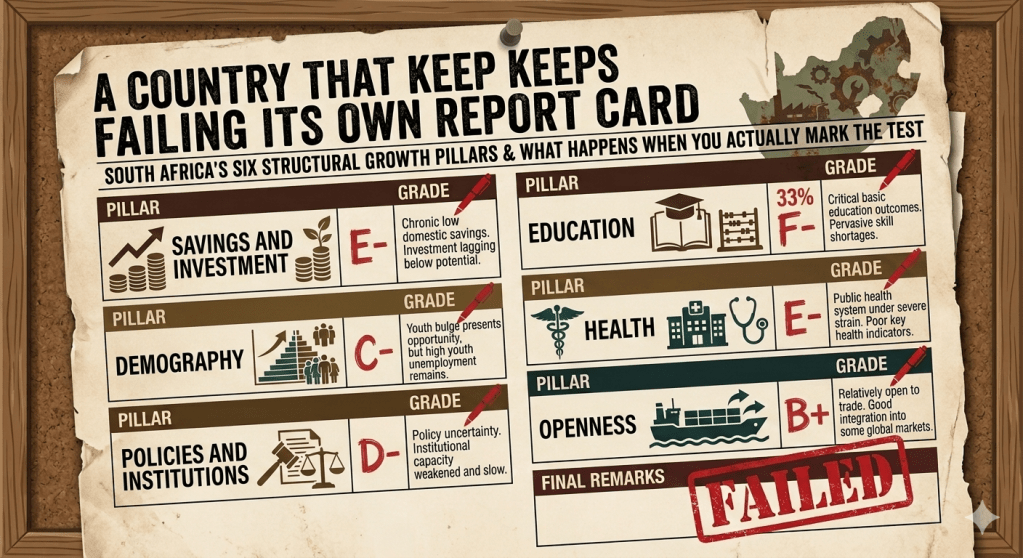
He identified six, grounded on empirical research. Six core pillars that determine whether a country grows sustainably or remains trapped in cycles of potential-without-progress. Six pillars against which, as a self-appointed student of this country, I felt compelled to run a scorecard.
What I found was not comfortable reading. But it was necessary.
SA fails to meet the criteria for five out of six fundamental growth pillars. This is not a policy problem. It is a structural emergency. Let me walk you through each pillar, the framework requirement, South Africa’s reality, and the consequence we keep pretending is just bad luck. Prof Saville, please correct your student where I have erred..
Pillar 1: Savings and Investment
The Threshold Nobody Talks About
The framework is blunt: to organically fund the kind of infrastructure a growing nation needs, a country’s gross savings rate must clear 25% of GDP. That is the minimum. Not the aspiration, the floor.
South Africa’s gross savings rate sits at approximately 13.3% to 13.7% of GDP. That is barely half of what is needed. But the headline number actually flatters us. Dig into household savings and you find something more alarming: households are not saving at all. They are dissaving, at negative 1.2% of disposable income, meaning South Africans are, on aggregate, consuming more than they earn. Debt is not financing investment. It is financing survival.
The consequence is structural dependency. A country that cannot save cannot self-fund. A country that cannot self-fund is permanently in the waiting room of foreign capital and foreign capital, as we know, is patient until it is not. The rand knows this truth better than any economist.
THE NUMBER THAT HAUNTS ME
Household savings at -1.2% of disposable income means that ordinary South Africans are not building wealth, they are eroding it. The productive class is consuming itself. You cannot build a nation on a foundation of collective financial depletion.
Pillar 2: Demography
The Dividend That Became a Debt
South Africa has a young population, median age of 29, with more than a quarter of citizens under 15. Rest of Africa median age is 18 to 19, keep this in mind. Africa is a not a country and South Africa is not Africa. South Africa is, by African standards, a middle-aged country. With a median age of approximately 29 years, it sits nearly a decade older than the broader sub-Saharan median of 19 to 20 years. On a continent where the demographic story is overwhelmingly one of youth, of bulging youth cohorts pressing against economies that must absorb them. Has South Africa, already moved past that first wave? I wonder!
This is not, on its own, cause for alarm. Compared to Western nations or the BRICS economies, 29 is still young. The dividend window has not closed. But the direction of travel matters as much as the current position. On paper, this is the demographic low-fat not full cream or double cream dividend. A sizeable enough, incoming workforce. A strong consumer base. Future taxpayers if healthy and in education, employment and training. Future innovators.
But here is where the story fractures.
Youth unemployment exceeds 60%. Not 20%. Not 35%. More than six in ten young South Africans are not working. That is not a labour market inefficiency, that is a civilisational failure to absorb its own young.
And the longer-term picture is quietly worsening. The fertility rate has declined to 2.17 births per woman, approaching population replacement level. Marriage rates are falling, particularly sharply among Black and Coloured South Africans, while divorce rates are rising. The number of children raised in single-parent households is growing, with all the documented downstream effects on educational attainment, mental health, and social mobility. The number of males who are Not in Employment, Education, or Training (NEET) is growing. The dating gap, what some are calling the “amadoda awekho” phenomenon, is widening.
Here is the behavioural science beneath the economics: on average, women date and marry horizontally or upward. If the pool of employable, stable men shrinks, fewer partnerships form. Fewer partnerships mean fewer children. Fewer children mean a narrowing future workforce. The demographic dividend quietly converts into a demographic debt, and nobody is sounding the alarm loudly enough.
You cannot collect a demographic dividend from a generation you did not invest in.
Pillar 3: Policies and Institutions
Independence Without Coherence
South Africa’s post-apartheid institutional architecture is, by continental standards, genuinely impressive. The Reserve Bank. The judiciary. The Madlanga Commission. The Chapter 9 institutions. These were built with intention and they have, largely, held.
But institutional independence is not the same as policy coherence. And it is policy coherence, consistency, predictability, long-term commitment, that moves capital from consideration to commitment.
With or without possible resignation or impeachment of PhalaPhala the Buffalo.
Coalition politics, following the ANC’s loss of its parliamentary majority, has introduced new volatility into an already turbulent governance landscape. Hiring and Promoting on political comradeship not competency and character is endemic. Municipal leadership changes with disturbing frequency. Law firms challenging BBBEE – Transformation mandates, however necessary, leaves compliance teams in perpetual uncertainty.
Corporate capital does not require perfection. It does require a reasonable basis for a ten-year plan. South Africa, right now, struggles to offer that.
Pillar 4: Education
Spending Without Learning
South Africa allocates a higher proportion of its national budget to education than most countries on the continent. This is not a story of neglect. It is a story of something more troubling than neglect: investment without return and a political culture that has learned to celebrate the evidence of failure as though it were proof of success.
Every year, a Minister of Basic Education stands at a podium and announces an 88% matric pass rate. The room applauds. The headlines run. And buried beneath that number, quietly, is the rot.
Only 44% of boys who started Grade 1 ever sat for Grade 12. The pass mark in some subjects sits at 33%, a third of a hundred, dignified with the word “pass.” Numeracy and literacy foundations, laid in the early grades, remain among the weakest on the globe. And yet the number that travels, the number that gets printed and framed and used to justify the budget line, is 88%.
This is not education leadership. This is Bell Pottinger with a budget allocation.
The question I keep asking is a simple one: when does South Africa get an education leader with the courage to retire the trophy metrics? Provinces compete for prizes and recognition, let them compete on quality. On how many children can actually read for meaning by Grade 4. On numeracy scores that are not embarrassing at regional benchmarks. On the percentage of boys, boys specifically, who make it from first day of school to final examination without the system losing them somewhere in between.
The 88% is a number that hides more than it reveals. And every year we celebrate it, we delay by another year the reckoning that might actually save a generation. The country consistently ranks near the bottom of global assessments for mathematics and literacy. PIRLS. TIMSS. SACMEQ. The data does not waver. Year after year, the same uncomfortable truth: we are producing large numbers of school leavers who are not equipped for the economy that awaits them.
The result is a dual-sided skills crisis. There is an oversupply of low-skilled labour competing for a shrinking pool of unskilled work, as AI, automation progressively eliminates those entry-level positions. Simultaneously, there is a severe shortage of technical, engineering, science, mathematical, and specialist skills, the very competencies that would allow South Africa to move up the value chain from commodity exporter to knowledge economy.
We are running an education system calibrated for an economy that no longer exists, to produce workers for jobs that are disappearing, while the jobs of the future sit unfilled.
A STRUCTURAL MISMATCH
The paradox of South African education is not a funding paradox. It is a quality and alignment paradox. Budget allocations without curriculum reform, teacher development, and accountability architecture will continue to produce the same expensive failure at scale.
Pillar 5: Health
Productivity Has a Body
There is a tendency in economic discourse to treat health as a social spending item, a cost, rather than an investment. South Africa’s health burden is a corrective to that thinking.
South Africa carries the largest HIV/AIDS caseload in the world. Antiretroviral treatment has been transformative, life expectancy for males has recovered to approximately 64 years, and females to 69.6. These are genuinely remarkable achievements of public health policy and civil society advocacy.
But the systemic weight remains enormous. Absenteeism. The chronic management demands of a large population living with HIV. The compound burden of tuberculosis, non-communicable diseases, and the fragilities of an underfunded public health system. All of this acts as a direct drag on national productivity, not in the abstract, but in the very specific form of prime-working-age adults who are less able to participate fully in the economy. Then add legal and illegal immigrants to the already complicated and chaotic health story.
A sick population does not maximise educational opportunity. A sick population does not build generational wealth. A sick population is not wrong or weak, it is expensive, in ways we have not fully accounted for, and it is our collective responsibility.
Pillar 6: Openness
The Blessing That Cuts Both Ways
This is the one pillar where South Africa can claim a qualified pass. The country is structurally open, deep capital markets, a freely floating currency, robust trade relationships with China, the United States, and the European Union. The mineral and agricultural export base has, repeatedly, saved South Africa’s national accounts when domestic demand has faltered.
But openness is a double-edged instrument. The same capital mobility that attracts foreign investment triggers currency volatility when sentiment shifts. The rand’s behaviour during periods of global risk-off is not merely discomforting, it directly affects import costs, inflation, interest rates, and the real purchasing power of the population.
And there are signs of a quiet retreat. Tighter controls on regional immigration signal a growing caution about regional integration, at precisely the moment when the African Continental Free Trade Area (AfCFTA) demands the opposite orientation. A country that wants the benefits of openness while hedging against its risks may end up with neither.
The Structural Report Card
Five out of six. That is the score. Not a pass. Not even a close call.
Pillar Requirement SA’s Reality – Verdict
1. Savings : Underutilized
> 25% of GDP. ~13.3% | Households saving at -1.2%. Severe Deficit
2. Demography
Youthful expansion..Young, but fertility declining; 60%+ youth unemployment.
3. Institutions – Deterrent
High stability. Volatile; coalition politics & shifting policy. Deterrent
4. Education – Skills Gap
Quality capability. High spend, low outcome; systemic skills mismatch.
5. Health – Drag
Productive workforce. Productivity drag.
6. Openness – Neutral/ Variable
Mutual benefit. Deep markets but currency volatility; mixed integration.
What This Means and What It Demands
I want to be careful here about what I am and am not saying.
I am not saying South Africa is broken beyond repair. I am not performing despair. I have run enough miles through this country’s streets, spoken to enough young men and women at our events, seen enough of what ordinary South Africans build with what they have, to know that the human material of this place is extraordinary.
What I am saying is this: extraordinary people, trapped in structurally deficient systems, will consistently underperform their potential. And we have been mistaking individual resilience for systemic functionality for too long.
Resilience is not a growth strategy. It is what people do when growth strategies have failed them. Prof Saville’s six pillars are not academic constructs. They are diagnostic instruments. They tell us, with uncomfortable precision, why South Africa’s growth trajectory has remained flat even when commodity cycles turn favourable, even when the global economy expands, even when the political temperature drops briefly below boiling.
The country is not unlucky. It is under-structurally-invested, across savings, demography, institutions, education, and health simultaneously. That is a five-pillar crisis. And five-pillar crises do not resolve through incremental tinkering or annual budget speeches.
They resolve through honest diagnosis, sustained political will, and the kind of intergenerational commitment that does not fit neatly in a five-year electoral cycle.
The test has been marked. The question is whether we are willing to look at the results, and do something about them before the next generation inherits the same report card.
============
Dr. Mzamo Masito
Between Thoughts — Intellectual Musings
Where the uncomfortable questions get a seat at the table..
 Between Thoughts -Intellectual Musings
Leave a comment