An Ode to Townships & Rural School Teachers
Who do the most. With the least.
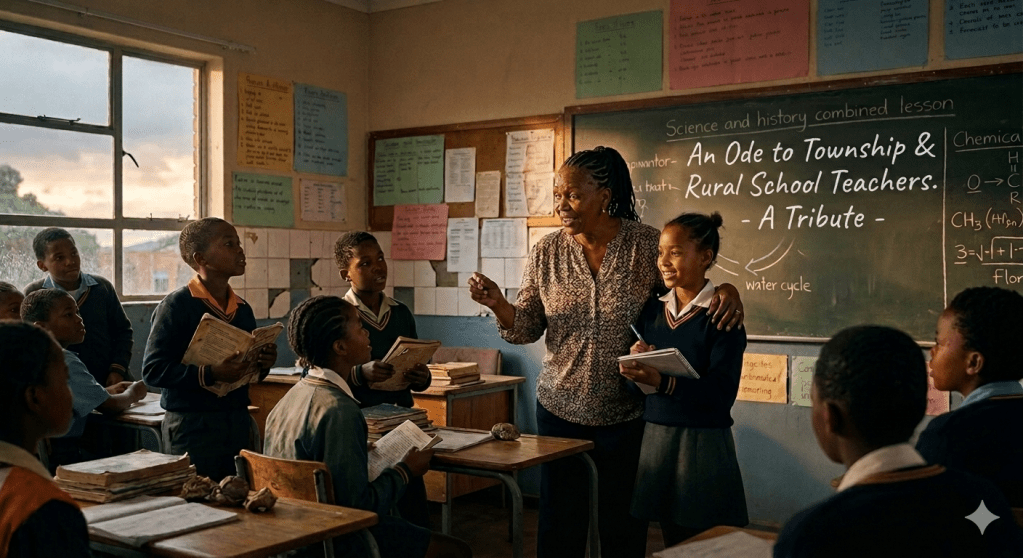
On Tuesday, I was invited to Moses Kotane Primary School in Braamfontein. I went not as a guest of honour, not as a keynote speaker, not as someone who had arrived. I went as a witness. And what I witnessed rearranged something in me.
The SADTU Matla Matimba Branch holds teacher gatherings every single Tuesday. Not occasionally. Every Tuesday. Grade R to Grade 12. They come with their agendas formally adopted. They come with committees: EduCom dealing with academic standards, LawCom navigating the BELA Act and the abolition of corporal punishment, GenCom fighting for every child, girls and boys alike. They come prepared. They come organised. They come, which is more than can be said for many people in more comfortable rooms.
They also celebrated Africa Day. And in that primary school hall in Braamfontein, the teachers spoke about Pan-African pedagogy, about a united continent, about what it means to educate a Black child not as an afterthought of the curriculum but as its primary reason. I sat there and felt something I did not expect to feel. I felt hope. And then I felt shame, because I had almost stopped coming here.
I had been so busy documenting the failure of the system that I had nearly missed the people still fighting inside it.
The 5:1 Ratio
The Gottman’s, the relationship psychologists, have a principle they call the five-to-one ratio. In relationships that survive and flourish, for every one negative interaction, there are five positive ones. The research is unambiguous. It is not the absence of difficulty that sustains a relationship. It is the deliberate, cultivated surplus of what is good.
I want to apply that principle here. Not to deny the rot and there is rot. Teachers who fail Grade 6 literacy tests. Union leadership that has sometimes protected the indefensible. Classrooms with no textbooks. Schools with no functioning toilets. A system that has inherited apartheid’s bones and not yet decided what to build in their place. I am not hiding any of that. It is real and it is a scandal and it must be named.
But I have spent too many years at one-to-zero. All rot, no root. All fire, no faith. And in that accounting, I have been ungrateful, ungrateful for the very teachers who made me, on whose shoulders I am currently standing while criticising the view.
Five to one. Today I owe five parts of gratitude. The rot can wait its turn.
Designed to Injure. Turned Into Gold.
Let me say what must be said plainly: I am a product of Bantu Education. Not metaphorically. Literally. The system I passed through was engineered, deliberately, intentionally, proactively, with legislative precision, by Hendrik Frensch Verwoerd, the ‘Father of Apartheid’ and Architect of Bantu Education, he designed it, to produce a specific kind of human being. Cheap. Compliant. Uncritical. Useful to white monopoly capital. Dangerous to no one. A servant. A pauper. A self hater. A mind that believed inferiority lies fed daily. A body without a mind that knew not its own power.
Hendrik Verwoerd said it himself in 1953, with the cheerful candour of a man who believed history would vindicate him: ‘There is no place for the Bantu in the European community above the level of certain forms of labour.’ The education system was not a failure of design. It was a success of design. It was built to produce exactly what it produced, inequality reproduced with pedagogical efficiency across generations. If Verwoerd makes it to heaven then there will be a heavenly supreme court case, arguments led by Advocates Ngcukaitobi SC and Skhakane SC.
I passed through that system. And I came out the other side with a PhD. With a career that has taken me through Unilever, Nike, Vodacom, Google, Canva. With a voice. With the audacity to stand in rooms and speak. With the ability to write this essay.
That transformation was not a miracle of government policy. It was a miracle of individual teachers who looked at a poisoned system and refused to let it poison their children.
They worked with what was meant to break us and alchemised it. They took the mud and the ash of Bantu Education, the inferior textbooks, the overcrowded classrooms, the message buried in every curriculum that you are here to be managed, not developed and in the gaps, in the margins, in the extra time they gave without being asked, they turned it into something else entirely.
They made diamonds from the dust. That is not hyperbole. That is a biography.
The Giants. By Name.
I want to name them. Because unnamed gratitude is not gratitude, it is comfort. And these people deserve more than my comfort.
Mr. Maqhubela, Lwandle Primary School, Khayelitsha.
There was a period in my childhood when I could not point to a man in my immediate world and say: there, that is what a good man looks like when he lives with dignity. Mr. Maqhubela stepped into that vacuum. He was not loud about it. He did not announce that he was filling a void. He simply showed up,. as a teacher, as a footballer, as a man who took young boys seriously. That seriousness is not a small thing. For a boy searching for a blueprint of manhood, a teacher who takes you seriously is the beginning of self-respect.
Mrs. Booi, Luhlaza Senior Secondary School, Khayelitsha
Mrs. Booi pushed me onto a stage I was not sure I belonged on. She entered us into Western Cape debating competitions. We went to those competitions and stood in halls with students from Model C schools and private schools in Cape Town schools with libraries, with coaches, with infrastructure, with the confidence that comes from being told, implicitly and explicitly, every day, that the world was built for you.
We were not told that. We were told the opposite by everything around us. And then Mrs. Booi sent us into those rooms anyway. And we held our own. We argued and we reasoned and we contested and something broke open in us that day. The lie broke open. The lie that said: you are inferior. The only thing that was inferior was the opportunity. Never the mind. Never the potential. Never the child.
The only difference between us and them was opportunity. Never talent. Mrs. Booi made sure we knew that. And knowing it changed everything.
Mr. Xhameni, Economics Teacher, Luhlaza Senior Secondary School, Khayelitsha
Mr. Xhameni had a Master’s degree from UCT. Let that sit for a moment. He could have walked into any number of institutions, banks, consulting firms, government departments and earned multiples of a teacher’s salary. He chose the classroom in Khayelitsha. Not as a sacrifice he advertised, but as a calling he honoured quietly.
He made me fall in love with Economics. But what he really gave me was something more fundamental: he taught me how to think. Not what to think. How. The difference between those two things is the difference between a student and a thinker. Between someone who passes an exam and someone who can navigate a world that has not yet presented its questions.
I owe my intellectual life, in large part, to a man who chose Khayelitsha over Cape Town’s corporate towers. I have never fully thanked him. This is my beginning.
Mr. Comrade Sharif Pandor, English Teacher, husband to Minister Naledi Pandor, Luhlaza High School, Khayelitsha.
Mr. Pandor taught us English. Except he did not, only, teach us English. He taught us freedom. He decolonised our minds before decolonisation of education was a hashtag, before it appeared on conference agendas, before academics built careers discussing what he was simply doing in a classroom in Khayelitsha.
He politicised us, not in the partisan sense, but in the deepest sense. He told us that freedom is not given; it is claimed, and it comes with the weight of responsibility. He told us our melanin was not a sin. He repeated, with the certainty of a man who had done theological and philosophical work: the darker the berry, the sweeter the juice. He said it not as a slogan but as a fact he had staked his life on.
He did not wait for the curriculum to be decolonised. He decolonised it himself, on a Tuesday, in front of fifty Black children who needed to hear it.
And now I sit in that school hall in Braamfontein, thirty years later, and I meet teachers carrying the same flame. Different names. Same fire. Same refusal to let the system be the ceiling.
What We Ask of Them. Without Asking.
We have a habit in this country of describing what is broken and demanding it be fixed, without reckoning with what it cost the people who held the broken thing together while we were talking.
South African public school teachers, particularly in township and rural schools, are no longer simply educators. They have not been for a long time. They are, on any given school day, expected to be:
The social worker — for the child who has not eaten.
The counsellor — for the child who is being abused at home.
The psychologist — for the child carrying trauma no child should carry.
The father — for the boy who has never seen one show up.
The mother — for the girl whose own mother is overwhelmed.
The priest — for the child who needs someone to believe that they matter.
And then: the teacher. On top of all of that. The teacher.
For salaries that have not kept pace with the complexity of what they are asked to do. In buildings that are sometimes structurally inadequate. With resources that represent a national embarrassment. And with the full knowledge that if a child fails, the public will blame the teacher, and if the child succeeds, the system will take the credit.
They are doing the absolute most, with the absolute least. And they have been doing it quietly, every Tuesday, while we were busy being outraged on social media.
What I Saw That Was Working
The GenCom Desk at that Tuesday meeting was pushing something that most national education conversations have still not caught up to: boys are failing and falling behind. Not as a complaint that displaces girls, but as a recognition that a generation of young men is quietly drowning in underperformance, disengagement, and a school system that has not yet figured out how to hold them. They wanted male teachers to step up and build programmes. That conversation is happening. Voluntarily. On a Tuesday.
The EduCom Desk was promoting the National Teacher Awards (NTA), not as a bureaucratic exercise but as an act of visibility. To say: we see you. You matter. Your work has a name and a stage. In a society that is far better at criticising teachers than celebrating them, this is counter-cultural. It is also, according to Gottman’s ratio, exactly what sustains the relationship.
And there was something else. An intangible. The way they spoke about their students. Not as a problem. Not as statistics in a pass-rate crisis. As children. As the future. As people worth showing up for every Tuesday, every week, regardless of what the headlines say about the state of education.
In that room, the education crisis was not the story. The children were the story. That is the posture of a teacher who has not given up.
To the Teachers. Directly.
I want to speak to you now. Not about you. To you.
You inherited a system designed to diminish the children in your care. You were handed inferior tools and told to produce superior outcomes. You were placed in communities carrying generational trauma and asked to build futures. You were given one of the most consequential jobs in any society and paid as if it were one of the least important.
And still. You came on Tuesday.
You came with your agendas and your committees and your passion about Pan-African pedagogy and your conviction that the Black child in your classroom is not a problem to be managed but a potential to be unlocked. You came with the memory of teachers who did this for you and you became them, for the next generation.
I know the system has sometimes failed you as badly as it has failed your students. I know politics are exhausting. I know there are colleagues who have given up, and some days you understand why. I know there are parents who are absent and governments that are inconsistent and resources that are inadequate and mornings when you drive to school wondering why you keep going.
You keep going because somewhere in that school is a child who has no one else. And you know it. And you go anyway.
That is not a small thing. That is, in fact, the most important thing. The literature on child development is unambiguous: one caring adult relationship is among the most powerful protective factors in a child’s life. One. Just one. For many children in township schools across this country, that adult is you. They may not know it yet. They may not thank you. They may not even remember your name the way I remember Mr. Mawhubela, Mrs. Booi, Mr. Xhameni, and Mr. Pandor.
But thirty years from now, someone will sit in a room and be flooded with memory. They will think of a Tuesday. They will think of someone who took them seriously when the world did not. And it will be you.
You are the alchemy. You are the part of the system that was supposed to produce servants and instead produced thinkers, dreamers, advocates, and free people.
The system did not do that. You did.
From the mud and the ash and the deliberately poisoned curriculum and the underfunded schools and the overcrowded classrooms and the political interference and the decades of attempted destruction of the Black mind, you made gold.
I am some of that gold. And I have not said thank you nearly enough.
Thank you.
To every teacher who still shows up.
To my soulful sister, Jacky Hude, who loves to teach and is in love with her students. I see you.
====================
Dr. Mzamo Masito
Written in gratitude, after a Tuesday at Moses Kotane Primary School, Braamfontein
===========
Between Thoughts — Intellectual Musings
Where the uncomfortable questions get a seat at the table.
 Between Thoughts -Intellectual Musings
Leave a comment