Three Songs. One Man. And the Day He Saw My Mother.
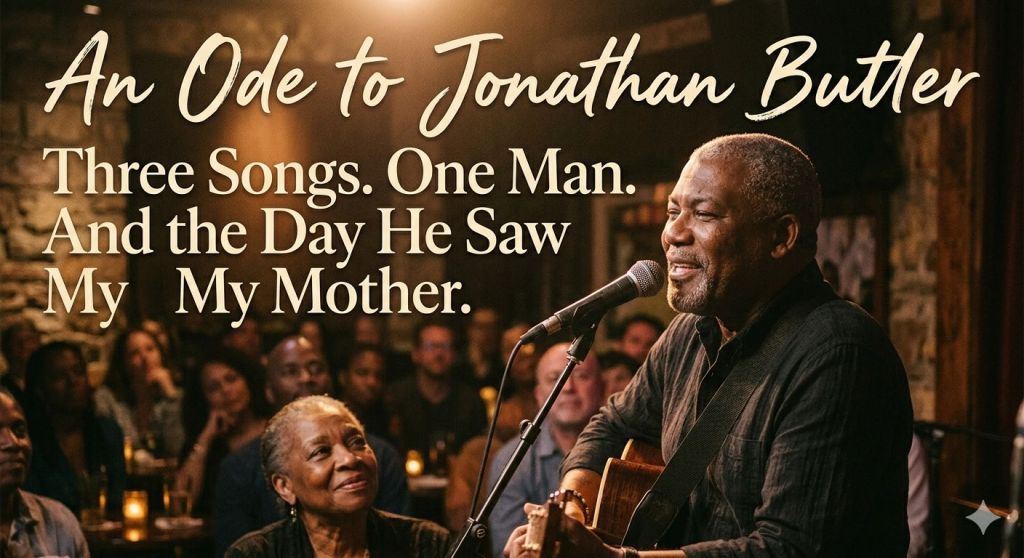
I grew up next to Athlone. Benny McCarthy’s Athlone (Hanover Park). But before Benny, always, before Benny, it was Jonathan Butler’s Athlone. Where Blacks and Coloureds are divided by a street, and sometimes by Manenberg and a railway line. The kind of divide that does not need a sign. Everybody just knows.
My dad used to play Jonathan Butler. That is how I was introduced to him, through 7th Avenue drifting out of speakers that were too big for the room they were in, in a shack house that was not big enough for the love it held.
“That one day, in all that humiliation and disrespect, JB saw her. And he gave her R500.”
The Day Jonathan Butler Saw My Mother
The second time Jonathan Butler entered my life, my mother came home from work.
She was a cleaner and a waiter at the Inn on the Square hotel, Green Market in Cape Town. A demeaning job, not because of the work itself, but because of the people she served. Apartheid had not only built walls. It had built people who did not feel the need to greet the woman clearing their plates. People who looked through her. People for whom their uThixo (Die Here) had made a human being invisible.
That day, she served Jonathan Butler.
And JB gave my mum a tip of R500 cash. In the early 1980s, R500 was not just money. Due to cumulative inflation, R500 then carries the same purchasing power as roughly R15,000 to R17,000 today. But money was not the thing. Not really.
Jonathan gave my mum the R100 and held her hand and said: Thank You.
When no one else bothered to say “I see you”, he said it.
My mum never stops talking about that day. Whenever she sees JB via telly, whenever she hears one of his songs, her heart lightens up. You will hear her say:
“I love that young man. He made me feel special after serving him a meal at the Inn On The Square, Green Market in Cape Town. Thank you Dr Jonathan Butler, you gave me a tip of R500, that made me feel special. It became a motivation for me to study further and support my Children. I respect you, thanks again. May God bless you❤️❤️❤️💐”
One day in all that humiliation and disrespect, JB saw her. JB made her feel special. JB motivated her to go back to school. That is what the money meant. Not rent. Not groceries. Sawubona. I see you. You matter. You are special.
On 19 May 2026, President Cyril Ramaphosa officially bestowed the Order of Ikhamanga in Silver upon Jonathan Butler at the National Orders Awards ceremony held at the Sefako Makgatho Presidential Guest House in Pretoria. The Order of Ikhamanga is South Africa’s highest civilian honour for excellence in arts, culture, literature, music, journalism, and sport.
The State saw Jonathan Butler last Tuesday. My mother saw him decades ago, before that was fashionable.
Song One: 7th Avenue
Released in 1988, 7th Avenue is not just a song. It is a postcard from poverty that does not want your sympathy. It is Butler growing up as the youngest of twelve children in a corrugated-iron shack in Belgravia, Athlone, a street away from where apartheid told people like him to stay.
The musical foundations of the song stretch back to 1978 and his time with Pacific Express, Cape Town’s legendary jazz-rock fusion band. But what emerged on that 1988 album is something more than music. It is memory preserved in sound. Stables and horses and community and poverty and the smell of a neighbourhood that held you even when the regime wanted you to disappear.
“Music was the glue. It was not an escape, it was a reason to stay.”
My father played this song. I did not know what it meant then. I know now. Some music is not entertainment. Some music is evidence, evidence that we were here, that we loved each other, that despite all of it, there was beauty on 7th Avenue.
Song Two: Falling in Love with Jesus
This one makes me cry. Every time. Without warning. The backstory is extraordinary. Butler had long wanted to record gospel music but resisted doing it for commercial reasons. He waited. He prayed. He waited for what he felt was a distinct, divine authorisation.
The melody that unlocked everything? He had recorded a short four-bar musical concept on his computer, decided it was rubbish, and threw it in his digital trash bin. He retrieved it. And from that discarded fragment, one of the great worship songs of our generation was born.
“In His arms I feel protected.
In His arms, never disconnected.
Falling in love with Jesus was the best thing I ever done.”
Butler grew up in apartheid South Africa as a broken young man. At nineteen, his late brother-in-law introduced him to Christianity. He credits not religion, but the pure, unconditional love of God, as the force that remade him. That distinction matters. Religion gives you rules. Love gives you a reason.
When his mother died. When a close friend died. When his wife battled cancer, he returned to this song. By the time he was 15 years old, when he was severely addicted to marijuana and “Buttons” and overcame severe drug addiction.
“In His arms he felt protected. In His arms, never disconnected.” These were not lyrics anymore.
They were a lifeline.
“UThixo does not need my perfect days. He sees the best in me. Even in my shadowy ways, uThixo ukhona.“
I understand this. On the days I am heavy and there are days I am very heavy, kuThixo I am light as a feather. Jonathan Butler taught me that through a melody he nearly threw away.
Song Three: This Is Love
This Is Love, from the same 2002 album Surrender, is the theological anchor of the three. Inspired by 1 John 4:4, the reminder that what is in us is greater than what is in the world, it blends smooth R&B and gospel in a way that should not work and absolutely does.
It is a song about spiritual transformation. About the before and after. About standing on the other side of something difficult and saying: that, that was love. Even the hard parts. Even the loss. Even the silence where an answer should have been.
When I hear this song, I see my mum’s eyes. The only eyes in the world that consistently lit up when I enter the room.
When I hear this song, I think about my mother’s hands, the same hands that cleared plates for people who did not greet her, who then received R500 from a man with the same skin tone as her, from the same street as her, who held those hands and said thank you.
That was love. That is love. Unasuprised, unperforming, unsentimental. Just a man who saw another human being and decided that mattered.
Thank You, Jonathan Butler
Three songs. One man. A lifetime of music that taught a Cape Town kid that faith is not a transaction, it is a relationship. That beauty can be grown in corrugated iron. That a four-bar melody in a trash bin can become a worship anthem for millions. That R500 and a held hand can mean more than any award ceremony.
On 19 May 2026, the Order of Ikhamanga in Silver was placed around Jonathan Butler’s neck by the President of the Republic, next to Minister Gayton McKenzie whose from Die Dal (Heidedal).
Decades earlier, my mother placed her memory of a held hand around her heart, and has not let go since.
“UThixo ukhona ngamaxesha onke. God is present in all times. Even in your shadowy ways.”
This is an ode to Jonathan Butler, for the music, and for seeing my mother that day when no one else bothered.
================
Dr. Mzamo Masito
Between Thoughts – Intellectual Musings
Where the uncomfortable questions get a seat at the table.
 Between Thoughts -Intellectual Musings
Leave a comment