On the Pain Olympics and why ranking suffering is one of the most powerful tools of oppression we have handed our own oppressors.
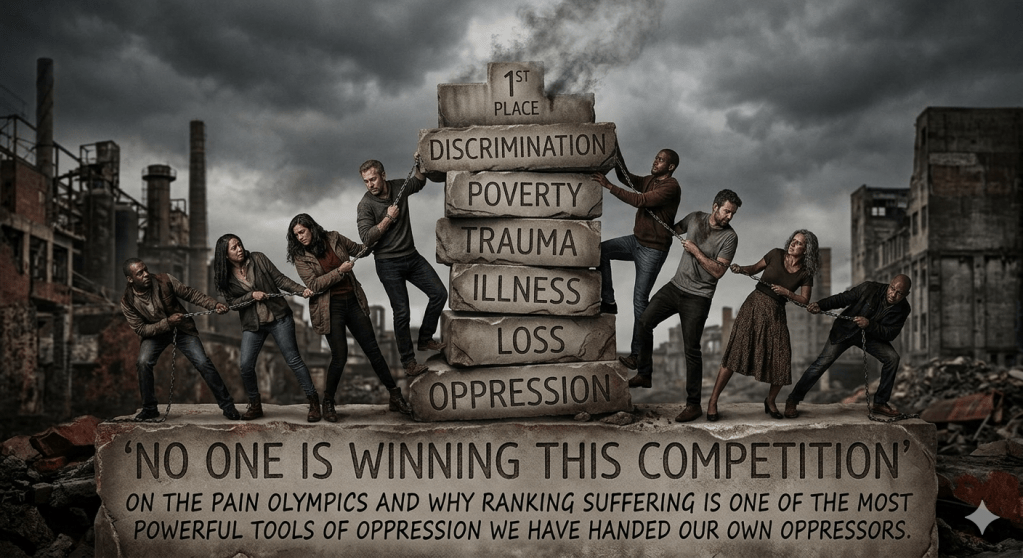
Deputy Minister Mapaseka Steve Letsike said something that should have stopped every activist, every policy-maker, and every social justice crusader in their tracks. Speaking from the Department of Women, Youth and Persons with Disabilities, an institution whose mandate centres women, youth and persons with disability and rightly so, she was unambiguous:
“We are not here to create a hierarchy of gender pain. It should not be a gender Pain Olympics. We need to stop the comparison.”
Five words did the work that five policy papers couldn’t: stop the comparison.
We don’t stop. We rank wounds. We audit grief. We cross-examine each other’s trauma for legitimacy before we grant it our sympathy. And while we are busy with that audit, the system that produced all this pain watches us, relieved.
THE COST OF THE COMPETITION
Every hour we spend ranking suffering is an hour the system that created it spends laughing at us.
The Living Room, the Boardroom, the Podium
The Pain Olympics is not a South African invention. But we have refined it into a national sport. We practise it on social media threads that start with a statistic and end with a war. We practise it at policy roundtables where coalition should be the agenda but conflict and competition runs the meeting. We practise it in NGO boardrooms where the fight is not against violence but over who owns the narrative of violence.
And we practise it in living rooms. When someone dares say, but what about men? and someone else fires back, what about women first? the conversation dies there. Nothing moves. No one is helped.
But here is what the living room argument never gets to: the queer community isn’t even on the pain podium. They are still outside the building, waiting, while the Pain Olympics Committee is in the back room testing testosterone and oestrogen levels to decide who qualifies. Their suffering doesn’t fit the binary. So it doesn’t count. And everyone, men, women, the whole debating team, goes home convinced they’ve done something important.
The format is always the same. One group surfaces a harm, real, documented, devastating. Another responds not with solidarity but with a counter-claim: our numbers are worse, our history is longer, society cares more about you. The conversation collapses into competitive suffering. The root cause stands untouched.
This is not accidental. The Pain Olympics has beneficiaries. None of them are the people in pain.
WHO ACTUALLY WINS THE PAIN OLYMPICS?
Not victims. The winners are: bureaucracies that cannot be held accountable by a fractured movement; polarising politicians who monetise identity grievance; NGOs who monetise pain with bulk of the funding going to salaries and wages, social media platforms rewarded by the algorithm every time the argument escalates; and the status quo, which survives precisely because the people who should be dismantling it are too busy arguing with each other.
You Are Not Thinking. You Are Performing.
Adam Grant, organisational psychologist and author of Think Again, argues that most of us approach contested topics in one of four modes and almost none of them are productive.
In a now-famous conversation with Brené Brown on The Curiosity Shop, Grant laid out the framework: in complex debates, we tend to show up as Preachers, Prosecutors, Politicians, or Scientists.
The Preacher defends their sacred beliefs with the fervour of a revival tent. The Prosecutor dismantles the other side’s argument as if building a court case. The Politician reads the room and tells the crowd what it wants to hear. Only the Scientist asks: what does the evidence actually say and what would it take to change my mind?
Apply that lens to the Pain Olympics and the anatomy of the problem becomes unmistakable. The GBV advocate arrives as a Preacher. The men’s rights speaker arrives as a Prosecutor. The politician arriving at the gender policy roundtable is, almost by definition, a Politician. Nobody in the room is wearing the lab coat. Nobody is genuinely curious about the full picture.
Grant’s framework is not a call for detached neutrality. He is not asking us to treat all positions as equally valid. He is asking something harder: to hold our convictions loosely enough to let evidence move them. That is not weakness. In the current discourse, it is the rarest form of courage.
“The goal is not to defend your past views. The goal is to have better future ones.” Adam Grant, Think Again
The Psychology of the Scoreboard
There is real psychology behind this. Kahneman’s work on loss aversion tells us that people feel losses more acutely than equivalent gains. When a movement perceives that another group’s recognition constitutes a loss of its own, even when no actual resource moves, the threat feels existential. It is not rational. But it is painfully human.
Layer on resource scarcity. South African government budgets for social services are genuinely limited. When advocacy groups compete for the same financial pool, solidarity becomes an economic risk. Collaboration costs you something. Division, perversely, feels strategic.
And then there is trauma validation, perhaps the most corrosive driver of all. People who have spent years fighting to have their reality acknowledged feel, viscerally, that someone else’s recognition threatens their own. It isn’t true. But when you are that tired, that invisible, nuance is a luxury you cannot afford.
Trauma doesn’t need to compete. It needs to be addressed. Those are two completely different tasks.
The Empathy Problem. We Feel When We Should Think
Psychologists distinguish between two forms of empathy, and the difference matters enormously here. Affective empathy is what most people mean when they use the word: you feel what another person feels. You absorb their pain. Your nervous system responds to their distress. It is powerful, visceral, and immediate.
Cognitive empathy is something else: the capacity to understand another person’s perspective, to model their experience intellectually, without necessarily sharing their emotional state.
The Pain Olympics runs almost entirely on affective empathy. We feel the suffering of our group. We identify with it. And because suffering is finite in our emotional imagination, we experience someone else’s claim to suffering as a withdrawal from a joint account we cannot afford to lose. Our affective response tells us: their recognition costs us something.
Cognitive empathy is what allows us to break out of that logic. It is what allows a feminist to understand, without betraying her politics, that boys in South Africa are also in crisis. It is what allows a men’s advocate to understand, without abandoning his concern, that women bear a statistically catastrophic burden of violence. These are not contradictions. They are facts that cognitive empathy can hold simultaneously, because cognitive empathy is not zero-sum. Understanding is not a finite resource.
The transition from affective to cognitive empathy is not a retreat from caring. It is what caring looks like when it matures into strategy.
THE EMPATHY DISTINCTION
Affective empathy: I feel what you feel. Cognitive empathy: I understand what you experience, even if it differs from what I experience. The Pain Olympics activates the first. Coalition requires the second.
The Mental Models We Are Trapped In
Charlie Munger, the architect of Berkshire Hathaway’s investment philosophy, argued that the biggest cause of systematic error is not bad data but bad mental models, the invisible frameworks through which we interpret data. When the model is wrong, more data doesn’t help. It just confirms the wrong conclusion faster.
The Pain Olympics is, at its core, a mental model problem. The operating model is scarcity: compassion is a finite resource, recognition is a zero-sum game, helping one group costs another group something. Every argument in the competition flows from that assumption. And that assumption is false.
The alternative model, the one Grant’s Think Again is asking us to adopt, is abundance thinking applied to human dignity. It holds that recognising the suffering of men does not diminish the recognised suffering of women. That extending policy frameworks to include queer South Africans does not subtract from frameworks protecting heterosexual women. That the human capacity for solidarity is not a budget that runs out.
This is not idealism. It is a more accurate model. The evidence from coalition advocacy, from every social movement that has achieved durable systemic change, is that it was built on cognitive empathy across difference, not on competitive suffering. Suffragists who allied across class. Civil rights organisers who built coalitions across faith traditions. HIV activists who held together across the stigma lines of their era.
The Pain Olympics is not just morally wrong. It is strategically catastrophic, because it locks participants inside a mental model that guarantees failure.
The problem is not that we lack information. The problem is that we are processing it through a framework that was always going to produce the wrong answer.
What It Destroys
The damage is not abstract. Fragmented movements cannot hold the line against systemic failures. Policy blind spots open and widen and into those gaps fall the people who don’t fit cleanly into any hierarchy: queer individuals navigating a framework that wasn’t built for them, disabled youth whose needs are afterthoughts in both gender camps, men in crisis who are told their crisis is a distraction from the real one.
Compassion fatigue sets in with the public. You have seen it, the exhaustion that settles over feeds perpetually ablaze with whose suffering matters more. People switch off. Donations dry up. Political will evaporates. And the people who most needed the attention lose it, not because the public is cruel, but because the noise drove them away.
Then there is secondary victimisation: the person whose pain is ruled insufficient by the court of public opinion. The man told his crisis doesn’t count because someone else’s is statistically worse. The woman whose trauma is dismissed because it doesn’t match the dominant narrative of the week. The gender-nonconforming person whose pain isn’t even granted a category. These people don’t just lose the argument. They lose the will to seek help at all.
What the Deputy Minister Is Actually Asking For
She is not asking us to pretend that harms are equal in scale, frequency, or historic cause. They are not. Gender-based violence against women in South Africa is among the most severe documented anywhere on earth. That fact is not up for revision.
What she is asking is that acknowledging one group’s pain does not require erasing another’s. That proportional recognition is not zero-sum. That a department mandated to serve women, youth, and persons with disabilities can hold that mandate without constructing a wall that other forms of suffering cannot penetrate.
This is intersectionality as policy logic, not as academic posturing. Evaluate harm through the actual complexity of human life, gender, race, class, age, sexuality, disability, geography, not to flatten those differences, but to understand them precisely enough to respond to each one. The queer community does not need to choose between the women’s camp and the men’s camp. They need a framework capacious enough to see them.
THE ALTERNATIVE TO THE PAIN OLYMPICS
Coalition advocacy. Proportional resource allocation based on verified need data. Policy platforms where diverse groups unite around shared goals, fixing the criminal justice system, expanding mental health access, protecting the family, without requiring any group to minimise its own experience in order to participate.
A Final Thought
There is a reason oppressive systems have always used division as a tool. A fractured movement cannot hold the line. A competition among the marginalised serves only those who benefit from the marginalisation itself.
Adam Grant asks us to think again, to hold our mental models loosely, update them when evidence demands it, and build arguments from curiosity rather than conviction. Deputy Minister Letsike asks us to stop ranking pain. The psychologists studying empathy ask us to move from the gut reaction to the considered understanding.
These are three versions of the same request. Put down the scoreboard. Pick up the map. Find the people who are still outside the building and extend the framework until it is large enough to hold them.
No one wins the Pain Olympics. And the longer we play, the more we all lose, including the people we were supposedly competing for.
============
Dr. Mzamo Masito
Between Thoughts — Intellectual Musings
Where the uncomfortable questions get a seat at the table.
 Between Thoughts -Intellectual Musings
Leave a comment