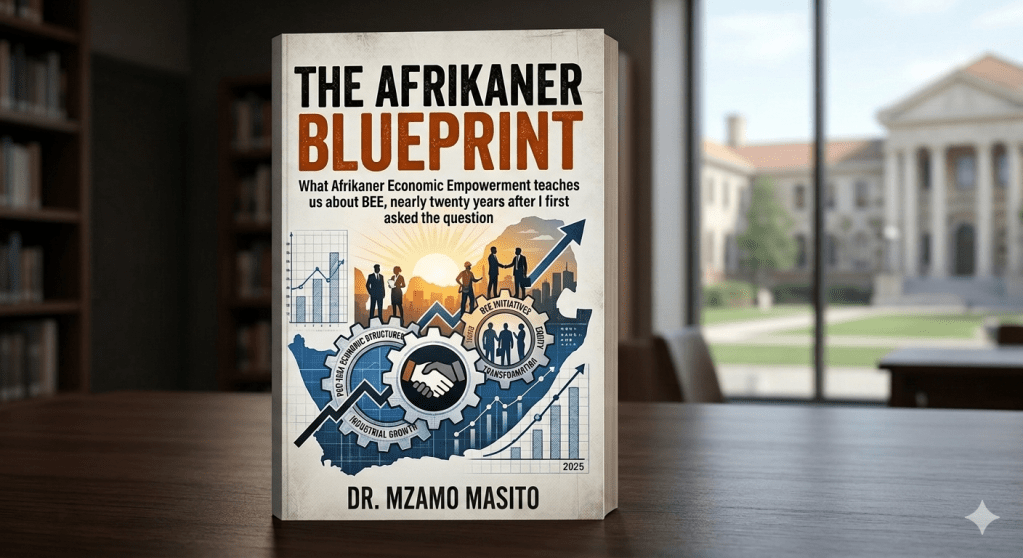
What Afrikaner Economic Empowerment (AEE) teaches us about BEE, nearly twenty years after I first asked the question.
📝 A Note on This Essay
In 2007, I submitted a Masters research paper at the Gordon Institute of Business Science (GIBS), University of Pretoria, titled Afrikaner Economic Empowerment (1890–1990) and Lessons for Broad-Based Black Economic Empowerment. This essay is a reflection on that research, what it argued, what has happened since, and what, frustratingly, still stands.
Marx said the tradition of all the dead generations weighs like a nightmare on the brain of the living. I opened my Masters paper with that quote in 2007, and I have never stopped thinking about whether we, as a country, have done the work of waking up.
The research question I asked was simple and, in some quarters, controversial: the Afrikaners pulled off one of the most effective group economic empowerment programmes in modern history. They moved from a dispossessed, largely illiterate, landless people after the Anglo-Boer War to controlling the commanding heights of the South African economy within a generation. What did they actually do? And what can Black South Africans learn from it?
The discomfort with that question in 2007 was real. Some heard it as legitimising apartheid. Some heard it as suggesting Black people were the problem and not doing enough. Some heard the ANC government from 1994 to 2006 did nothing good for Blacks. Some heard, after 1994 we cannot blame Apartheid. Some heard Botha and Verword were right to say that Blacks cannot govern.. Neither was the argument.
The argument was simpler and more uncomfortable than both: we are sitting on a fully documented case study of successful group economic empowerment, built in this country, in this economy, in this political context and we have largely refused to engage with it seriously because the politics of acknowledgement get in the way.
Almost twenty years later, the question is still live. And the Gini coefficient has barely moved.
“South Africa inherited the most successful grassroots economic empowerment programme ever executed on this continent. It was called apartheid. The question is what we learned from it.”
What the Research Actually Found
I interviewed fourteen experts, eight Afrikaner Economic Empowerment (AEE) scholars and six BEE practitioners. Combined experience across the sample exceeded 250 years. The names in that room included members of the Boederbond, people who had designed BEE policy, people who had been on the receiving end of apartheid, and Afrikaner academics who had spent their careers studying the volk’s ascent. The conversations were charged. Two respondents literally got up and walked the room.
The core finding was this: the structural variables that drove Afrikaner empowerment and the elements currently measured on the BBBEE Generic Scorecard were remarkably similar. Ownership. Management control. Skills development. Procurement. Enterprise development. The Afrikaners did all of these things. They just did them for ten percent of the population, and they did them on the broken backs of the other ninety.
But the deeper finding, the one that my AEE respondents and BEE respondents agreed on across racial lines, was about what BEE was missing that AEE had in abundance. Two things specifically: a savings culture, and what the experts called the soft side of empowerment.
💡 The Soft Side
The Afrikaner empowerment programme was not just about money and policy. It was a comprehensive cultural, psychological, and identity project. The Afrikaans language, the Dutch Reformed Church, the Nederduitse Gereformeerde Kerk (NGK), the Broederbond, the Helpmekaar, the universities at Stellenbosch and Pretoria, all of these institutions were simultaneously building economic instruments AND rebuilding Afrikaner self-concept. They created visible symbols: the Voortrekker Monument, the Afrikaans language in commerce and education, cultural pride as economic fuel. Afrikaans is widely considered one of the youngest and most highly developed standardised languages in the world.
As one of my BEE respondents asked: “how do you empower confused people who suffer from an inferiority complex, do not know they are human beings, do not trust each other, and still think English is better and the white man is superior?” That question has not been answered in the BEE architecture. It was not even asked.
The AEE did not happen in a vacuum. The experts were clear on this, and I want to be equally clear: Afrikaner economic empowerment was achieved through the deliberate, systematic, and violent economic exclusion of Black people. The Land Act of 1913. The Colour Bar Act. The Pass Laws. Job reservation. Bantu education. These were not incidental features, they were the engine. The volk could not have risen at the speed it did without first ensuring that the majority were consigned to cheap, unfree labour. You cannot draw a lesson from AEE and pretend that foundation does not exist. It does. And it is precisely why the comparison matters: the people who built the blueprint did so on a foundation of deliberate harm. BEE is attempting to reverse that without access to the same instruments of state force, without a closed economy shielded by sanctions, and without the ability to exclude anyone.
That is the harder problem. And it is the problem the 2007 research tried to name.
Then and Now: The AEE Blueprint vs. the BEE Reality Dimension. AEE (1890–1990) & BEE/BBBEE (1994–present)
Driver.
AEE – Defeat in Anglo-Boer War, British exclusion, poverty, drought, fear of extinction.
BEE– Apartheid legacy, racial economic exclusion, inequality, Gini coefficient over 0.63
Intent.
AEE– Survival of the volk; ethnic empowerment at all costs; equality with (and eventually dominance over) the British.
BEE– Redress apartheid imbalances; broad-based economic inclusion; reduce racial inequality
State Role.
AEE– NP used state-owned enterprises, procurement, job reservation, legislation, and political power to drive Afrikaner advancement. Partial.
BEE– Persuasive first phase, regulatory second phase. BEE largely left to private sector compliance
Cultural/Soft Side.
AEE– Comprehensive: Broederbond, DRC, Afrikaans language, universities, symbols of pride, savings culture, volkskapitalisme
BEE– Absent. BBBEE scorecard measures ownership and management but not identity, culture, savings, or self-belief
Key Instruments.
AEE– Parastatals (Eskom, Iscor, Sasol, SAR), Sanlam, Volkskas, co-operatives, discriminatory legislation
BEE – Ownership deals, employment equity, skills levies, sector charters, procurement targets
Savings Culture.
AEE- Central. RDB created savings culture from the start. Volkskas, Sanlam built from Afrikaner pooled capital
BEE – Not measured. No savings culture element in BBBEE scorecard. Deal-led, debt-financed empowerment dominant
Measurement of Progress
AEE – Per capita income vs. English, class mobility, political power, private sector ownership, educational attainment
BEE – great progress first 15 years (1994 – 2008). BBBEE unenforceable compliance scorecard, black ownership %, senior management representation, skills spend
Key Flaw
AEE– Built on the violent exclusion and cheap labour of the Black majority. Morally catastrophic. Not replicable ethically.
BEE – Too narrow beneficiary base, elite capture, comrades loyalty and appointments over competence and character, “clever blacks” were set aside or they stepped aside, fronting (whites involved), the employment equity commission report remains red, no consequence management on non-compliance, compliance without transformation, not broad-based enough.
Eighteen Years Later: What Has Changed
When I submitted that paper in November 2007, the BBBEE Codes of Good Practice had only just been gazetted, February 2007. The DTI baseline study at the time showed that over 80 percent of companies were non-compliant across every scorecard element. Ownership, management control, skills development, procurement, enterprise development: all in the red. The system that was supposed to deliver broad-based economic transformation had, in its first decade, primarily produced a small class of politically connected multimillionaires now billionaires. The DTI’s own data showed that 72 percent of BEE deals worth 80 billion rand involved just six empowerment companies, almost all linked to politics and politicians.
What has happened since?
Some things have moved. The black middle class has grown substantially. The UCT Unilever Institute’s Black Diamond studies showed real class mobility: from 2 million in 2005 to numbers closer to 5 million today, with significantly expanded buying power. Senior management representation has improved, though it remains deeply skewed. The 2014 Codes of Good Practice revised the scorecard to prioritise skills development, enterprise and supplier development, and broad-based ownership. Fronting regulations were tightened. The Employment Equity Amendment Act, effective January 2025, now sets sector-specific numerical targets with genuine enforcement mechanisms.
📊 The Numbers in 2025
South Africa’s Gini coefficient stands at approximately 0.63 on income, and at 0.90 to 0.95 on wealth, meaning wealth inequality is even more extreme than income inequality. Research published in 2024 found that the typical Black household owns 5 percent of the wealth held by the typical White household. The top 10 percent of the population captures 70 percent of all pre-tax income. Racial inequality in pre-tax income in 2019 was at approximately the same level as 1993. Thirty years of democracy. The Gini barely moved.
What has not changed is the structural critique I made in 2007. BEE still lacks a savings culture imperative. There is still no soft side to the scorecard, no measurement of identity, confidence, psychological self-determination, or the kind of cultural pride that the Broederbond built into Afrikaner economic life as a deliberate instrument of advancement. The beneficiary base, despite BBBEE’s ‘broad-based’ ambition, still skews heavily toward an educated urban elite. The people at the bottom of the pyramid, the rural poor, the informally employed, the generation that left school without finishing, have been largely untouched by thirty years of transformation policy.
The ANC government used state-owned enterprises as a vehicle for black middle-class creation, exactly as the National Party used them for Afrikaner advancement. But where the NP used Eskom and Iscor to train, promote, and eventually spin off private Afrikaner businesses, the post-1994 SOEs were captured rather than developed. Eskom is not a springboard for black entrepreneurship. It became a liability. The parastatal model that drove AEE at its best became the corruption model that undermined BBBEE at its worst.
“The Afrikaners understood that empowerment went beyond money. They built monuments. They built universities. They made Afrikaans the language of commerce. They rebuilt the identity of a broken people into a proud one. BEE built a scorecard.”
The Volk Never Stopped Building
While BEE kr BBBEE has been debated, taken to Pretoria High Court by four white law firms, reformed, captured, and critiqued. Afrikaner civil society has been quietly executing something that looks, structurally, exactly like a continuation of AEE, without ‘apartheid’ (even though some missed the ‘good old days’), without state force, and with remarkable discipline.
The Solidarity Movement, operating under the explicit philosophy of Ons sal self (we will build it ourselves), has built a parallel ecosystem: Akademia as a private Afrikaans university, Sol-Tech as a vocational college, Solidarity as a trade union and professional network, AfriForum as a legal and civic watchdog with hundreds of thousands of members, and Helping Hand as a social welfare arm funding bursaries for poor Afrikaners. This is not nostalgia. This is institutional architecture, the same model the Broederbond and the DRC used in the 1930s and 1940s, rebuilt for a democratic context.
Sakeliga represents Afrikaner business interests with a free-enterprise philosophy that deliberately operates outside state dependency. Orania is a working model of economic and cultural self-determination. The FAK continues cultural preservation. The Freedom Front Plus holds political space in Parliament under Section 235 of the Constitution, the self-determination clause.
The point for the blog is not that these organisations are wrong to exist.
The point is the contrast: one community looked at the post-1994 landscape and built institutions.
The other community negotiated a scorecard. One is a movement. The other is a compliance framework, espescially the last 15 years (year 2000 to now).
My 2007 research found that the soft side, the cultural institutions, the savings architecture, the collective identity project, was missing from BEE. Nearly two decades later, the Solidarity Movement is proof that it works. And BEE still does not have an equivalent.
The section should also note the divergence within Afrikaner civil society, Afrikaners vir Suid-Afrika explicitly rejects ethnic nationalism and advocates for integration into the broader constitutional democracy, because intellectual honesty requires acknowledging that this is not a monolithic community, and that not all Afrikaners endorse the separatist model and not all Afrikaners want to be USA refugees under the blatant lie of “white genocide“.
The Lessons That Still Stand
I will restate the key findings from the 2007 paper, because they remain as relevant now as they were then.
The soft side is not optional: The AEE’s most durable achievement was not Sanlam or Sasol. It was the rebuilding of Afrikaner psychological self-concept. A people who had been humiliated, dispossessed, and told they were inferior rebuilt their identity before they rebuilt their bank accounts. The savings culture, the language pride, the cultural institutions, all of this was the foundation on which economic empowerment was built. BEE policy does not measure any of this. It does not even attempt to. Until a transformation programme takes seriously the question of what it feels like to be Black in South Africa’s economy, the inferiority complex, the dependency syndrome, the tendency to distrust each other’s wealth, the scorecard will remain a compliance exercise.
A savings culture is structural, not aspirational: The RDB, Volkskas, Sanlam, the co-operatives, these were not appeals to Afrikaners to please save. They were engineered institutions that made saving the default. The money pooled by the volk became the capital base for Afrikaner business expansion. No equivalent institution has been built in the BEE era. The deal-led model of empowerment, where politically connected individuals borrow the full value of an equity stake and then require 30 percent annual returns to service the debt, is not a savings culture. It is a debt culture dressed in empowerment language.
State power is the accelerant: The Afrikaners understood that political power without economic policy is theatre. The moment the NP won in 1948, the state became a developmental instrument for the volk. Job reservation. Procurement preferences. Parastatal employment. The state was not neutral, it was directional. Post-1994, the ANC government deployed state power through BEE legislation, but the execution was too often captured by elite interests rather than directed toward the bottom of the pyramid. State power works when it is genuinely developmental. When it is captured, it accelerates inequality rather than reducing it.
The intent must be collective, not individual: Volkskapitalisme was explicitly about the group. The volk. Every Afrikaner. When the Afrikaner middle class began prioritising individual profit over collective advancement, which the Broederbond itself noted with alarm by 1975, the broader empowerment project started to fragment. BEE, as designed and as implemented, has been largely an individual project. It asks: who gets this deal? Not: how does this deal lift the community?
The context is not the same, but the principles are: Every expert I interviewed in 2007 reminded me that AEE happened in a closed economy, behind sanctions, in conditions that are not replicable. BEE operates in a globalised, competitive, open market. That is true. It is also sometimes used as an excuse for the absence of ambition. The principles, pooled capital, cultural pride, state as developmental instrument, broad beneficiary base, skills as the foundation of everything, are not time-limited. They translate.
The Question We Still Have Not Asked
In 2007, one of my BEE respondents became visibly angry during our interview. Not at me. At the architecture of BEE. He said: “BEE exists to enable blacks as a collective to catch up with whites and earn their respect. But the purpose of BEE has mutated into a project to advance the 1% if not 0.01% black elite.”
That mutation is now institutionalised. The Government of National Unity, which includes the DA, has created a new political context for BEE in 2025. Deputy President Paul Mashatile reaffirmed in November 2025 that BEE remains a key policy of the state and does not need to be repealed, but acknowledged it needs review. The DA has long argued for a needs-based rather than race-based empowerment model. The ANC has resisted, correctly pointing out that needs and race are not yet separable in South Africa because apartheid made them structurally synonymous.
This debate is important. But it is not the deepest question. The deepest question is the one my 2007 respondent was asking. Even if we fix the compliance architecture, even if we broaden the beneficiary base, even if we address fronting and elite capture, what do we do about the person at the bottom who does not believe the economy is for them? Who has internalised, after generations of exclusion, that wealth is for other people? That education is uncertain? That the system will find a way to keep them out?
The Afrikaners answered that question with a monument and a language and a church and a savings scheme and forty years of relentless institutional investment in Afrikaner self-belief. The answer was not subtle. It was total. It was cultural. It was generational.
We have not yet found our equivalent answer. We have found deal structures and scorecards and compliance percentages. These are necessary. They are not sufficient.
“You cannot build a prosperous people on a broken self-concept. The Afrikaners knew this. We have not yet acted as if we know it too.”
I was a young MBA student in 2007. I grew up in Gugulethu, eXesi, Middledrift, Valhalla Park, and Khayelitsha. I had watched the post-1994 promise arrive and, for too many people around me, pass. I wrote that paper because I believed and still believe that learning from history, including the history that was built on your own exclusion, is not collaboration. It is intelligence.
The Afrikaners built a blueprint. It was morally caustic and catastrophic in its method. But in its structure, its insistence on cultural identity, pooled capital, state development, skills as the foundation, and the collective over the individual, it contained lessons that a serious empowerment programme cannot afford to ignore.
South Africa is now thirty years into democracy and remains the most unequal country in the world. The typical Black household owns five cents for every rand of white household wealth. If that number does not move us to a different quality of urgency, I do not know what will.
We do not need to replicate apartheid to learn from AEE. We need to be honest enough to read the blueprint, extract what works, discard what was Luciferian, criminal, and build something that finally delivers on the promise of 1994.
The paper is in the UP repository. It has been there since 2007. Anyone can read it. The question is whether, nearly two decades later, we are ready to seriously learn and do better.
===================
Dr. Mzamo Masito
Between Thoughts — Intellectual Musings
Where the uncomfortable questions get a seat at the table..
📚 Source Note
This essay draws from my original MBA research: Masito, M. (2007). Afrikaner Economic Empowerment (1890–1990) and Lessons for Black Economic Empowerment. GIBS, University of Pretoria. Available at the UP Institutional Repository. Updated with current data from: World Inequality Database (2024); Branson et al., British Journal of Sociology (2024); Tandfonline Racial Wealth Gap study (2024); DTIC BBBEE Commission reports; Statistics South Africa.
 Between Thoughts -Intellectual Musings
Leave a comment