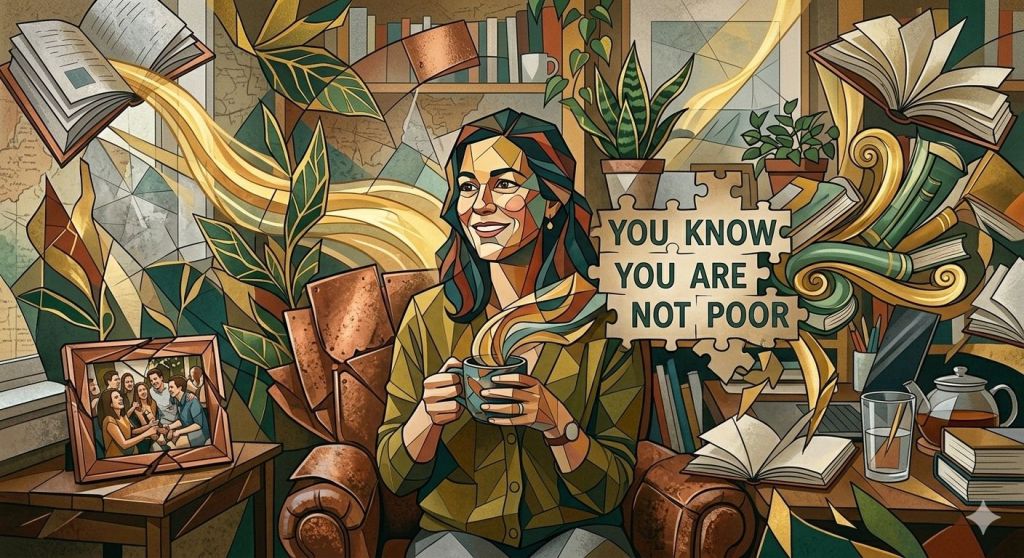
This is not a guilt trip. It is a mirror.
The following is a list of things that, if they apply to you, are quiet confirmations that you are not poor. That is good news. The problem is not that you have it good. The problem is when having it good makes you forget that the majority of the planet does not. When your comfort becomes your whole reference point for what is normal, you start mistaking luxury for logic, and lifestyle for common sense.
Read this lightly. But read it honestly.
On Hunger
You Know You Are Not Poor When You Fast
You listen to podcasts about intermittent fasting. The 16:8 method. OMAD. The metabolic switch. You plan your eating windows with the precision of a surgeon.
“Poverty is most marked by the absence of choice and capabilities. Hunger is present both in fasting and starvation. But fasting is elective, starvation is forced. Choice means fasting does not connote poverty.” — Amartya Sen (via Yaw)
Poverty is daily fasting. There is no 16:8. There is just “8”, eight hours of eating if you are lucky. Poverty does not need a method. It already has one. It is called no money.
The poor know NOMAD. Not One Meal A Day. No Meal A Day. Not mad. Just hungry.
The Reality: The poor do not fast by choice. They skip meals because there is nothing to eat.
The Contrast: You compress your eating window by choice, track your macros, and feel accomplished. Poverty has been doing intermittent fasting for generations. It just never got the podcast.
You Know You Are Not Poor
When You Are Lactose Intolerant
You cannot handle ordinary milk. You call ahead to restaurants. You carry your own oat milk. You demand almond, oat, or coconut alternatives with the conviction of someone whose life depends on it.
Poverty knocks out intolerance quickly. If the only thing available is what supposedly makes you sick, you adapt. Darwin was right. Adapt or die. The body learns. The immune system adjusts. The psychological luxury of avoidance evaporates.
Once you start requesting donkey milk or Nakazawa milk, the Japanese luxury milk harvested from cows milked once a week at dawn, fetching prices that would feed a township family for a month, you have left the conversation entirely. You are playing Monopoly money while the rest of the world plays for survival.
Nakazawa Milk, A Japanese luxury milk sourced from cows milked once weekly at dawn. High in melatonin. Marketed as a stress remedy. Priced for people whose stress is a lifestyle.
The Reality: The poor drink what is available. They honour the cow, the goat, the sheep. That milk goes a long way to ensure no one dies that day.
The Contrast: You negotiate plant-based alternatives while the poor negotiate whether today is a milk day at all.
On Mobility
You Know You Are Not Poor When You Do Not Own a Shoemaker’s Number
You have never needed a cobbler. Your shoes are not built to be repaired. They are built to be replaced. You drive to the gym to walk on a treadmill, adding to the carbon footprint while across the world a woman walks six hours a day for water, food, or work.
Terry Pratchett once described it perfectly through the character of Sam Vimes. A rich man buys quality boots for fifty dollars. They last decades, can be repaired, maintained. A poor man can only afford ten-dollar boots that fall apart within a year. Over a decade, the poor man spends more on inferior boots than the rich man spent on one excellent pair. This is the economics of poverty: it costs more to be poor.
It costs more to be poor. That is not a paradox. It is the architecture of the system.
The Reality: The poor walk for survival. Their shoes carry real distance. They know every cobbler in the neighbourhood by name.
The Contrast: You drive to the gym to simulate the walking the poor do just to reach a bus stop.
On Technology and Disconnection
You Know You Are Not Poor When You Pay for a Digital Detox
You willingly hand over your smartphone at a mountain retreat to “reconnect with nature.” You pay a premium for the privilege of being unreachable. You call it healing.
The Reality: The poor do not need a digital detox. They experience involuntary disconnection daily, data costs, power cuts, broken screens, no devices.
The Contrast: Your curated silence is their structural exclusion. You pay to disconnect. They pay, dearly, to connect.
On Fashion and Aesthetics
You Know You Are Not Poor When You Buy Pre-Ripped Jeans
You spend extra money on jeans and tees that arrive already torn, faded, and frayed. The factory has pre-distressed them for you. You call it style.
The Reality: Poverty does not buy fashionably ripped clothes. The poor wear torn clothes because they cannot replace them.
The Contrast: They use needles, thread, and patches to hide the wear. You pay extra to flaunt it. The same rip. Opposite meanings.
You Know You Are Not Poor
When You Thrift for the Aesthetic
You spend weekends digging through secondhand stores for retro finds. You wear your bargain purchases as a badge of sustainable, counter-cultural cool.
The Reality: The poor buy secondhand because it is the only financially viable option.
The Contrast: For them it is thrift. For you it is a curated lifestyle statement. Same rack. Completely different reasons to be there.
You Know You Are Not Poor
When Your Minimalism Cost a Fortune
Your bare concrete walls, empty shelves, and carefully cleared rooms are a design philosophy. You spent thousands on hidden storage to achieve the clean look. You call it Zen.
The Reality: A poor person’s bare room means they cannot afford furniture. Their empty walls are absence, not aesthetic.
The Contrast: You paid to remove things. They cannot afford to add any. The same empty room. Worlds apart.
On Rest
You Know You Are Not Poor
When You Have a Sleep Coach
You hire a specialist to optimise your REM cycles. You buy a smart ring, blackout curtains, white noise machines, and a mattress that cost more than a year’s rent in most of the world.
The Reality: Poverty sleeps whenever and wherever it is physically possible.
The Contrast: The poor sleep through metal roofs in rainstorms, crowded rooms, and the anxiety of tomorrow’s survival. They do not track sleep. They survive exhaustion.
You Know You Are Not Poor
When You Voluntarily Sit in an Ice Bath
You pay thousands for a cold-plunge tub. You time yourself. You post about the discipline it takes. You call it biohacking.
The Reality: The poor endure cold showers and freezing water because they cannot afford electricity or a functioning water heater.
The Contrast: Your test of mental resilience is their daily shivering reality. You do it by choice before a warm towel. They do it because there is no alternative.
On Food
You Know You Are Not Poor
When You Subscribe to an Ugly Produce Box
You pay for a subscription that delivers misshapen carrots and bruised apples to your door. You do it to fight food waste and feel environmentally conscious. You Instagram the wonky vegetables.
The Reality: The poor have always eaten the bruised, the small, and the misshapen, because it is what is cheap or left over.
The Contrast: For them, it is thrift. For you, it is a curated lifestyle choice. Same vegetables. Completely different relationship to scarcity.
You Know You Are Not Poor
When You Make Sourdough as a Hobby
You nurture wild yeast cultures like pets. You buy specialised jars, precision scales, and imported organic flour. You spend three days on a single loaf. You post the crumb structure.
The Reality: The poor have fermented and preserved food for centuries, out of absolute necessity, to prevent rot and survive seasons with no refrigeration.
The Contrast: For them, preservation is a battle against spoilage. For you, it is a culinary craft project and weekend personality.
On Travel and Recreation
You Know You Are Not Poor When You Go Camping & Hiking for Fun
You invest in lightweight carbon-fibre tents, thermal sleeping bags, and portable titanium stoves. You drive to a national park to sleep on the ground and call it roughing it.
The Reality: The poor experience forced displacement, homelessness, and migration. Sleeping unsheltered is a vulnerability they try to escape.
The Contrast: You view it as a refreshing weekend reset. Their exposure is your recreation.
You Know You Are Not Poor
When You Choose Slow Travel
You book multi-day train journeys through remote landscapes specifically because they are inefficient. You seek out eco-lodges that are deliberately hard to reach. You pay premium for the “authenticity” of unhurried life.
The Reality: The poor endure gruelling, slow, unreliable transit because fast infrastructure is financially out of reach.
The Contrast: You romanticise their structural trap as an experiential luxury. The same long journey. One chosen. One imposed.
On Children and Parenting
You Know You Are Not Poor
When You Choose Screen-Free Parenting
You pay high Waldorf or Montessori tuition to keep screens out of your child’s life. You speak of building grit, imagination, and a connection to the physical world. You let your children roam freely as a philosophical statement.
The Reality: The poor leave children unsupervised because they cannot afford childcare. They lack tablets and internet access due to cost, not principle.
The Contrast: Your intentional digital-free childhood is a romanticised version of their structural deprivation. You chose it. They have no alternative.
You Know You Are Not Poor
When You Feed Your Dog Gourmet Raw Food & its on Insulin and it has Medical Aid.
Human-grade organic minced beef. Green-lipped mussels. Vitamin supplements. Medical Aid. Insulin resisitant dog. You know your dog’s macros.
The Reality: The poor feed their pets whatever table scraps remain, balancing the animal’s survival with their own food insecurity.
The Contrast: Your dog eats a diet more nutritionally optimised than what sits on millions of human family tables tonight. Let that land.
On Work and Hustle
You Know You Are Not Poor When You Romanticise the Grind
You wear your 80-hour week like a badge of honour. You post motivational content about “loving the grind.” You drink specialised nootropic energy drinks and treat overwork as an identity.
The Reality: The poor work multiple low-wage shifts just to keep the lights on. For them, relentless work is a crushing economic necessity that breaks the body and shortens life.
The Contrast: For you, it is a self-imposed game to maximise career optimisation. You chose the grind. They are stuck in it.
The Point
None of this is to shame you for what you have. It is to ask whether what you have has made you incapable of seeing what others do not.
The truly dangerous thing about material privilege is not excess. It is the way excess quietly rewires your reference point for normal. When your comfort becomes your baseline, struggle looks like weakness rather than what it actually is: a structural condition that the vast majority of human beings are navigating every single day.
Fasting becomes wellness.
Cold becomes therapy.
Ripped jeans become fashion.
Slow travel becomes luxury.
Thrifting becomes identity.
And the people for whom these were never choices, never lifestyle statements, are invisible.
Here is the invitation this piece extends:
Be grateful. Not performatively. Not with a gratitude journal that you also paid for. Genuinely. In a way that changes what you do.
Be grateful in a way that loosens your grip. That makes you give more, complain less, and extend more grace to people whose lives are harder than yours in ways you will never fully see.
Because here is what the poor understand that the comfortable often forget:
Choice is the original luxury.
Everything else follows from it.
You have it.
Use it for more than yourself.
===================
Between Thoughts — Intellectual Musings
Dr. Mzamo Masito · mzamomasito.com
Where the uncomfortable questions get a seat at the table.
 Between Thoughts -Intellectual Musings
Leave a comment