On the sudden death of a therapist, and the strange grief of losing the one who held your secrets
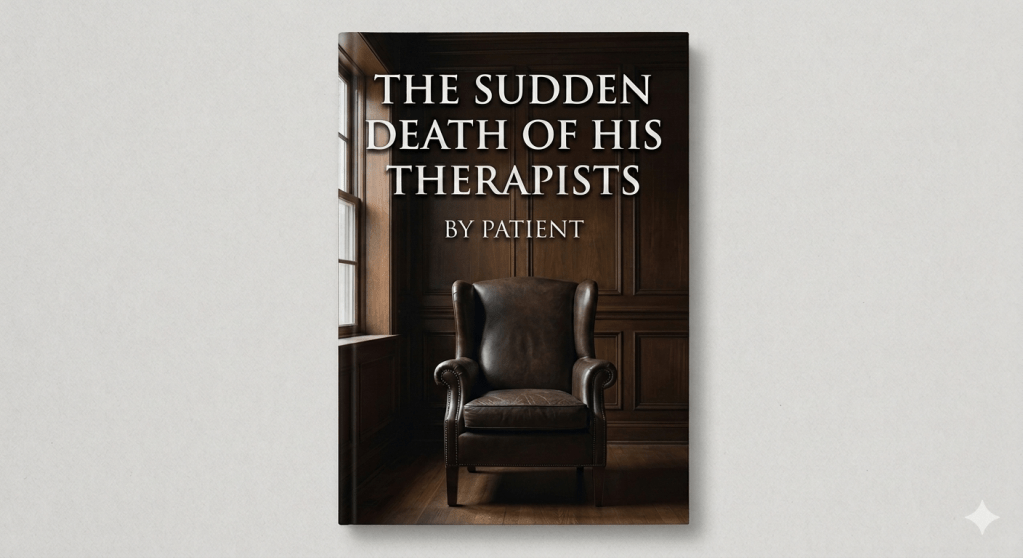
I. The Matrix Glitch
A friend called me in pain. His voice was fractured. He asked to meet urgently, so I went straight to his place. When I arrived, he was sobbing.
For men, seeing another man cry still triggers a glitch in the matrix. It takes a moment to get the brain, the heart and the soul in sync, to find the words and the actions that can match the weight of another man’s tears. We are socialised from boyhood to be strangers to our own internal landscape. We are taught to bypass sadness, shame, joy, fear. Alexithymia is real and quiet: words without the emotions attached to them.
I have learned, over time, not to rush in with solutions. I have learned to sit in discomfort, to offer a hug, to simply be present. I have learned not to speak first, to find a strange solace in shared silence.
After a stretch of time that felt as long and alien as a moon landing, he looked up and told me.
His therapist had died. He did not wake up.
My friend only found out because he drove to his weekly session, walked down the familiar corridor, and found the office door locked. He asked at reception. The elderly woman who cleans the offices and brings the tea was standing nearby. She looked at him with heavy, maternal eyes.
“Oh, mkhwenyana. Ushonile. Ngxese mntanam. Akavukanga.”
Oh, son-in-law. He has passed. My deepest sympathies, my child. He did not wake up.
He stood there, mute. Uninvited tears came tumbling down, the regret of words never said, of confessions never made. He had never told the man that he appreciated him beyond the hourly fee.
The old woman did what maternal grandmothers do everywhere. She pulled out a handkerchief, wiped his tears, and hugged him for an eternity, as though she had personally invented love.
“Kuzolunga,” she whispered. It will be okay. Then, unexpectedly, she added: “You might need to be your own therapist until you find another friend whose vault never opens to spill your secrets. A friend you pay, but gladly pay. You might have to be your own therapist until you find a replacement.”
I went home that evening carrying a low, borrowed weight, as if it were my own therapist who had died. The proxy grief was intense enough that it threatened to harden from a passing feeling into a settled mood. I could not sleep. And my mind began to circle one unsettling question: why had I assumed, without ever examining it, that therapists live forever?
II. The Data of the Dark
The researcher in me woke in the middle of the night and went hunting for statistics on people who die in their sleep, as if a number could digest the shock. The data is sobering.
HOW THE NIGHT TAKES US
An estimated 1 in 8 people (roughly 12.5%) die during the night. Globally, that is 25,000 to 45,000 people every day who simply do not wake up.
Nocturnal cardiac arrest: sudden cardiac arrest causes about 90% of unexpected deaths during sleep. Between 22% and 30% of all sudden cardiac deaths occur overnight, between 10 p.m. and 6 a.m.
Sleep apnoea: untreated severe obstructive sleep apnoea lowers overnight oxygen and raises the risk of premature cardiovascular death by 46%.
Stroke: roughly 25% of all strokes happen while a person is asleep.
“Dead-in-bed” syndrome: in people under 40 with Type 1 diabetes, severe nighttime hypoglycaemia accounts for about 6% of deaths.
I obsessed over his cause of death, as if a medical label would make the tragedy logical. But data cannot digest dismay. Statistics cannot absorb shock or cure disbelief.
Someone who knows your deepest secrets becomes immortal in your heart. Or you selfishly demand they stay alive until you are cured.
We believe the therapist will outsmart the Reaper, that they will sit Death down in a chair for a brisk round of CBT and DBT. And then come the regrets. Why had my friend not confessed everything sooner? The therapist had known he was holding back, and had remained patient. Now the heaviness of those unsaid things feels three times what it was before the door was locked for good.
III. The Post-Death Data Policy
A protective, slightly paranoid thought surfaces next. He knew my deepest secrets. Where do they go now? Who keeps them? Are they destroyed? Can a patient read the raw, unedited analysis scribbled in those private notebooks? In South Africa, the law gives a strict and structured answer.
Who controls the records
The Executor of the deceased therapist’s estate becomes legally responsible for the physical and digital files. If the therapist worked in a partnership, the records usually transfer to the surviving partners to maintain continuity of care. Many ethical practitioners also appoint a “Clinical Executor”, a trusted colleague named in a professional will, to handle the clinical files securely, contact active clients, and offer referrals.
How long they are kept
Files cannot simply be discarded. Under HPCSA guidelines, adult records must be stored safely for at least six years from the date they became dormant. Records for minors are kept until the patient’s twenty-first birthday. Records of mentally impaired patients are kept for the patient’s lifetime. If no partner or successor takes over, the Executor must keep everything safe for at least twelve months before any long-term decision is made.
Confidentiality and your access
Privacy stays fiercely active after death under POPIA and the National Health Act. The therapist’s spouse, children, and relatives are forbidden from reading session notes. As the patient, you retain the right of access under PAIA: you can ask the surviving partners or the Executor to transfer your records securely to a new practitioner. When the retention period lapses, files must be destroyed securely, industrial shredding or digital overwriting, with a formal destruction log kept by whoever disposes of them.
IV. The Granny and the Dutchman
It only struck me later how much meaning was carried by who delivered the news, and who had received it. A Xhosa grandmother from Mzimkhulu, mop in one hand and handkerchief in the other, broke the death of a German-Dutch psychologist to a grieving Black man in a corridor between two worlds.
These are two entirely different grammars of grief. The therapeutic tradition my friend’s psychologist came from is, at root, a European inheritance: the fifty-minute hour, the contained dyad, the careful neutrality, the boundary that says you may bring your whole self into this room but I will not bring mine. Healing happens between two people, privately, by appointment, for a fee. It is a tradition of containment.
The grandmother spoke from a different inheritance entirely. In isiXhosa and isiZulu from Mzimkhulu, a person is a person through other people, umntu ngumntu ngabantu. Grief is not contained; it is held communally. She did not book a session. She did not stay neutral. She closed the distance, used her body, called him mkhwenyana, son-in-law and folded him into kinship in a single word. Where the therapist’s tradition kept a deliberate, healing distance, hers abolished distance as the very thing that heals.
One tradition heals by holding a boundary. The other heals by dissolving it. My friend had been living inside both, and never noticed.
What is quietly devastating is that the woman who restored him in that corridor was, in the building’s hierarchy, the least credentialed person there. No degree, no rooms, no invoice. And yet she diagnosed his condition exactly, you might need to be your own therapist for a while and prescribed the correct interim treatment in under a minute. The continent’s oldest therapeutic technology is a grandmother with a handkerchief, and we have built entire professions while forgetting we already had her.
Perhaps the deepest grief here is not only that a man died. It is that my friend had outsourced to a paid European stranger the function that, a generation or two ago, the granny and the elders performed for free and that he could no longer easily access the older system even as the newer one failed him in a locked corridor. He stood between the two, and for a moment both held him at once.
V. The Mourning Mind
Then comes the void. Who does a wandering mind turn to now? A wandering mind is an unhappy mind, especially a clever one that has read every psychology text and memorised the DSM-5-TR. In that locked room, my friend’s intelligence was no longer armor. The therapist had an arsenal of gentle tricks to humanise him, to force the heart to say what the left brain kept over-rationalising. In that office, his head finally met his gut.
He recalled the texture of the bond. Who else would he tease about a pair of unpolished brown boots, a stubborn relic of conscription into the South African Defence Force during apartheid? Which new therapist could ever replicate that Dutch-blunt bullshit detector? He remembered one session where, after weeks of badgering the man to shine his shoes and abandon old military ranks, he walked in to find the tall, lanky figure fidgeting in his chair, looking down. It clicked: the boots were brand new and shined to a mirror. “Do you want a hug, a sweet, or a gold star?”. My friend teased him. They shook hands and laughed an enormous laugh.
Farewell, therapist and friend. The vault is closed, but the impact remains.
VI. Moving Forward
How to therapy yourself while you search
Sudden death without a goodbye is its own category of loss. There is no terminal session, no closure, no handover. Grief researchers call this kind of unanchored mourning a form of traumatic or disenfranchised grief, and a few concrete practices help carry it in the interim.
COPING WITH SUDDEN, TRAUMATIC GRIEF. INTERIM PRACTICES
Name it as trauma, not weakness. A death with no warning ambushes the nervous system. Expect intrusive thoughts, broken sleep, and a looping need to know the cause of death. This is the brain trying to make an unbearable event predictable. It will ease.
Write the unsent letter. Put down every confession, secret, and update you never delivered. Do not filter. The page becomes an interim vault, a place the secrets can live until you find a person.
Externalise the relief, do not bottle it. Say the unsaid words aloud, to the empty chair or on a walk. Unspoken gratitude does not need the recipient alive to be discharged.
Invoke his inner voice. When you start to intellectualise, pause and ask: what would the tall Dutchman with the polished boots say right now? You already know his bullshit detector. Turn it on yourself, gently.
Separate the feeling from the mood. Sadness is a guest; let it visit. A mood is a guest that moves in. Anchor the days, sunlight, movement, food, one human conversation, so grief does not quietly become depression.
Borrow the granny’s medicine. Do not grieve only in the European register, alone and contained. Tell a friend, an elder, a sibling. Let someone close the distance. Umntu ngumntu ngabantu, you do not have to hold this by appointment only.
Protect the basics and watch the exits. Sudden loss is when old numbing habits return. Keep an eye on the drink, the scrolling, the overwork. If the darkness sharpens into something you cannot manage alone, treat that as a reason to reach for help now, not later.
How to find a new therapist without comparing
“Replace” is the wrong word. You are not looking for a twin; you are looking for a successor, and the next relationship will have a completely different texture. A few things make that easier.
FINDING THE NEXT ROOM
Say it out loud in the first session. Tell the new therapist plainly: my previous therapist died suddenly, I am grieving that specific bond, and I tend to intellectualise my feelings. A good clinician will work with exactly that.
Expect a different armour. The next person may be a soft-spoken woman, or a younger, gentler clinician with none of the Dutch bluntness. Let their unfamiliar tricks reach your defences in a new way. Different is not lesser.
Grieve the old one inside the new work. You are allowed to spend early sessions talking about the therapist you lost. That is not disloyalty to the new one; it is the work.
Give it three or four sessions before you judge. Comparison is loudest at the start. The texture of trust takes time to lay down again.
The vault did not spill your secrets when it closed. It sealed them into a foundation. Now it is time to build the next room.
If any of this is close to home and the weight starts to feel unmanageable, please reach for a person, a doctor, a counsellor, or someone you trust. You do not have to be your own therapist forever.
================
Dr. Mzamo Masito
Between Thoughts- Intellectual Musings
Where the uncomfortable questions get a seat at the table.
 Between Thoughts -Intellectual Musings
Leave a comment