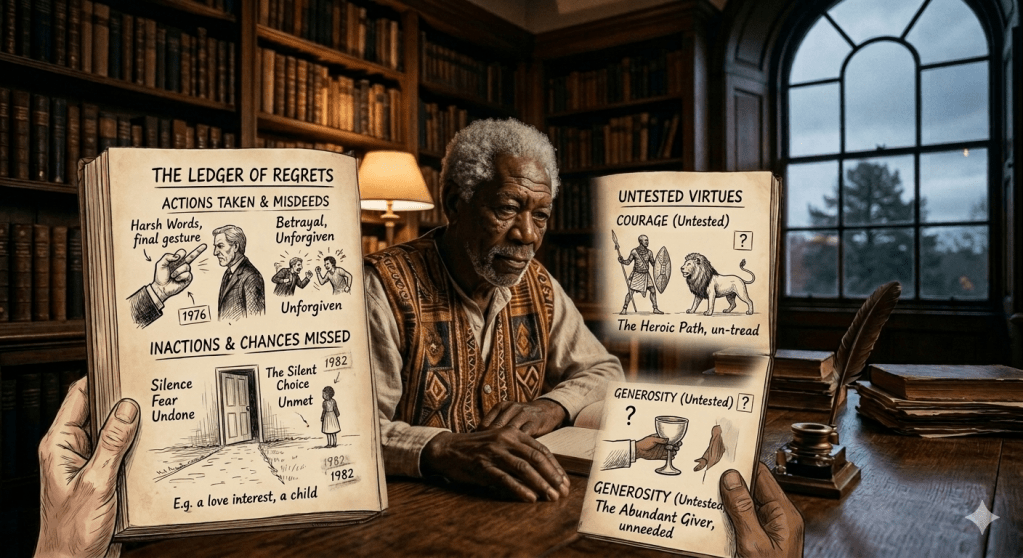
I was watching the Madlanga Commission. And something unexpected happened, I started feeling sorry for them. The men and women in the hot seat, tissue on the head, drinking gallons of water, visibly unravelling under the heat of consequence. People who, in many cases, had robbed us as taxpayers. Who had corroded the moral fibre of a country I love.
I wondered if they had regrets.
And then, uncomfortably, I wondered something else entirely: could I have been that person?
“You are only as faithful as your options. Do not judge others too harshly, you have simply not been tested yet.”
To say with certainty,
‘I will never be corrupt,’
‘I will never be bought,’
‘I will be the principled one who resigns rather than complies’,
is not to know thyself.
It is to confuse the absence of temptation with the presence of virtue.
Most virtues we espouse are empty promises until the moment that virtue costs us something real. Costs us our reputation. Our comfort. Our income. Our safety. Our family’s security. Many of us walk around wearing untested virtues like medals we haven’t earned.
PART ONE: UNTESTED VIRTUES
The psychological research on this is both illuminating and deeply humbling.
The Holier-Than-Thou Flaw. Bounded Ethicality
Psychologists Ann Tenbrunsel and Max Bazerman gave this phenomenon a name: Bounded Ethicality. It captures a severe blind spot in human self-perception, we judge our own future behaviour based on our ideals, but we judge other people’s behaviour based on their actions.
In hypothetical situations, we always predict we will take the high road. ‘I would never take that bribe. I would never sign off on that irregular appointment. I would never stay silent while the institution was being hollowed out.’ But when the actual situation arrives, with real pressure, real consequences, real people depending on you, the brain does not behave the way we imagined. It shifts from moral mode to rational and survival mode. We are, it turns out, spectacularly poor predictors of our own ethical choices.
The Research Says: We fail to factor in the sheer weight of real-world pressure when imagining our future behaviour. The hypothetical version of ourselves always has more courage than the situated version.
The Illusion of Moral Superiority. Tappin & McKay (2017)
But it goes further than poor prediction. We don’t merely overestimate our future courage, we have already convinced ourselves, right now, that we are more moral than the people around us.
Psychologists Ben Tappin and Ryan McKay published a landmark study in 2017 titled The Illusion of Moral Superiority. Their finding was striking: virtually all people rated themselves as significantly more just, fair, and trustworthy than the average person. Not most people. Nearly everyone.
What makes this particularly interesting is that moral self-enhancement is not simply an extension of general self-esteem or a catch-all positivity bias. It operates as its own specific distortion, stronger, more irrational, and more pervasive than how people inflate their assessments of their own intelligence or competence. We are, it seems, especially reluctant to accept that we might be ordinary in our virtue.
The real-world consequences are sobering. When opposing sides of a conflict both privately believe they are the righteous ones and the research says they almost always do, the conditions for resolution collapse. Both parties feel morally licensed to escalate, because both believe they are defending something good. Neither believes they are the problem.
And therein lies the trap. The man signing the irregular procurement order does not see himself as corrupt. He sees himself as someone who has earned the right, who has been wronged, who is simply evening the score. His moral self-image is not an obstacle to the corruption. It is its enabler.
The Research Says: The belief that we are already highly moral makes us less responsive to ethical appeals, not more. You cannot reach a person who has already decided they are one of the good ones.
The Danger of the Virtuous Self-Image. Moral Licensing
Harvard research on Moral Licensing reveals something genuinely disturbing: people who hold a deeply virtuous self-image are often more vulnerable to corruption, not less.
When you believe you are fundamentally a good person, an honest citizen, a dedicated public servant, a hard worker who sacrificed early in their career, your brain accumulates moral credit. And that credit, when a sufficiently large opportunity presents itself, becomes available for a withdrawal.
The internal logic becomes: ‘I have given so much to this institution. I have protected others. I have been overlooked. I deserve this.’ The very virtue becomes the psychological permission slip for the vice.
The Boiling Frog. Ethical Fading
No one wakes up one morning and decides to steal billions. No one sits down at their desk and resolves to collapse a state institution. It happens through what researchers call Ethical Fading, a gradual process in which the ethical dimensions of a choice disappear from view entirely.
It starts with a small thing. Signing off on a slightly irregular document because the boss asked. Accepting a minor favour. Attending a lunch you probably shouldn’t have attended. Nothing happens. No one calls. No lightning strikes.
So the boundary shifts. Your baseline recalibrates. What once felt like a compromise no longer registers as one. By the time a person is sitting before a commission drinking water in visible anguish, they are looking back at a decade of incremental steps, each one, in isolation, feeling almost reasonable.
“At no single point did they feel they were making a monstrous decision. The monster is assembled slowly, one small compromise at a time.”
Situation Over Character. The Milgram Lesson
One of the most unsettling findings in modern social psychology is this: the situation matters far more than the character of the individual.
The Milgram experiments demonstrated that ordinary people, placed in the right situational context, would administer what they believed were dangerous electric shocks to strangers, simply because an authority figure told them to. Not monsters. Not sociopaths. Ordinary people.
When Situational Strength is high, when corruption is normalised around you, when everyone else is doing it, when dissent means losing your livelihood or your family’s security, individual virtue collapses with remarkable speed.
The quote I keep returning to is not mine. But it haunts me: ‘Virtue is often just the absence of temptation.’ True character is not the values you shout when life is good. It is defined, strictly, by what you are willing to lose to protect them.
I have not been sufficiently tested. Neither, probably, have most of the people reading this.
PART TWO: ON REGRET
The second thread that kept pulling at me as I watched the commission was simpler, and perhaps more universal: do they regret it?
Not fear of consequences. Not remorse performed for cameras. Actual regret, the private, 3am variety that no legal team can help you with.
Regret is one of the most studied emotions in behavioural science, and what researchers have discovered tells us a great deal about how we make decisions and what we ultimately value.
The Foundation: Kahneman & Tversky on Action vs. Inaction
The foundational work on regret was done by Daniel Kahneman and Amos Tversky in 1982. Their ‘Action Effect’ showed that, in the immediate aftermath of a bad outcome, actions generate more intense regret than inactions, because it is psychologically easier to undo a deliberate act in your mind. ‘If only I hadn’t done that thing’ is a cleaner narrative than ‘if only I had done something I never did.’
Ninety-two percent of participants in their stock-switching thought experiment reported that the person who actively switched investments would feel worse than the one who did nothing, even though both lost exactly the same amount.
The Time Pivot: Gilovich & Medvec (1994)
The twist arrives when you zoom out. Psychologists Thomas Gilovich and Victoria Husted Medvec discovered that over a lifetime, the pattern inverts completely.
Short-term: regrets of action dominate.
Long-term: regrets of inaction become the deepest and most persistent. The things you did not do. The conversation you never had. The apology you withheld. The risk you avoided. These are the regrets that calcify.
You can make amends for something you did. You cannot easily recover the window you let close.
Daniel Pink’s World Regret Survey
Daniel Pink built on this temporal framework when designing the World Regret Survey, analysing over 26,000 regrets from people across 134 countries. What he found was that human regret, across all cultures and circumstances, clusters into just four categories:
FOUNDATION REGRETS
The consequence of failing to build stability early. Accumulated from small, poor choices: undersaving, ignoring health, not taking education seriously. These compound over decades.
BOLDNESS REGRETS
Born from playing it safe. People overwhelmingly regret failures of courage, not starting the business, not making the move, not saying the thing that needed to be said.
CONNECTION REGRETS
The single most common category globally. Letting key relationships drift. Unmade phone calls. Failure to reach out. These particular regrets linger longest.
MORAL REGRETS
Consciously taking the low road. Acts of unkindness, betrayal, dishonesty. The moments when we knew better and still chose the lesser version of ourselves.
Pink’s argument and I find it persuasive, is that regret is not something to be avoided or suppressed. The ‘no regrets’ mantra is a form of emotional dishonesty. Regret is part of our cognitive architecture. It is the system that tells us what we actually value by pointing at where we fell short of it.
“Regret is not a punishment. It is a signal. The question is whether you are willing to hear what it is telling you.”
Handling Regret Constructively
Pink’s framework for working with regret, rather than against it, involves three moves: self-compassion (acknowledge the failure without self-immolation), disclosure (say it out loud, make amends where possible), and extraction (mine it for data to make better choices going forward).
Sitting before a commission, sweating through tissue paper, is a particular kind of reckoning with all four regret categories simultaneously. Foundation choices made poorly. Bold choices made corruptly. Connections, to community, to country, severed. And moral choices that cannot be undone.
CLOSING THOUGHT
I am not writing this from a position of superiority. That is the whole point. Watching the Madlanga Commission, I did not feel contempt. I felt something closer to a kind of terrified recognition.
We are all, in some sense, one situation away from a version of ourselves we would prefer not to meet. The most honest thing we can do is acknowledge that and then build the systems, habits, and boundaries that reduce the likelihood of the test arriving uninvited.
Because the virtue you haven’t been tested on is not a virtue yet. It’s just an option you haven’t had the chance to sell.
“Know thyself. Including the parts you’d rather not know.”
============
Dr. Mzamo Masito
Between Thoughts — Intellectual Musings
Where the uncomfortable questions get a seat at the table.
 Between Thoughts -Intellectual Musings
Leave a comment