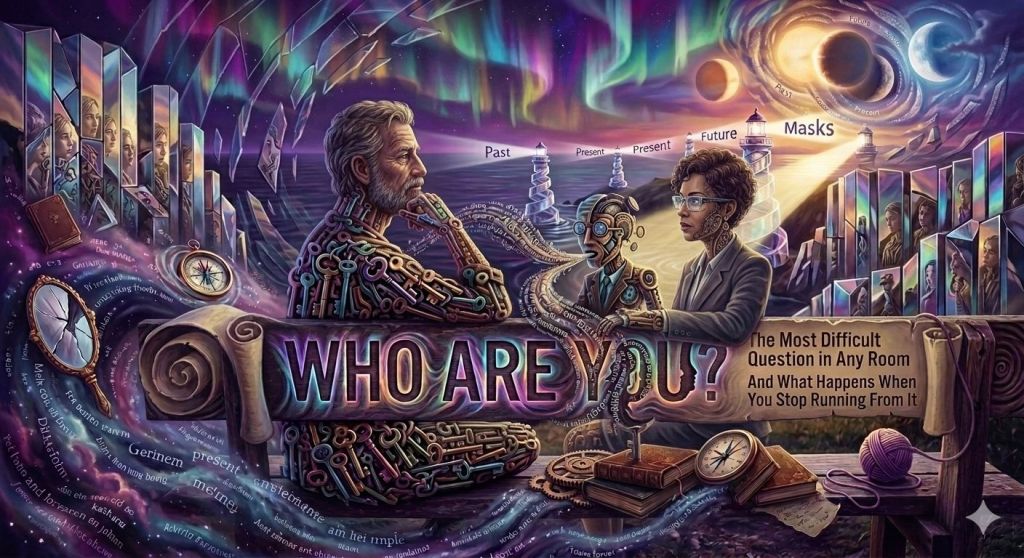
The Most Difficult Question in Any Room And What Happens When You Stop Running From It.
It started with a WhatsApp status. Someone I follow posted a clip I had seen before but never quite sat with. I asked them to send it. I watched it several times.
Jack Nicholson. Adam Sandler. A dimly lit room. Nicholson leaning back in an armchair, nerdy sunglasses on, flashing that slow, iconic grin. Sandler opposite him, shifting slightly, trying to hold his composure.
The film is Anger Management (2003). The scene is a group therapy session. Sandler’s character, Dave Buznik, a mild-mannered man court-ordered into therapy, is asked by Nicholson’s eccentric Dr. Buddy Rydell to do the simplest thing imaginable: introduce himself.
“I don’t want you to tell us what you do.
I want you to tell us who you are.”
What follows is a masterclass in avoidance disguised as confusion.
Dave: “I’m an executive assistant at a major pet products company.”
Rydell: “That’s what you do. Who are you?”
Dave: “I like playing tennis on occasion…”
Rydell: “Not your hobbies, Dave.”
Dave: “I’m a nice, easygoing guy…”
Rydell: “You’re describing your personality.”
Dave (exasperated): “I don’t know what the hell you want me to say!”
And there it is. Not stupidity. Not stubbornness. Just the authentic bewilderment of a person who has never once been asked to separate himself from the scaffolding he has built around himself.
Dave is not unusual. Dave is most of us.
Why the Question Breaks People
Strip someone of their job title, their relationship status, their achievements, their well decorated exterior, their address and most people are left staring at an empty page.
There are three reasons for this:
Label Dependency. Society is extraordinarily efficient at training us to define ourselves through external categories. What we do for income. Who we belong to. What we own. These labels feel like identity because they function like identity, until someone removes them.
The Illusion of Stability. Human identity is genuinely fluid. It shifts across time, context, and loss. Trying to compress an evolving, multi-dimensional inner life into a clean verbal answer feels, correctly, like a lie. So people hesitate.
Fear of Vulnerability. To answer the question truthfully is to confront the gap between who you are and who you intended to become. That is uncomfortable territory. Most people are not accustomed to standing there voluntarily.
Struggling with the question is not a sign of weakness. Often it signals high self-awareness, recognition that you are too complex to be reduced to a soundbite. But a total inability to answer, particularly when the only words that come are your job title or your partner’s name, reveals something else:
that your sense of self-worth has been outsourced entirely to the external world.
Is It Even a Fair Question?
Honestly? It depends entirely on how it is asked.
In most professional and social settings, “Who are you?” is a lazy prompt. It is grammatically small but existentially enormous. It gives the listener no context, no sense of whether the asker wants to know your professional history, your values, your origin story, or your wounds. It asks you to guess what register they are operating in and answer accordingly.
In that sense, it is a linguistic trap. Not a malicious one, but a trap nonetheless. Which is partly why people answer with their résumé, because the professional register feels safest and most socially legible.
But in the right context, a therapy room, a mentorship conversation, an honest dinner table, it is the most important question you will ever be asked. Because it forces you past the scaffolding. It asks you to show up as yourself, not as your function.
The question is not unfair. It is just rarely asked in a space safe enough to answer truthfully.
The Gender Divide
Sociological research on identity development reveals a consistent and culturally reinforced split.
Men default to agency and achievement. We are conditioned to answer through occupation, status, capability, what we produce, what we have built, what we can provide. Our identity lives in the doing. This is not a character flaw; it is the distilled message of every system we have been raised inside.
Women default to communion and relationship. They are conditioned to answer through their roles relative to others, mother, wife, sister, aunt, godmother, daughter, caregiver. Their identity lives in the connecting. And while this sounds warmer, it carries its own trap: a self that only exists in relation to others disappears the moment those relationships change.
Both patterns are forms of the same evasion, the substitution of role for self. Both collapse under pressure. And both point to the same underlying truth: very few of us are taught, anywhere in our formation, to locate our identity inside ourselves rather than outside.
The Worst Ways to Answer
Since we are being honest:
The Résumé Recital. Listing job titles, degrees, and awards. This tells people how you generate income, not who you are. It is the human equivalent of describing your car when someone asks you to describe yourself.
The Pre-emptive Apology. Starting with what you are not. “I’m not really anyone special, just a normal guy…” This does not signal humility. It signals that you have already accepted someone else’s verdict on your worth.
The Defiant Script. “I’m just me.” “What you see is what you get.” These are conversation-enders dressed up as authenticity. They shut the door on real connection while performing the posture of openness.
The Better Way
The best answer to “Who are you?” does not reach for what you do. It reaches for why you do anything at all.
A formula that holds up:
I am someone who values [X], is driven by [Y], and expresses that through [Z].
Example:
“I am someone who fundamentally values curiosity. I am driven by a need to understand how systems work, especially the ones that shape human behaviour. I usually express that by reading obsessively, asking uncomfortable questions in rooms where everyone else seems satisfied with the answer.”
Notice what is absent: the job title, the LinkedIn summary, the list of accolades. What remains is a person. That is the goal.
The Mzamo Answer
I have been asked this question many times. In boardrooms, in classrooms, on stages, in workshops, in the quiet after a keynote. And I have arrived, not without effort, at an answer that I believe is true.
I start with my name.
I am Mzamo. My name means: Life is Effort. Life is Effortful.
Nike says Just Do It. Mine is Just Try It. The attempt matters. The willingness to step into the effort, knowing it might be hard, knowing you might fail, that is the core of who I am. All I have control over is my Effort not the win or lose.
I live by three values. They are not aspirational. They are autobiographical.
Freedom
I know what it is to not be free. I grew up in Apartheid South Africa. I grew up in a country called Cape Town, which, depending on who you are and where in the city you wake up, can feel like two different countries sharing a postcode.
Freedom is not a political slogan for me. It is a lived memory and a daily commitment. My freedom, your freedom, everyone’s freedom. They are the same thing or they are nothing.
And freedom does not exist in isolation. Next to it, inseparably, are Choice and Self-Agency. When you have true freedom, you also have the capacity to decide your own life. But here is the part people skip: freedom comes with responsibility. You cannot claim the right to shape your own path and then refuse accountability for where it leads.
Ubuntu
I am because we are.
I grew up in a village amd townships. Not metaphorically, literally. I watched how a community held itself together without wealth, without infrastructure, without the systems that wealthy people assume are preconditions for human flourishing. I watched neighbours carry grief they had not earned, and carry it anyway, because that is what being in community actually means.
Ubuntu is not a brand value. It is not something you put in a company culture deck. It is a mode of being. It says: your humanity is not separate from mine. What I do to you, I do to the air we share. The west has finally caught on – they now know that loneliness kills and chronic loneliness has a mortality risk similar to smoking 15 individual cigarettes a day.
Respect
I grew up poor. And poor people are invisible. Not metaphorically invisible, actually invisible. You walk into a room and the eyes slide past you. You speak and the room keeps talking. You exist and the world continues as if you don’t.
My life’s work, in every domain I have operated in, has been to make those who are invisible become visible. To insist that respect is not a reward. It is not something you earn through a title or a salary or a seat at the right table.
Respect is a foundation. It should be the floor of every meeting, every greeting, every interaction, regardless of rank, class, orientation, background. You do not begin by assessing whether someone deserves it. You begin by offering it. Then you see what builds from there.
I end with my Mission:
My mission, my North Star, is to democratise Opportunity and increase Trascendence for everyone (Boys and Gilrs) through education as a key out of poverty, and advocating for men and boys..
The Real Question Behind the Question
The reason “Who are you?” breaks people is not because they are confused. It is because they have been trained, for decades, to know themselves only through the mirror of other people’s expectations.
When you strip that mirror away, the room goes quiet.
The work and it is work, is to build an answer that holds even in that silence. An answer that does not depend on a job staying stable, a relationship surviving, a title being renewed. An answer that is yours, regardless of what the world is doing around it.
Dave Buznik never found his answer in that therapy room. But he kept trying. And in the trying, he discovered something.
The question is not designed to be answered cleanly.
It is designed to be lived.
===============
Dr. Mzamo Masito
BETWEEN THOUGHTS — INTELLECTUAL MUSINGS
Where the uncomfortable questions get a seat at the table.
 Between Thoughts -Intellectual Musings
Leave a comment