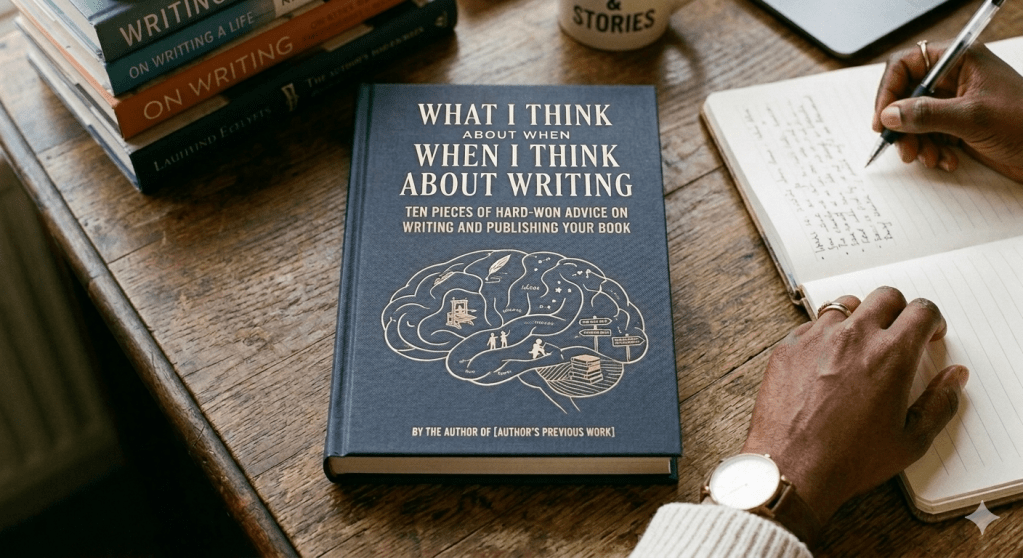
Ten Pieces of Hard-Won Advice on Writing and Publishing Your Book
Since I published This Country Hates Our Men (Boys) and launched this blog (Between Thoughts-Intellectual Musings), I have appeared on several media platforms discussing the plight of men and boys in South Africa. That visibility has brought two distinct categories of response: people who violently disagree with what I have written, and people who ask me, sometimes desperately, how they can write and publish a book of their own.
I welcome constructive criticism. When you challenge the ball, not the player, you advance knowledge. Even being proven wrong advances knowledge. But rude, hostile, verbal violence, the kind that tackles the person rather than the idea, will be met with the same Old Testament energy it arrives with. I will not turn the other cheek.
As for the hostile critics: Chinua Achebe and Toni Morrison both offered the same quiet wisdom on this. If there is something you violently disagree with, that disagreement is a revelation, a loud or silent message that there is something missing in the book, the article, the podcast episode, that you need to write. It is far easier to be an armchair critic. It is harder to get into the arena, into the mud, and wrestle with the issues yourself.
“If there is something you violently disagree with, that is a message, to you, that there is something missing that you need to write.”
After every event, the second question I get, always, is: “How can I also write a book? You grew up in similar conditions to me, went to a township school like I did. Now I believe it is possible.”
You do not need to write a hundred books to give advice on writing. You do not need to run fifteen Comrades to advise someone on ultras. One is more than enough. Here is what I know.
ONE. Just Write It
The best advice I ever received about writing came from a conversation about running.
When I worked at Nike, Bruce Fordyce, nine-time Comrades Marathon champion, arguably the greatest ultra-distance runner in South African history, would visit our Midrand offices to speak with the EKIN team about product and the culture of running. EKIN (Nike spelled backwards) is Nike’s elite internal group of product experts, storytellers, and community ambassadors.
One afternoon I pulled Bruce aside. I told him I wanted to run a marathon, then Two Oceans, then Comrades. I asked for sage tips. He had a particular energy, always measured, emotionally regulated, as though he was perpetually in a meditative state and never spoke fast. He paused, then said:
“Run. Just run. The rest will follow.“
Get up, put the running shoes on, and run. Your body will teach you more than I can, about pacing, about hydration, about listening to what you need, but none of that learning begins until you start running.
I followed the advice. I have since run many marathons, ultras, and trails, locally and globally.
The same principle applies to writing. All you need to do to start is write. Just write. Make writing a habit. I wrote for many years without publishing a word, partly because when you are employed at a senior level, the employer effectively owns your time. Too many visible side hustles signal distraction. If you are delivering forty percent and meeting targets, the assumption is that you could have delivered four hundred percent if you were fully present. You can debate the merits of that logic, okusalayo, uphethwe, but what matters is that you are employed. Sukufuna ukuba licephe- uphathe uphethwe!.
I kept writing anyway. Google Docs and Google Cloud became my companions. Dump all your thoughts there. One poem I sent to a now-defunct magazine, never expecting them to publish it.
They did. Just write.
TWO. Do Not Mark Your Own Exam
You cannot be the person who sets the exam, writes the exam, marks the exam, moderates the exam, and invigilates it. That is fraud.
Separate the act of writing from the act of editing. Do not write while holding a red pen, you will end up writing nothing. Or you will write while constantly erasing yourself until there is nothing left to say.
When you write, you automatically conjure an invisible judge. Sometimes it is the teacher who told you that you would amount to nothing. Sometimes it is the parent who threw your ideas in the bin. All those writing PTSD ghosts return to test you. Learn to welcome them. Ask them to sit down and watch you evolve, watch you fumble, make bad sentences, lose the thread. Do not do to yourself what was done to you in childhood. The world will attempt to self-sabotage you without your permission. You do not need to assist it.
THREE. English Is Not a Measure of Intelligence
For a long time I carried a low English-language inferiority complex. My own private-school-going daughters corrected my grammar and pronunciation. At my school, the English teacher was perpetually drunk. All I remember from those years is a single sentence: “Jack of the Bushveld was a brave dog.” The fundamentals: subject, object, verb, pronoun, adverb, where to place a colon, we were largely on our own.
It took me a long time to understand that English fluency is not the only measure of intelligence. You can write in your mother tongue. The South African book market has a critical shortage of well-written books in Zulu, Xhosa, Sotho. There are more books to be sold and read in those languages than in English alone.
The more important questions are these:
Before you worry about English, ask yourself:
Can you think?
Do you have ideas?
Can you read with meaning?
How is your pattern recognition?
When you read, do you wrestle and rumble with the author’s ideas?
Do you have ideas of your own?
If those questions are answered positively, English will find you where you are. Write the way you speak, the way you hear the words, the way you see the words and hear the visions. You can always hire an editor. You can use AI tools to polish the prose, but AI cannot supply the original ideas locked inside your soul. AI can co-write; it cannot replace you. If you did not write it, you will know. As Sankomota sang: “ you waiting for your name to be called and your body shakes with disbelief, because you know you never worked for it”.
You can lie to people. You cannot lie to yourself.
FOUR. It’s Opinions, Not Facts
In my thirties, while doing public talks on the Black Diamonds for the UCT Unilever Institute, I met one of South Africa’s greatest writers. I told him about my dream to write. He had attended one of my talks and said I was one of the best public speakers he had ever encountered. He autographed his book to me: “Mzamo, undoubtedly one of the best speakers I have ever met globally.”
I shared a short article I had written. He read it on the spot. Then he looked at me and said:
“Stick to public speaking.”
He left me standing there, cold
I did not write for five years after that.
After a while I learned something essential: even the greatest writers do not have a monopoly on the truth. They have a truth, not the truth, not thee truth. They are not omniscient. I had allowed one man’s opinion to become my fact. I gave his words power over me for five years.
Was he right? Possibly. The work I wrote then was probably not good. Most people start by producing work that is not good. That is not a reason to stop. Read Atomic Habits. One percent improvement, consistently applied over time, compounds into something worth reading.
FIVE. Be a Sponge
“Be stupid for two seconds and wise for life.“
I went to people who had walked the path before me. I remember meeting Professor Zakes Mda and asking him about writing. He gave me soulful tips. The late Dr. Mazisi Kunene was generous with his time and even invited me to his office to speak further and he shared that magnificent line from his work: “Those who feast on the grounds of others are often forced into gestures of friendship and giggles they do not desire.”
I had lunch with Khaya Dlanga, who mapped the lay of the book land for me,. how he thinks about writing, about publishing, what to watch out for, how to promote a book, what publishers look for. Thanks, Khaya. I will pay it forward. I am paying it forward now.
Have the humility to know that others have walked this path before you. You do not have to do this alone. And most people who have written and published books are remarkably generous with their knowledge, if you approach them with sincerity.
SIX. Be a Student Again
Attend book clubs. Learn how readers think about books. Some book clubs invite authors to discuss their work, that is an extraordinary window into the craft from the reader’s side. I listen to Oprah’s Book Club largely to learn from authors: where their ideas come from, how they deal with doubt and criticism, how they beat writer’s block.
I attended writing and publishing workshops. I used YouTube and Google to read and listen to the thirty writers who most influenced my thinking. I searched for their interviews, how they write, what their process looks like, how they navigate the vulnerability of putting a book into the world.
I studied James Baldwin, whom I love deeply. I studied Ben Okri, one of the most difficult writers I have ever tried to read; I struggled to finish his books, and I learned from that struggle too. I listened to authors I disagree with. You learn as much from those you resist as from those you admire.
My greatest South African writer of all time is Lewis Nkosi. I have read almost everything he wrote. He is a harsh critic, of writing, of ideas and no one is spared. Reading how he critiques subject matter, and occasionally the person, taught me more about craft than most writing courses.
SEVEN. Know Your Problem and Your Contribution
Professor Adrian Saville gave me a framework for research and for writing, that I have never forgotten. Before you write anything of significance, you need to be able to answer these questions:
The Five Questions:
What is the problem you are trying to solve?
Why does this problem matter?
Why should anyone else care?
Has it already been solved and if so, what is the gap?
What does your book contribute to practice, research, and knowledge?
When I wrote This Country Hates Our Men (Boys), I was clear about my problem: boys are failing and falling behind. We are leaving half the population behind. Men are struggling. I was clear on why it matters and on what would happen if we do not address it.
If you do not like the word “problem,” use Oprah’s word: intention. What is your intention for writing this book?
And remember this: people do not ultimately buy books for the problem. They buy books for the solution. They are purchasing an answer. Parents reading my book needed to know how to stop their boys from failing and falling behind. First they needed to be convinced this was a real problem, then they needed to know what to do. Always remember: no one buys a product for the problem alone. They buy the solution. Value attaches to the solution. Price is what people complain about when the solution is poor.
EIGHT. Know Your Reader
Who is this book for? Who are you writing for?
Who is your primary reader? Your secondary reader? Your reader at large? What do you want those readers to think, do, and feel after they have turned the last page? Be precise about this. A book written for everyone is a book written for no one.
The clearer you are about your reader, the clearer your voice becomes.
NINE. Courage — Have It, Find It
“Courage is the virtue that sustains all other virtues.” Maya Angelou
Write courageously about things you believe in, even if you get shot at. That is what I learned the hard way. A virtue is not a virtue if it does not cost you something. Everyone speaks easily about their principles until those principles are tested.
One practical note: it is much easier to write about difficult topics if you are economically free. The social media cancellation machine cannot cancel someone who does not need them. But always write from a position of building bridges, of healing, of ensuring that no one is intentionally left behind. Avoid destructive competition. Avoid conflict for its own sake.
On social media, some people have allowed their hurt and pain to metastasise into relational aggression, into hate speech, into hostile venting. They arrive seeking punitive justice, to murder someone with words, to heal a part of themselves that was hurt and never received acknowledgement. That is their pain speaking. It is not your responsibility to absorb it as fact.
TEN. Be Vulnerable
Talk about yourself. Be courageously vulnerable. Rather than writing about other people, write about yourself. Readers connect with human beings who are real, who do not sugarcoat their lives, who are honest about their flaws and shadows, who are willing to be naked on the page. It shows you care.
Balance what is private and what is personal. Protect your loved ones. Get their consent.
Write about things you truly care about, things you are willing to be vilified for, things you are willing to have dragged across social media. Because that will happen. Some people will offer constructive criticism; others have not yet learned the art of it and will attack you personally. Those are things you are going to have to learn to live with. Choose your subjects accordingly, not to avoid controversy, but because they genuinely matter to you.
A Final Word: Lessons from the Literary Giants
Because I do not consider myself a writing giant, I went to those whose books shaped me. These seven literary figures, drawn from the rest of Africa, African-American, and South African traditions, challenge us to look far beyond plot or grammar. Their combined wisdom shifts the question from basic mechanics to purposeful creation.
I. Language as the Flesh of the Story — Lewis Nkosi & NoViolet Bulawayo
Lewis Nkosi believed writing is primarily a struggle with language. Do not rely on having a compelling real-life experience or a political message; focus on the music and arrangement of your words. NoViolet Bulawayo goes further: invent your own way of speaking rather than copying standard English structures. Allow your characters’ names, cultural rhythms, and distinct speech patterns to breathe.
II. The Weight of Audience and Authority — Toni Morrison & James Baldwin
Morrison famously advised writers to write the book they want to read but cannot find on the shelves. Free yourself from the “white gaze“, do not waste time explaining your culture or humanity to outsiders; write with the assumption that your primary audience already understands your world. Baldwin demanded absolute, brutal honesty: ask yourself whether you are writing to appease, or writing to uncover the naked truth about human nature, hidden traumas, and societal delusions.
III. Culture, Cosmology, and the Choice of Tongue — Mazisi Kunene
Kunene argued that language is a combative weapon and an instrument to reassert cultural values. Consider how your writing connects to your community’s deep history and cosmological worldview. He chose to write in isiZulu to keep his narratives rooted in an authentic African sensibility. Language is not just a vehicle; it is a declaration.
IV. Representation vs. Interpretation — Nadine Gordimer & Alex La Guma
Both wrote through the fires of South African apartheid, yet they teach a crucial lesson about craft: do not merely record or “represent” the brutal facts of what you see, you must interpret them. Nkosi heavily critiqued writers who thought that simply living through hard times was sufficient to make a good novel. Balance your political urgency with artistic craft, so that your work outlives its immediate historical moment.
V. The Physical and Mental Process — NoViolet Bulawayo
Envision internally first, shape and process the story inside your head before rushing to type it out. Consider drafting by hand; working in longhand can forge a closer, more intimate connection to your material. And always remember: revolutionary storytelling defies tyranny, ignites imaginations, and dreams new, better possibilities into existence.
My Ignorance Is Infinite
I am still learning and will die learning. My ignorance is infinite. Work on chipping away at it every day. Prejudice, after all, is a long-term emotional commitment to ignorance.
The advice above is not complete. It is not exhaustive. It is not the advice of a hundred-book author. It is the advice of someone who spent years writing without publishing, who was told to stick to public speaking, who finally got into the arena and danced anyway.
“Your ignorance is infinite. That is not a limitation. That is the invitation.“
Now go write the book only you can write.
==================
Dr. Mzamo Masito
Between Thoughts — Intellectual Musings
Where the uncomfortable questions get a seat at the table.
 Between Thoughts -Intellectual Musings
Leave a comment