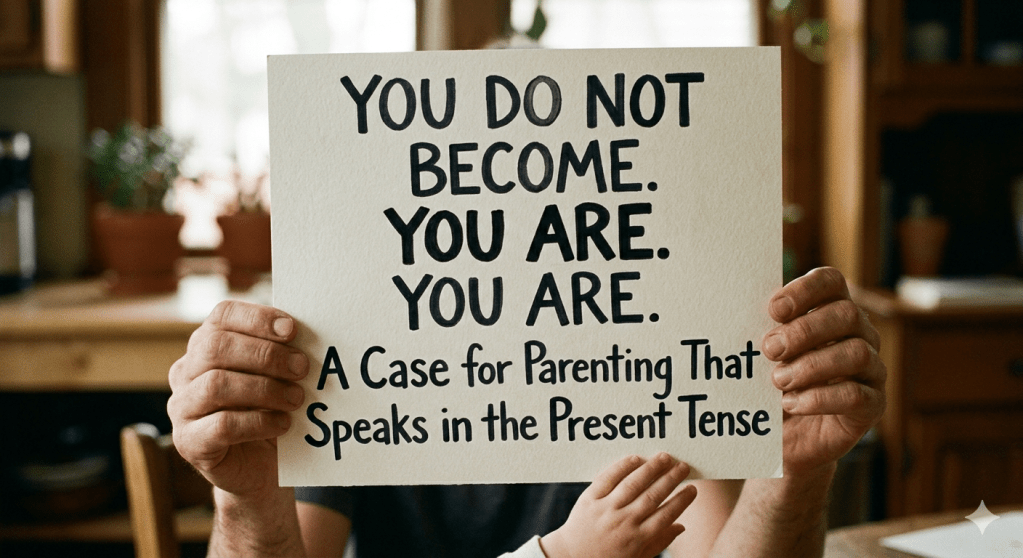
YOU ARE.
YOU ARE.
A Case for Parenting That Speaks in the Present Tense
There is a phrase so common in parenting that we have stopped hearing it. It is said in kitchens and classrooms and churches across every culture, delivered in a tone that mixes disappointment with warning, love with threat:
“You will become a liar. You will become a thief. Keep this up and you will become nothing.“
It is, on the surface, a reasonable thing to say to a child. It stakes a claim about consequences. It links present behaviour to future character. It gives the child a warning and, implicitly, a way out. If you stop now, the prophecy need not come true.
I want to make a case that this language, well-intentioned, widely used, emotionally gentle, is the wrong language. Not because it is cruel, but because it is soft in precisely the wrong place. It lets the child escape the present moment, and the present moment is the only place where anything actually changes.
PART ONE: THE GRAMMAR OF AVOIDANCE
When we say ‘you will become,’ we are conjugating the child’s character in the future tense. The message is: you are not yet a thief. You are not yet a liar. You are, at this moment, a child who is on the way to becoming something bad and we are here to warn you before the transformation completes.
This grammar does several things simultaneously. It protects the child’s present identity. It defers the moral weight to a hypothetical future self. And it converts what is a concrete, present act, theft, lying, cruelty, into a prediction, a threat, a weather forecast.
The child hears it as: I have not yet crossed the line. There is still time. The line is out there somewhere, and I haven’t reached it.
And crucially, the child is right. That is exactly what the language says. The line is out there. Not here. Not now. Not in this kitchen, with the evidence still on your chin.
‘You will become’ is a mercy extended at exactly the wrong moment. It is kindness deployed as avoidance.
The alternative and it sounds harsher, which is exactly why parents resist it, is to speak in the present tense. Not ‘you will become a thief.’ But: ‘You are, right now, behaving as a thief. This act is theft. You are the person who committed it.’
And then, and this is the part that is almost always left out, immediately offer the exit. Not as a future possibility. As a present one.
‘You are a thief right now. In the next minute, you can choose not to be. The door is open.’
PART TWO: UNDER THE BED. A STORY
I need to tell you where I learned this. Not from a textbook. From a woman who never read a parenting manual in her life.
I was a child in Cape Town. And I stole condensed milk.
Not from a shop. From under the bed, which, in the kind of home I grew up in, was also a storage facility. Every inch of space carried weight. I found the tin, the old-school kind where you punch two holes on opposite ends to let the sweetness flow. And I took a dip. Then another. The thing about stolen things and I knew this even then, is that they taste better. The sweetness of transgression adds a flavour that no honest tin can replicate.
I was savouring both the condensed milk and the quiet joy of thievery when I heard footsteps. My mother, home from work earlier than expected.
I rushed to put the tin back. I forgot to wipe the evidence from my chin and lips.
She looked at me. She knew immediately. I have always been a terrible liar. Ghost busted.
I braced for the belt. Or the peach tree whip. But that day, my mother decided differently.
She sat me down. And she did not say what most parents say.
She did not say: if you keep this up, you will become a thief.
She said:
You are not going to become a thief.
You are a thief.
The behaviour is thievery. The act is that of a thief.
I remember the shock of those words. Not because they were loud. Because they were precise. She was not threatening me with a future. She was handing me the present, which was heavier.
And then she explained why she was choosing this language. Slowly. Deliberately. The way she spoke when something mattered:
Parents who tell their children they will become something, it suggests that thievery has a scale. A points system. As if you need to collect enough coins before you reach the level of No Return, and then boom, now you are a thief. Thievery is not Pac-Man, my son. Thievery is falling in love with the devil slowly. It starts with condensed milk, then moves to something else also small, then sooner or later it becomes normal. Then retail theft. Then cars. Then cash heists.
You are not going to be a condensed milk thief. You are a condensed milk thief. You cannot give me back that condensed milk that is all over your cheek and your lips.
I started wiping my lips as if it would change the verdict. It was still sweet. Not as sweet as before I was caught. But sweet.
She continued:
Luckily for you, your thievery is still low grade. It has not yet hurt society at large. But it has hurt me. And your family.
I started crying. The last thing a son wants to do is disappoint his mother. His very first love.
She wiped my tears. Tenderly. And then came the part that I have spent decades understanding:
You have a golden chance to make a different decision after this talk. You can choose to continue stealing, or you can choose not to be a thief and move away from such a bad habit. I know what you are capable of, my son. You are a good son. With a golden heart. You and thievery are not one. You are better than what you did. You can choose better.
You and thievery are not one.
That sentence is the whole philosophy. She named the act fully. She placed it in the present tense without softening it. And then, in the same breath, she separated the act from the identity. The child is not the theft. The theft is something the child did. And the child can, beginning now, do something different.
Not beginning when they have earned back enough moral credit. Not beginning after sufficient punishment. Beginning now. In the next minute.
I never stole condensed milk again. I saved my money, bought a tin, and gave it to her as a peace offering. Tears again, real ones, the kind that come with repentance. She accepted it. And the matter was never raised again.
My mother had a particular habit. If she was still disappointed in you, she would repeat it. For hours. For days. She would tell anyone who cared to listen. She would say ‘this is the last time I am saying this, after this I will thula, thul’ and then, if triggered again, start from scratch.
She did not do that with the condensed milk. She accepted the peace offering, smiled, and promised me fish and chips, snoek and slaap chips, because she knew exactly what I loved.
The matter was closed. Truly closed. Because it had been truly opened first.
PART THREE: THE TWO PHILOSOPHIES
Let me name the contrast plainly, because I think it deserves to be seen clearly:
“You Will Become” TO “You Are”
“You will become a liar” TO ” You are lying right now.”
“If you keep this up, you will become a thief.” TO “This act is theft. You are a thief in this moment.”
“Keep behaving like this and you will be a failure.” TO “This choice has consequences. What will you do next?”
Judgement is deferred, the threat lives in the future.
Judgement is immediate, the act is named in the present.
The child escapes the present with a warning.
The child owns the present and is then offered a door.
Virtue is conditional, earn your way back by not repeating.
Redemption is immediate, it is available in the next minute.
Fear-based: the threat of becoming motivates change.
Truth-based: the reality of being motivates change.
The ‘You Will Become’ school of parenting is not wrong to care about the future. It is wrong to locate the moral weight there. The future self is abstract. The present act is concrete. The child standing in front of you with condensed milk on their chin is real. That moment, fresh, charged, still-felt, is the only classroom that exists.
A threat about who you will become if you continue is, fundamentally, a transaction with fear. Do not become that thing. Fear the future version of yourself. Modify your behaviour now to avoid that label later.
My mother’s approach was something different. It was a transaction with truth. You are the thing you did. And you are also better than the thing you did. Both are true simultaneously. The path back does not run through a future you haven’t earned yet. It runs through the next decision, which is available right now.
Fear says: do not become.
Truth says: you already are and you can also already choose differently.
PART FOUR: WHAT THE RESEARCH TELLS US
This is not only a maternal instinct. It maps onto something that behavioural science has been documenting carefully.
Present-Moment Accountability
Research on moral development, from Lawrence Kohlberg’s stages through to contemporary work by Jonathan Haidt, consistently shows that moral reasoning anchored in concrete, immediate experience lands differently than abstract, future-oriented warnings. The younger the child, the more pronounced the effect. Children do not think in futures the way adults do. They live in nows.
A future threat requires a cognitive leap: imagining a future self, projecting consequences forward, connecting present behaviour to a hypothetical character. A present statement requires no such leap. It describes what is, not what might be.
Identity and Behaviour: The Self-Labelling Effect
There is a well-documented phenomenon in social psychology: when people are labelled , even temporarily, they begin to align their behaviour with the label. This is called Identity-Based Motivation. It cuts both ways.
The concern with ‘You will become a thief’ is that it simultaneously avoids the present label and introduces the future one as a possibility. The child does not receive ‘you are a thief’ as identity information, which would create dissonance and demand resolution. Instead, they receive ‘thief’ as a future state, which is abstract enough to be dismissed.
The approach my mother used, naming the present act fully, then immediately separating the identity from the act, is actually more precise and more kind. It says: this act belongs to you. And you are larger than this act. Those are not contradictions. They are the whole truth.
Ethical Fading and the First Step
Research on Ethical Fading. the process by which moral dimensions of a choice gradually disappear from view, tells us that the most dangerous moment is not the large transgression. It is the small one that goes unnamed. The first step that is allowed to fade into background noise.
My mother understood this before the researchers did. By naming the condensed milk theft as theft, not as a warning sign of future theft, but as actual theft, happening now, she prevented the first step from fading. She made it real, present, and named. And then she opened the door.
The antidote to Ethical Fading is not future-oriented threat. It is present-tense naming. Call the first step what it is, on the day it is, so that it cannot quietly become something else.
PART FIVE: THE DOOR THAT OPENS NOW
The most important part of my mother’s approach and the part most often missing from the parenting that names present acts, is what came immediately after the naming.
She did not say: you are a thief, therefore you are lost.
She said: you are a thief right now, and you have a golden chance to make a different decision after this talk.
The door opened in the same sentence as the verdict. Present-tense accountability does not mean present-tense finality. It means present-tense truth, which is the only foundation on which genuine change can be built.
This is the architecture of the intervention:
Step 1: Name the act in the present tense. Not ‘you will become’ but ‘you are, right now, doing this.’
Step 2: Name the impact. Not the abstract future cost but the real, present harm — to the mother, to the family, to the relationship that is already in the room.
Step 3: Separate the act from the identity. ‘You and this behaviour are not one. You are better than this act.’
Step 4: Open the door immediately. The chance to choose differently is not out there in the future. It is in the next minute.
This is not softness. It is the opposite of softness. It is precision, the kind that requires a parent to hold two things simultaneously: the full weight of what happened and the full faith in who the child is. Most of us reach for one or the other. My mother held both.
The most demanding thing a parent can do is name the act completely and then, in the same breath, believe in the child completely. Both without flinching.
CLOSING THOUGHT
I have been in enough rooms, boardrooms, conference halls, school halls, men’s circles, to know that the language of ‘you will become’ does not end in childhood. We carry it into adult life. We warn rather than name. We threaten rather than confront. We postpone the moral weight to a future that somehow never arrives with quite enough force.
The men and women at the Madlanga Commission did not wake up one morning and decide to steal from a country. They faded into it. One small step at a time. Each step is unnamed. Each act allowed it to dissolve into background noise, because no one, or not enough people. said: this is what this is. Right now. Today. Not ‘you will become corrupt.’ But: this act is corruption.
I think about my mother often when I think about this. She was not a behavioural scientist. She was a woman with a son and a tin of condensed milk and a decision to make about what language to use.
She chose the present tense. And she changed the future.
That is what I mean when I say she was the best teacher I ever had.
Speak in the present tense. Name the act. Hold the child. Open the door. This is an alternative parenting curriculum. Another way.
========================
Dr. Mzamo Masito
Between Thoughts — Intellectual Musings
Where the uncomfortable questions get a seat at the table.
 Between Thoughts -Intellectual Musings
Leave a comment