On deprivation dreams, buying back time, and why memories appreciate while things depreciate
“Given the choice, buy experiences over things, because the evidence shows experiences tend to produce more life satisfaction and more happiness on average, especially when they are shared with others.”
Deprivation Dreams
When you have been poor for a long time, you mostly have deprivation dreams. You know you are poor when, in your sleep, you are being chased. You know you are poor when you are scared of answering unknown numbers, because an unknown number is never an opportunity, it is a debt collector, a bill, bad news. You know you are poor when all your boss’s jokes are funny, because laughing at them is not humour, it is job security.
Poverty is not just an empty bank balance. It is a chronic stressor that rewires your instincts and colonises even your subconscious. It keeps the brain in a perpetual state of high-alert survival. And it plants a deep-seated hunger for ownership, for things you can touch and lock away, that takes years to unlearn.
That said, let me be honest: things are not the enemy. It is always nicer to cry in a Mercedes with air conditioning than in a shack. Comfort matters. Dignity matters. But comfort is the floor, not the ceiling.
Why the Poor Instinctively Buy Things
Having been poor, the instinct is to buy things, to acquire things, to camouflage inner poverty. This is not reckless spending; it is a logical psychological response to years of lack:
Visual camouflage. Physical items act as armour, they hide past deprivation and protect against social judgement.
Tangible security. Objects offer a concrete sense of ownership that cannot easily vanish overnight.
Satiating deprivation. Buying satisfies years of pent-up desires and forbidden impulses.
But here is what the poor can never afford, and what poverty hardly ever teaches: time. What we are not taught in the foundation phase is that time and freedom are golden. Buying back time, the freedom to sleep, to rest, to simply sit peacefully without the constant rush to survive, is what we should be praying for. The deepest poverty is not a lack of items; it is a total deficit of time.
“True wealth is the transition from buying objects to buying freedom.”
What the Research Says
This is not just sentiment; behavioural science backs it up. A foundational line of research found that people generally report more well-being from experiential purchases than material ones, partly because experiences satisfy deeper psychological needs: autonomy, relatedness, self-esteem, and meaning. A 2021 meta-analysis spanning 360 effect sizes from 141 studies confirmed the overall “experiential advantage” holds on average.
But the most important finding is the social one: socially shared spending is valued more than solitary spending, while solitary experiences are not clearly better than possessions. The slogan is directionally right, but the real driver is shared connection.
Why do experiences win?
They become part of your identity. A memory of hiking in the mountains feels more like “you” than another gadget on a shelf.
Anticipation builds joy. Looking forward to a trip often feels as good as the trip itself. Waiting for a package delivery rarely does.
Fewer social comparisons. It is easier to envy a friend’s new car than their weekend camping trip. Experiences are more personal and less competitive.
They strengthen relationships. Shared moments create stories and bonds, while objects are often enjoyed alone.
Mexico City, Clarens, and the Stretched Mind
Ideally, buy experiences with friends, your partner, loved ones, and family. They are always sweeter, more memorable, more impactful. You build a bank of “do you remember when we…” moments. You develop a new language, a private code, built from shared experience.
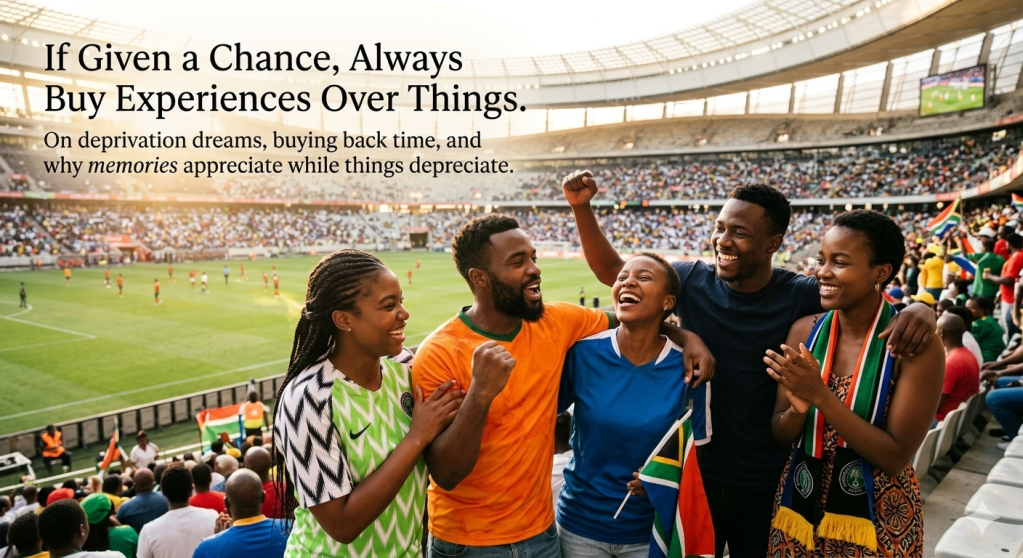
This week I was in Mexico City with friends I have known for over two decades, one of them for over three. We watched the opening match, South Africa versus Mexico. We had fun, and it was sweeter because I was with people I love, respect, and trust. The match was the occasion; the friendship was the experience.
And if you want to grow, get out of the country you were born into. Many people in the Bible had to leave their comfort zones and their countries of birth in order to grow and realise their dreams. Recently my cousins decided to do the same, their very first trip was to Clarens and Lesotho, the first time their passports were stamped. They tasted the bug.
As my cousin put it:
“Once you are outside your country, your mind is stretched and it never returns to its original shape. You think differently, your goals expand. I am hooked and looking forward to the next trip.”
— My cousin, after Clarens and Lesotho
Having an experience to plan and look forward to makes the whole year less heavy, including a mean boss. It is a far better escape than alcohol and drugs.
Practical Strategies: From Asset-Buying to Time-Buying
Step 1: Shift your valuation metric. Stop comparing prices to your total income; start comparing them to your hourly wage. If you earn R450 an hour, a R1,800 convenience service costs you four hours of life. If it saves you six hours of grueling labour, you have just bought back two hours of pure freedom.
Step 2: Audit your time and energy deficits. Identify the recurring, low-leverage tasks that trigger survival-mode anxiety or physical exhaustion. Outsource what drains both time and energy (deep cleaning, major repairs). Automate the rest (grocery delivery). Keep what nourishes you, if cooking is your therapy, keep cooking.
Step 3: Climb the time-buying ladder gradually. Start with micro-efficiencies: pre-chopped vegetables, laundry drop-off, the direct flight instead of the exhausting layover. Then frictionless commuting: the toll road over gridlock, the rideshare when you need to rest. Then household outsourcing: cleaning, garden care, tax preparation. This converts weekend chore anxiety into open blocks of rest, without triggering the subconscious guilt of “wasting money” on things you could do yourself.
Step 4: Redefine the purpose of savings. Unlearn the survival instinct that cash must immediately become a tangible asset to feel real. Reframe your emergency fund as a “peace fund”, a pre-paid block of time. Six months of expenses means you own six months of your life. You can walk away from a toxic boss without instantly starving.
Step 5: Establish no-guilt spending rules. If an expense gives you an extra hour of sleep, a stress-free meal with family, or eliminates a chore you dread, it is a mandatory health investment, not a luxury.
A Necessary Caveat
“Things” are not the enemy, the research itself says the experiential advantage is not absolute. Material purchases can be the better choice when they are useful, long-lasting, or frequently used. A quality tent enables camping trips. A reliable bicycle lets you explore your city. The key is to buy things that lead to experiences, not possessions that sit unused, collecting dust and guilt.
The Closing Thought
So next time you are deciding between a new watch and concert tickets, or a fancier couch versus a cooking class with people you love, go with the shared experience. Memories and mental peace appreciate in value; items depreciate the moment they leave the shop. You will end up with better stories, deeper bonds, a stretched mind and far fewer dust-collectors.
“Buy experiences, especially shared ones. The poor acquire things to cure material poverty; the free acquire time and memories to cure the deeper kind.”
=================
Dr. Mzamo Masito
Between Thoughts – Intellectual Musings
Where the uncomfortable questions get a seat at the table..
 Between Thoughts -Intellectual Musings
Leave a comment