On Why Freedom Is Not a Concept.
It Is a Covenant
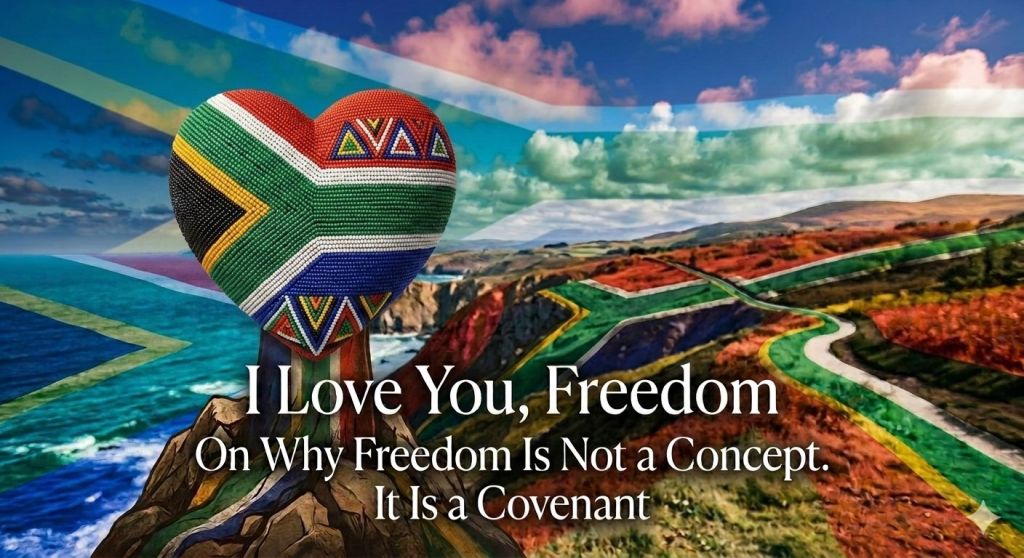
It is June 16th. In South Africa, this date does not need introduction. It is Youth Day, a national commemoration of the 1976 Soweto Uprising, a day that marked a defining turning point in the liberation struggle against apartheid.
I will not reflect on June 16th per se. But I want to talk about Freedom. And why I love it. Not philosophically. Not academically. Personally.
“I do not intellectualise freedom. I have lived its absence.”
The Trinity of Values & The Engine of Courage
I live by three values, plus one:
Freedom
Ubuntu
Respect
+1 Courage
The Three Pillars
Freedom. The ultimate state of self-ownership and autonomy.
Ubuntu. The recognition that my freedom is inextricably bound to the freedom of others.
Respect. The practical bridge that ensures your freedom does not infringe upon the dignity of another.
These three pillars only function because of a hidden fourth element: Courage.
As Maya Angelou observed, courage is the foundational virtue. Without it, Freedom, Ubuntu, and Respect are just safe, polite concepts. Courage makes your morality active. It transitions you from “righteous normative morality”, doing what society says is right because it is easy, to costly morality: doing what is right when it ruins your comfort, your safety, or your status.
Isibindi: The Liver That Holds the Courage
When I was ithwasa, a traditional healer initiate, over twenty-five years ago, along the banks of the Msunduzi River near Pietermaritzburg, where they hold the famous Dusi Canoe Marathon, we woke each morning before sunrise. Without fail, we began with a gratitude prayer.
The Morning Ritual: Before Sunrise
Sibonga Ukulala. We give thanks for quality sleep.
Sibonga Ukuvuka.We give thanks for waking up.
Sicela Isibindi. We ask for liver. We ask for bravery. We ask for courage.
This morning ritual followed what I now recognise as a psychologically perfect sequence for transformation: acknowledgement of safety, grounding in the present, preparation for spiritual warfare.
We addressed Qamata (the Xhosa Supreme Being), Mvelinqange (the Zulu First Creator), Nkulunkulu (the Most High), and our Ancestors. The initiate was never alone. This mirrors the 12-Step concept of a Higher Power, moving the individual away from isolation and into a vast, supportive cosmic network.
“Asking for Isibindi is asking for the internal strength to filter out the toxicity of your past, your fears, and your ego.”
The direct translation of Isibindi as “liver” is culturally and biologically precise. In many African and Eastern languages, the liver and bile, not the heart, is the seat of courage and resilience. Biologically, the liver is the body’s ultimate filter, purifying the blood of toxins. Metaphorically, Isibindi is the raw internal strength to filter out fear, ego, and the weight of the past.
The Serenity Prayer came to mind then as it does now: “God, grant me the serenity to accept the things I cannot change, the courage to change the things I can, and the wisdom to know the difference.” The amathwasa, in their pre-dawn prayers, were asking precisely that.
The Initiate’s Journey as Spiritual Rehab
I have carried this realisation for years but it crystallised only recently, at age 52: traditional healer initiation is spiritual rehab. Both institutions operate on the same psychological architecture:
Breakdown of Ego
In rehab, you strip away the substance and the false confidence. In initiation, you wear prescribed garments, shave your head, and submit to strict taboo. Both processes intentionally dismantle the old, sick self to build a healthy one.
Isolation for Realignment
Initiates are removed from society (ekuthwaseni) just as patients enter inpatient rehab. You must leave the environment that made you ill to understand how to live well.
Crisis as the Calling
For the addict, it is rock bottom. For the traditional healer, it is uthwasa, often manifesting as physical illness, mental distress, or persistent misfortune. Both are cosmic alarms: the way you are living is no longer working.
Service as the Final Step
The 12th Step of AA is to carry the message to others. The final stage of initiation is graduating as a healer, isangoma or inyanga, to serve the community. You are kept alive so that you can keep others alive. Both paths teach the same truth: you cannot think your way into a new way of living. You must pray, act, and submit your way into it, one sunrise at a time.
When Science Finally Caught the Elders
The morning gratitude ritual of the amathwasa is also evidence that Africans have always understood the power of gratitude, long before the scientific literature caught up with old wisdom.
What Gratitude Research Confirms
Neurological Rewiring: Gratitude activates the medial prefrontal cortex — responsible for learning, decision-making, and emotional regulation.
Chemical Boost: Expressing gratitude triggers neural release of dopamine (the reward chemical) and serotonin (the mood stabiliser), creating a natural antidepressant effect.
Vagus Nerve Activation: Gratitude regulates the autonomic nervous system, slowing heart rate and reducing cortisol, switching the body from “fight-or-flight” to “rest-and-repair.”
We knew this. We prayed it into our mornings before any neuroscientist named it. The difference is that we lived it as covenant, not clinical intervention.
Why Freedom Matters to Me
I do not view freedom as an abstract, academic theory. I view it through the lens of lived contrast. My understanding of freedom was forged not in a library but in a police van. Not in a lecture hall but on the streets of Gugulethu.
“My apprenticeship for freedom was apartheid. Nietzsche understood that sometimes slavery is the precondition for freedom.”
I know the absence of freedom. I know teargas and German Shepherd dogs. I know the weight of a klap from a soldier who beat me not for my sins but for my skin. I saw stars. My tears refused to fall, as though my soul was in protest.
I remember the old white Afrikaner postman on his bicycle who called me a Kaffir when I was six or seven years old. A man whose only claimed superiority was low melanin. A man who was utterly unremarkable in every measurable way, yet the system told him his ordinariness made him superior to me.
I know apartheid. I did not read it in a textbook. I did not intellectualise it in a graduate seminar. I lived it. And that lived apprenticeship is the precise reason freedom is not a concept to me. It is a covenant.
The Lineage of Subjugation
My freedom was bought across generations of systemic oppression.
My ancestors survived the commercial brutality of the Dutch East India Company (VOC), British colonial expansion, and the generational trauma of slavery.
My grandfather and great-grandfather never received the freedom they deserved.
Friedrich Nietzsche’s assertion that profound freedom often requires a period of deep constraint mirrors my history precisely: the weight of the past forged an absolute intolerance for tyranny.
Freedom Is Fragile. Always.
Freedom in South Africa is not an abstract political concept. It is a hard-won, costly inheritance. It matters because it is the direct antidote to a system that legally stripped the majority of their self-ownership, their movement, and their dignity. True freedom grants every individual the right to write their own story. It transforms people from state subjects into autonomous human beings.
But freedom is highly fragile and never permanently secure. It requires continuous maintenance. The institutions protecting it, the Constitution, the courts, the free press, are only as strong as the citizens willing to defend them. If we treat freedom as a permanent guarantee rather than a vulnerable asset, we insult the generational sacrifices that paid for it.
The Lifecycle of Freedom.
HOW WE ERODE IT
• Micro-surrenders: silence in the face of minor injustice
• Demanding conformity: weaponising shame against independent thinkers
• Echo chambers: trading critical thought for comfortable tribalism
• Complacency: assuming someone else will fight the battles
HOW WE NOURISH IT
• Costly morality: speaking truth to power even when it costs you
• Activating Ubuntu: using your liberty to defend the dignity of others
• Enforcing boundaries: resisting state and social overreach immediately
• Protecting free spaces: supporting independent media and civil dissent
How Freedom Erodes. Slowly, Quietly
The Slippery Slope
Minor rights are surrendered for temporary safety or political convenience.
Normalising Tyranny
Small overreaches accumulate until systemic oppression becomes the new normal.
Loss of Voice
Dissent becomes dangerous. Conformity becomes mandatory. Accountability disappears.
Institutional Decay
Trust vanishes, leaving society vulnerable to corruption and authoritarian rule.
How We Nourish and Keep Freedom Alive
Practice Costly Morality: Speak truth to power even when it threatens your comfort, social standing, or livelihood.
Activate Ubuntu: Use your personal liberty to defend the dignity and rights of weaker or marginalised groups.
Enforce Strict Boundaries: Explicitly question authority and resist any state or social overreach immediately.
Protect Free Spaces: Support independent media, whistleblowers, and open platforms for civil disagreement.
It Is Not Yet Uhuru
In a country that remains one of the most economically unequal in the world, with crippling unemployment, millions dependent on social grants, poor health and education outcomes, crumbling public institutions, commission after commission cataloguing state capture, and a political class too often preoccupied with self-preservation, freedom remains an unfinished project.
We have the word. We do not yet have the full substance. It is not yet Uhuru.
“I do not love Freedom because it was given to me. I love it because it was taken from those who came before me, and I refuse to waste what their suffering purchased.”
And still, on this June 16th and every day after it I choose to speak to Freedom not as a political concept but as a covenant. As a living presence I have not yet fully met but refuse to stop pursuing.
Viva Freedom.
Please never forsake us.
Come in all your fullness, so we may experience you in your fullness in our lifetime.
I love you, Freedom.
==================
Dr. Mzamo Masito
Between Thoughts – Intellectual Musings
Where the uncomfortable questions get a seat at the table.
 Between Thoughts -Intellectual Musings
Leave a comment