Male Sycophants.
The Men Nobody Talks About:
Yes-Men and the High Price of Borrowed Glory
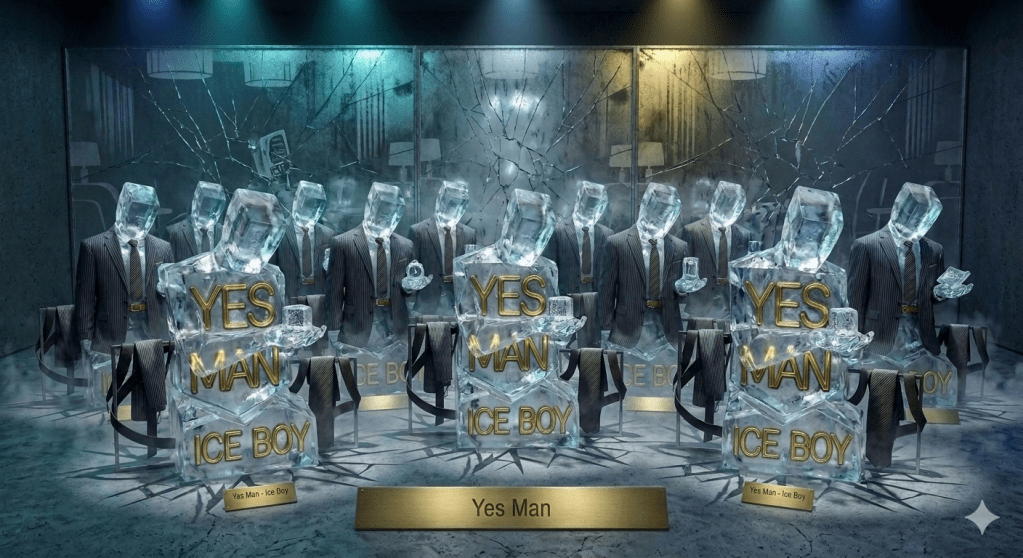
Allow me to be judgy for a moment, even though the scripture says thou shalt not judge. This is a venting exercise and an analytical one. Both can be true at the same time. Society has spent considerable energy dissecting women who love men with money and resources. We have an entire literature. We have book clubs for it. We have a Netflix series for it. Sue Nyathi gave us four women navigating the gravitational pull of one wealthy man, and the whole country had something to say.
But we have almost nothing to say about the men who love men with money and resources.
The extra miles they walk. The not-so-funny jokes they laugh at until tears stream down their faces. The bending over, literally and figuratively. All in the name of the glow. All in pursuit of the shine.
Today, I want to talk about them, the ice boy, the yes-men, the sycophants.
We scrutinize the slay queen. We ignore the ice boy. Both are in the same transaction.
I am talking about the proximity sycophants, the yes-men, the bootlickers, the court jesters, the political fixers, the hangers-on, who trade their autonomy, their dignity, and ultimately their identity for the reflected glow of wealth, power, and status. They are everywhere. They are more numerous than any of the four female characters in The Polygamist. And the most powerful among them, the big dogs, the shadows, the invisibles, have not been caught yet. It is the ice boys who end up on the hot seat.
01. Who Are These Men?
They are the modern equivalents of the royal court: the courtiers, the gatekeepers, the hype-men. In different spaces, they carry different titles.
The Ice Boys
A term that entered South African social and political vocabulary to describe men who literally carry the ice bucket, open the doors, and anticipate every whim of a wealthy patron, the “big dog“, simply to stay inside the VIP section. They are present at every table. They are indispensable in the moment. They are the first to disappear when the music stops.
The Political Fixers and Lackeys
Mid-level operatives who sweat under the lights of Madlanga judicial commissions. They clean up the messes of invisible elites. They act as human shields, absorbing the legal and reputational consequences of decisions made by men who will never sit in that chair. Watch any commission of inquiry closely. The dehydration. The tissues. The excessive sweating that goes beyond any physiological explanation. These are men whose entire nervous system is calibrated to serve someone else’s agenda.
The Social Parasites
Men with no distinct personal brand, no independent wealth, and no identifiable skill, yet somehow present on every yacht, in every boardroom, at every launch. Their currency is access. Their only asset is adjacency.
02. What Is Their Psyche?
The internal architecture of these men is built on deep contradictions. Understanding it requires more compassion than contempt, because the forces at work are not simply personal failures. They are human vulnerabilities, systematically exploited.
The Somebody/Nobody Void
At the core lies a profound sense of inadequacy. They feel like a nobody on their own. Instead of building self-worth through personal mastery, through the slow, grinding, unglamorous accumulation of skill and character, they seek an identity shortcut by attaching to a somebody. The patron becomes a mirror. When the patron is respected, the sycophant feels respected. When the patron is celebrated, the sycophant feels celebrated. It is borrowed identity, and like all borrowed things, it must eventually be returned.
Borrowed Narcissism
This is not simply admiration or mentorship. It is a psychological dependency, a condition in which a man internalises the grandeur of another man as a substitute for his own. He feeds on fame crumbs to fill an emotional hunger that no amount of proximity will ever permanently satisfy. The hunger is always there. It simply requires a bigger patron, a bigger room, a more powerful man to stand behind.
Hyper-Vigilance and the Body Under Pressure
Because their status is entirely dependent on the whim of another man, these men live in a state of permanent psychological stress. They are always reading the room. Terrifyingly aware that one unforced error, a missed cue, a delayed laugh at a bad joke, a moment of visible independence, could exile them from the camp entirely.
This manifests physically. The excessive sweating. The dehydration. The physical tension that no amount of expensive tailoring can conceal. The body keeps the score, even when the man refuses to.
THE BEHAVIOURAL SCIENCE
Chronic subordination activates the body’s stress-response systems, elevated cortisol, heightened sympathetic nervous system activity, hypervigilance, in the same way that sustained social threat does. The ice boy is not simply nervous. He is physiologically managed by someone else’s power.
03. Why Do They Do It?
The Illusion of Speed
Building wealth, influence, and credibility from scratch takes decades of grinding work, failure, humiliation, and patience. Being an ice boy offers immediate entry into rooms, tables, and conversations that would otherwise take a lifetime to access. The shortcut is seductive because it is real, at least in the short term.
Proximity as Currency
In many societies, looking like you have access to power is almost as useful as having power itself. These men use their closeness to the big dogs to intimidate peers, attract partners, and secure small-time deals that their own credentials could never justify. The patron’s shadow does work that they cannot.
The Fear of Obscurity
To them, being ordinary, unseen, unremarkable, unmentioned, is a fate worse than degradation. They would rather laugh at a terrible joke in a five-star restaurant than tell a genuine joke in a tavern. They would rather be wrong in the right room than right in the wrong one.
They would rather laugh at a terrible joke in a five-star restaurant than tell a genuine joke in a tavern.
04. What Do They Gain?
The gains are real. That is the honest part of this analysis. If they gained nothing, the transaction would not persist. They receive material crumbs: luxury travel, expensive clothing, high-end alcohol, entry into spaces they could never afford on their own. Occasionally, the proximity pays off in more substantial ways, a contract, a board seat, a tender that appears simply because they were the loyal body in the room when a decision was being made. And they receive social shielding: insulation from the harsh realities that ordinary men face alone, protected by the economic shadow of their patron.
The gains are real. The losses are catastrophic.
05. What Do They Lose?
The Authentic Self
When you force yourself to laugh at jokes that are not funny, agree with opinions you find abhorrent, and perform acts against your own conscience, your true personality atrophies. The process is gradual. You do not notice it happening. But eventually, the mask eats the face. And by the time you look for the man you used to be, he is gone.
Dignity and Respect
The tragedy of the ice boy is that he is never truly respected by the man he serves, and he is never respected by the people watching from the outside. He is regarded as an appliance. Useful. Interchangeable. Entirely replaceable the moment a newer, more eager, more pliable model arrives.
Accountability. They Take the Fall
When things collapse, when commissions convene, when empires crumble, when the law finally arrives, the shadows and the invisibles disappear. The ice boys are left on the hot seat. Sweating through their suits. Holding the blame. Facing the legal consequences for decisions made by men who will never face consequences of any kind.
Time
This may be the most devastating loss of all. They spend their peak years, the years of energy, ambition, creativity, and possibility, building another man’s legacy. When the patron dies, discards them, or loses everything, these men discover they have no independent skills, no personal network, no foundation of their own. They gave their best years to a man who never saw them as anything other than furniture.
THE FINAL ACCOUNTING
Fame crumbs do not nourish. They simply keep you begging at the table. And when the table is cleared, the men who built nothing for themselves have nowhere to sit.
A Personal Reflection: Kobe and the Fame Crumbs
I once spent time with the late Kobe Bryant during the 2010 FIFA World Cup in South Africa. Everywhere I went with him, he was chased by fans. Cameras. Energy. Attention. And then something strange happened.
I noticed that his fame began to rub off on me. People started asking whether Kobe was my friend. Kobe would say, “Mzamo, my brother” and in those moments, I was no longer just Mzamo. I was Mzamo-who-knows-Kobe. I was collecting fame crumbs simply by being present in his orbit.
Thankfully, he left within a week.
I say this to reflect on men who linger around men who have everything or are perceived to have everything. Had that experience lasted six months, I ask myself honestly: who would I have become? The temptation to stop building Mzamo and simply live as Kobe’s “brother” would have been immense. That is not a weakness unique to me. That is a human vulnerability.
It takes immense spiritual grounding to recognise that proximity to massive energy is not the same as having your own energy. That fame crumbs do not nourish the soul. That reflected glow, no matter how bright, eventually fades the moment the source moves on. The men who stay permanently in those shadows have simply lost the strength, or the courage, to walk away and cook their own food.
Closing Thoughts
The Polygamist gave us four women orbiting one powerful man. But around every powerful man are also other men, invisible in the public discourse, but deeply present in the architecture of his influence.
We have a name for women who leverage proximity to power. We find it worthy of novels, series, and trending commentary. We owe the same analytical honesty to the men who do the same thing, often at greater personal cost, in deeper silence, and with less cultural permission to ever speak about it.
The ice boy is not simply a character. He is a societal symptom. And until we start talking about him, with the same precision, the same scrutiny, and yes, the same compassion, we are only telling half the story of power.
The line between proximity and dependency is thinner than any of us want to admit. And the soul lost in that crossing is always your own.
===========
Dr. Mzamo Masito
Between Thoughts – Intellectual Musings
Where the uncomfortable questions get a seat at the table.
 Between Thoughts -Intellectual Musings
Leave a comment