The Gogos are Holding us Together.
#RecognizeTheGogo. #RecogniseTheMkhulu
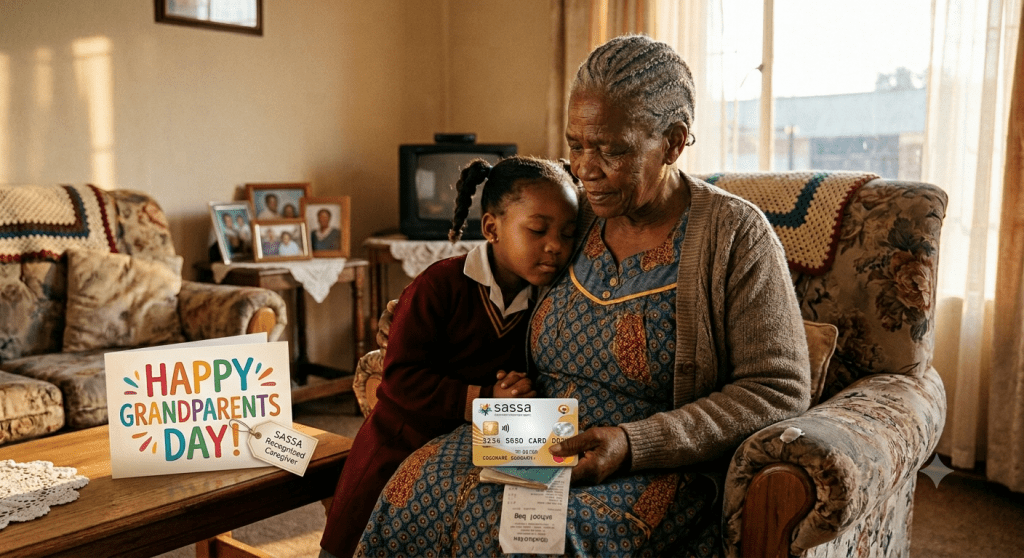
#RecogniseTheGogo. | #RecogniseTheMkhulu
I was at an event recently when someone leaned over and said, almost in passing: “I was raised by my grandparents.” She said it the way people mention the weather, like it was simply a fact of life. No drama. No editorial. And in South Africa, it very often is. In African Men Care, a non profit, whose role is to democratise opportunity ans increase transcende for every child, through educarion and advocacy for boys and men. Close to 50% of African Men Care, learners are raised grandparents, mainly the granmother.
We celebrate Mother’s Day in May. Father’s Day in June. But somewhere in the calendar, in the architecture of our civic year, we have left out the people who are actually doing the parenting for millions of our children. We have left out the gogos and mkhulus.
“For millions of South African children, the word ‘Mother’ is not the woman in the kitchen. It is the woman with grey hair, a pension book, and a school bag she bought on credit.”
This is not a sentimental argument. It is a structural one. And the numbers demand that we take it seriously.
The Numbers First. Because They Are Not Minor.
Statistics South Africa does not soften what it finds. And what it finds on the structure of the South African family is sobering:
9.7 million children in South Africa currently live with their grandparents.
40% of all households with children are grandparent-headed, that is nearly 8 million children.
64.5% of those grandparent-headed homes are led by grandmothers.
64.1% of children in grandparent-led homes in rural areas live with neither biological parent present.
40% to 66% of all South African children live in households without their biological fathers.
These are not marginal statistics. These are not edge cases. This is the actual shape of the South African family and our national calendar does not reflect it.
When 40% of children with a roof over their heads are sleeping in grandparent-led homes, and our schools are still sending children home to make Mother’s Day cards for a woman who is not there, we have a mismatch between our civic imagination and our lived reality.
The Cultural Hypocrisy We Have Not Named
Ubuntu is not a decorative concept in African philosophy. It is operational. It means your humanity is constituted by your relationships and by your obligations to those relationships. We say we are a people who honour our elders. We say age carries dignity. We say the gogo is the backbone of the family. And then we give her nothing. No formal day. No institutional acknowledgement. No national moment where the country turns to her and says: we see you. We know what you have done. We are grateful.
She does not get a pension large enough to cover school fees. She does not get structural relief for the childcare burden she has absorbed because her children, for whatever valid or inexcusable reason are absent. And she does not get a day.
“A culture that claims to honour its elders but builds no civic space for their sacrifice is not honouring its elders. It is simply using them and calling it tradition.”
The cultural hypocrisy here is not malicious. It is a product of our inherited civic architecture, a calendar designed in a context that does not match our social reality. But naming it as hypocrisy is necessary before we can resolve it.
The Case For: What Establishing This Day Actually Does
The proposal on the table is specific: proclaim the first Sunday of October as National Grandparents and Caregivers Day, aligning with the United Nations International Day of Older Persons on 1 October. Simultaneously, the Department of Basic Education should shift school-level events from strict ‘Mother’s and Father’s Day’ activities to an inclusive ‘Primary Caregiver Day’ , welcoming whoever is actually raising the child.
Why does this matter?
First, it validates lived reality. For millions of children, Mother’s Day and Father’s Day are exercises in absence. Schools that require children to make cards for parents who are not present are not celebrating family, they are marking loss. An official Caregivers Day redirects the celebration to the person who showed up.
Second, it corrects an accountability gap. African culture explicitly tasks the community and particularly elders, with raising children. But the community has not reciprocated with formal recognition. Recognition is not merely symbolic. It creates the conditions for policy attention, grant reform, and targeted relief. You cannot fund what you have not first named.
Third, it reduces childhood trauma. Children in non-traditional family structures who are forced to participate in Mother’s and Father’s Day school activities are being asked to perform a family they do not have. That is not a minor inconvenience. For some children, it is a recurring wound. A Caregiver Day, inclusive, spacious, honest, heals something we have been quietly breaking every year.
Fourth, it provides a policy platform. A formal national day is not just a moment. It is infrastructure. It gives the Department of Social Development an annual, structured moment to launch health screenings for elderly caregivers, review grant adequacy, and surface the invisible labour that is currently the only thing standing between millions of children and complete neglect.
The Case Against: The Objections Worth Taking Seriously
A balanced argument requires engaging the objections honestly. There are three worth naming.
The first is the risk of normalising parental absence. If we build a civic day around grandparent caregiving, do we implicitly let absent parents off the hook? Do we celebrate the workaround instead of demanding the fix? This is a legitimate concern. The answer is that this proposal does not call for the elimination of Mother’s and Father’s Day. It calls for the addition of a third day, one that fills the gap without erasing the expectation that biological parents should be present and accountable. We can hold both truths at once.
The second objection is the alienation of functional parents. Roughly a third of South African children still live with both biological parents. Those parents are present. Those parents are doing the work. Eliminating holidays that celebrate them would be unjust. This proposal does not require that. The logic here is additive, not substitutive.
The third is more philosophical: will a day change anything material? Public holidays are often criticised as cheap symbolism. The response here is threefold. This day would fall on a Sunday and cost the fiscus nothing in lost productivity or holiday pay. It aligns with existing UN and African Union frameworks on elder dignity. And symbolism, done correctly, is not cheap, it is the precondition for material change. We funded institutions we first imagined. We passed laws for rights we first named.
Symbolism without policy is hollow. But policy without symbolism rarely mobilises the political will needed to sustain it. The day and the policy reform must move together.
The World Has Already Moved
South Africa would not be pioneering here. It would be joining a coherent international movement. The United States formally proclaimed Grandparents Day by presidential decree in 1978. Poland observes Grandmother’s Day on 21 January and Grandfather’s Day on 22 January. Estonia officially recognises Vanavanemate Päev on the second Sunday of September. Brazil, Spain, and Portugal anchor their celebrations to 26 July. The United Kingdom marks it on the first Sunday of October.
The proposed South African date, the first Sunday of October, maps directly onto global practice and the UN framework. This is not a difficult alignment to make. It requires political will, not legislative reinvention.
A Final Word. On What We Owe
There is a woman in Khayelitsha right now ironing a school uniform that belongs to her grandchild. She woke up at 5 am. She will walk to the taxi rank. She will pack a lunch she could not really afford. She will not appear on a Mother’s Day card. She will not receive a bouquet in June. She will simply continue.
“Our gogos and mkhulus did not sign up for this. They came out of retirement, out of the rest they had earned and re-entered the most demanding job in the world. The least we can do is give them a Sunday.”
The proposal for a National Grandparents and Caregivers Day is not sentimental. It is structural. It is honest. It is overdue.
Almost 10 million children know this. Their gogos know this. It is time for the Republic to know it too.
============
Dr. Mzamo Masito
Between Thoughts — Intellectual Musings
Where the uncomfortable questions get a seat at the table.
 Between Thoughts -Intellectual Musings
Leave a comment