A useful guide for men. What men need to know and how to be great allies.
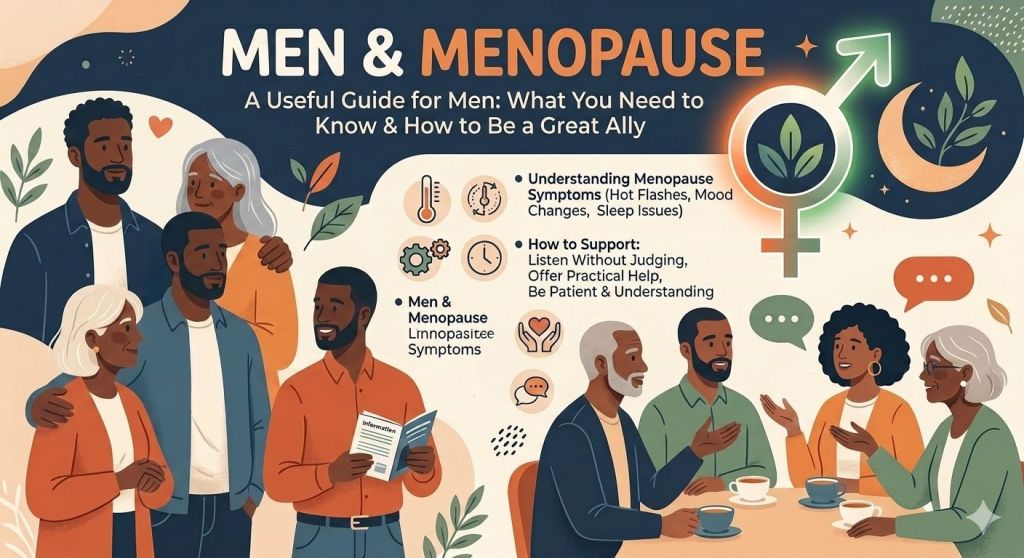
We talk a lot about men causing harm. GBV statistics. Gender pay gaps. Toxic masculinity. All of that conversation is necessary. But there is another conversation, one about men as allies. And one of the least-talked-about spaces where men can show up powerfully is women’s health.
Menopause is one of those spaces.
I attended a Vastly Sage Gentlemen’s Brunch at The Leonardo Sandton organized and founded by Amanda Dambuza. In that room, men spoke honestly, about confusion, frustration, fear, and regret. What I heard, and what I learnt, has stayed with me. This post is for every man who has a mother, sister, partner, daughter, aunt, colleague, or friend who is a woman. That is every man.
STAT: Females make up approximately 51%, (32.2 million) of South Africa’s population. For South Africans aged 40 and older, women are the clear majority. Menopause is not a niche issue. It is a national one.
Voices From the Room
Men were asked to share their experiences. What came out was raw, honest, and largely unspoken until that morning.
“My wife started menopausing and I did not know. No sex in the house. Moody and easily sensitive. I was frustrated and thought it was me, or she was no longer interested. I nearly started having an affair.“
“I think our divorce happened at a time when she was menopausing. We would be having sex and halfway she would ask we stop, either she was no longer in the mood or it was painful and dry. I thought it was my fault or she was no longer keen.”
“I know very little about menopause partly because my wife doesn’t want to talk about it. I learnt about it last year at work, got home wanting to discuss it, and felt completely cancelled.“
“Now I know why my mum was sweating so much and always irritable. She had to have a total hysterectomy. I had no idea what she was going through.“
“My sister was diagnosed at age 29 with early menopause and had to do a radical hysterectomy. She was depressed and became suicidal for a year. Looks like the worst is over now.”
“I am a single father raising three daughters. My middle child was diagnosed with early menopause, lots of crying, mood swings, misbehaving, and suicidal ideation. She was advised to take HRT. For the majority of women experiencing moderate-to-severe symptoms, the health benefits of HRT far outweigh the risks.“
“It feels like a war zone at home. Kunzima.”
“Now I understand my female boss. She is 51. Last year she started bringing a fan into every meeting. Sharp-tongued, irritable, even rude at times. Many complaints. Bad reviews. None of us knew what was happening to her body.“
“ My partner always wants to have sex, especially early mornings 3am to 4am, while fast asleep or in deep sleep. I cannot keep up. I feel like a failure or I am failing her”
Ignorance breeds prejudice. Prejudice is a long-term emotional commitment to ignorance. Educate yourself,. do not wait to be educated.
The Etymology: Why Does ‘Menopause’ Contain ‘Men’?
Xoli Madlala, founder of Redefining Menopause Africa and author of The Perimenopause Globetrotter, opened with a question. She had men call out the first words that came to mind when they heard ‘menopause’: mood swings, shouting, crying, hot and cold, fans, car accidents, angry wife, no sex, Ben 10s.
Before learning more about menopause, let’s start with the language myth: the “Men” in Menopause and Menstrual.
The idea that ‘menopause’ and ‘menstrual’ prove that ‘women’s problems start with men’ is a folk joke etymology, a creative play on words that erases 2 000 years of linguistic history.
The word menopause was coined in 1821 by French physician Dr. Charles de Gardanne. To create a precise, scientific-sounding word (ménopause) to replace older, vaguer terms like “the change of life” or “the critical age” or “the end”, “ the climacteric or the female climacteric”, “the critical age”, “cessation of terms or flowers” and “ age of return.”
The word menopause, comes from two Ancient Greek roots:
Mēn (μήν), meaning ‘month’ or ‘moon.’ A woman’s menstrual cycle lasts roughly 28 to 30 days, the same as a lunar month. The connection is to biology and timekeeping, not to adult males.
Pausis (παῦσις), meaning ‘a cessation’ or ‘a stopping.’
Put together: the literal meaning is ‘the stopping of the monthly cycle.’
The ‘men’ in menopause has nothing to do with men. There are other words that start with “men” – menu, mental, mentor, menad, menace, and menaccanite.
CURIOUS FACT
Over 80% of women start looking for information about menopause only when they are already going through it. Men typically know even less. This guide is a step toward closing that gap.
What Is Menopause?
Menopause is the time in a woman’s life when her body permanently stops releasing eggs, marking the end of her fertility. Think of it as a major biological hardware update. It is a completely natural phase of aging, usually happening between ages 45 and 55, though it can, and does, happen earlier. The youngest documented case in South Africa was age nine.
The Fuel Analogy
Imagine a woman’s ovaries as a fuel tank filled with estrogen and progesterone, the main female hormones. Before menopause, the tank is full. These hormones regulate periods, protect bones, keep the heart healthy, and control body temperature. During menopause, the tank runs empty. The ovaries stop releasing eggs and hormone production drops drastically.
Three Stages
Perimenopause: The ‘countdown’ phase. Hormones fluctuate wildly. This is when most physical and emotional symptoms occur. It can last several years.
Menopause: The official milestone, diagnosed retroactively once a woman has gone 12 consecutive months without a period.
Postmenopause: The years following that milestone, where hormone levels stabilise at a low level.
Premature Menopause (Premature Ovarian Insufficiency – POI) and Early Menopause
While menopause is most commonly experienced between the ages of 45 and 55, some women experience it much earlier. Premature menopause (or Premature Ovarian Insufficiency – POI) occurs when ovarian function declines or stops before the age of 40, while early menopause occurs between the ages of 40 and 45. In rare cases, ovarian failure can occur in childhood or adolescence; the youngest well-known South African case was diagnosed at the age of 16. Premature menopause affects approximately 1% of women, while early menopause affects around 5% of women. Causes may include genetics, autoimmune conditions, chemotherapy, radiation therapy, smoking, certain medical conditions, or surgical removal of the ovaries (oophorectomy). Both premature and early menopause can have significant physical, emotional, reproductive, and financial implications, making awareness and support essential.
What Menopause Actually Feels Like
The drop in estrogen causes a glitch in the body’s internal thermostat, the hypothalamus. The symptoms that follow are completely involuntary. Men need to hear this clearly: she is not choosing this.
Common Symptoms
Hot flashes, ‘Personal Seasons.’ The Japanese call postmenopause the Second Spring. A sudden wave of heat floods the body, causing sweating and flushing, often followed by chills.
Night sweats and severe sleep deprivation.
Brain fog, forgetting words, losing focus.
Mood shifts, anxiety, and rapid emotional changes driven by brain chemistry, not choice.
And beyond the well-known symptoms, menopause can also bring:
Lactose intolerance, migraines, dizziness
Heart palpitations, electric shock sensations
Acne, hair loss, increased facial hair
Painful urination, cramps
Itching, touch sensitivity
Crying spells, low self-esteem, social withdrawal
Loss of identity, loss of purpose
Difficulty reaching orgasm
Bitter taste in the mouth, dark under-eyes, clumsiness
Changes in body odor
Itchy ears, crawling sensations
Sensory overload and phantom smells.
Not every symptom in midlife is menopause. Low iron, vitamin D deficiency, thyroid disorders, and other health conditions can occur alongside menopause and may mimic or amplify symptoms such as fatigue, brain fog, mood changes, muscle aches, and sleep disturbances. A thorough assessment is essential to ensure women receive the right diagnosis, support, and treatment.
She is not moody. She is menopausing. There is a difference and knowing it changes everything.
Menopause and Relationships: What Men Need to Know
The hormonal fluctuations of menopause can place immense strain on relationships, sometimes leading to separation or divorce. Every man in a relationship with a woman in mid-life needs to understand these dynamics.
Spousal estrangement: Drastic shifts in personality can make partners feel like strangers to each other.
Communication breakdown: Mood changes can turn minor misunderstandings into recurring conflicts.
The ‘menopause divorce’ spike: A documented rise in divorces among couples in their 40s and 50s, often initiated by women seeking a complete reset during this transition.
Loss of sexual intimacy: A drop in libido, combined with physically painful intercourse caused by vaginal dryness, can lead to a complete cessation of sexual activity.
Rejection misinterpretation: Men often mistake a partner’s need for physical space or reduced sexual desire as a personal rejection, or a sign that the relationship is over.
Resentment and burnout: Conflict can escalate when a partner feels unsupported, while the man feels worn down by unpredictable emotional shifts.
Social and domestic withdrawal: Severe exhaustion may cause a woman to pull back from shared hobbies, family gatherings, and daily household life.
KNOW THIS
Ignorance of menopause is one of the underacknowledged causes of mid-life relationship breakdown in South Africa. Men who understand what is happening can become allies. Men who don’t can unknowingly become an additional source of pain.
How Men Can Be Great Allies: A Stage-by-Stage Guide
1. Perimenopause. The Transition Phase
During this phase, hormones fluctuate wildly, and she may not even realise why she feels different.
Track the changes together. If she is suddenly struggling with sleep, anxiety, or irregular periods, gently suggest exploring perimenopause together.
Take on the cognitive load. Brain fog makes managing a household stressful. Step up, organise schedules, pay bills, plan meals,. without being asked.
Validate her emotions without judgement. Instead of ‘Is it that time of the month?’, say: ‘I can see you’re overwhelmed. How can I lighten your load today?’
2. Menopause. The Peak Symptom Phase
This is when physical symptoms like hot flashes and severe exhaustion are most intense.
Create a sleep sanctuary. Invest in cooling sheets, a bedside fan, or a dual-zone mattress topper. Her temperature comfort matters.
Be a social shield. If she’s too exhausted for social events, step in, ‘We aren’t going to make it tonight, we need a quiet evening’, so she doesn’t have to explain herself.
Normalise physical intimacy adjustments. Vaginal dryness makes sex painful. Explore lubricants. Shift the focus toward massages, cuddling, and non-penetrative touch so she never feels pressured.
Practice temperature empathy. If she opens all the windows in winter, put on a hoodie. Do not complain about the cold.
3. Postmenopause. The Long-Term Health Phase
Once periods stop, her body faces new, often invisible health risks, bone density loss and increased heart disease risk chief among them.
Become an active partner in her health.
Get knowledge. Read Xoli Madlala’s book.
Cook heart-healthy meals. Rich in calcium and Vitamin D.
Exercise with her. Join her in weight-bearing exercises like weightlifting, hiking, or walking.
Support her medical choices. Whether she chooses HRT, herbal supplements, or lifestyle changes, attend appointments if she wants company. Be her second set of ears.
Celebrate her Second Spring. In many cultures, postmenopause is a time of liberation and new beginnings. Support her new interests, career pivots, and personal goals.
Do Men Also Experience Menopause?
The men in the room asked. It is a fair question.
No, not in the same biological way. The medically accurate terms are andropause or late-onset hypogonadism. While commonly called ‘male menopause,’ the comparison is inaccurate for key reasons:
Timeline: Men experience an incredibly slow decline in testosterone, roughly 1% per year starting around age 30 to 40. Most men’s bodies adapt without severe or sudden symptoms.
Fertility: Men do not experience a total shutdown of their reproductive system. Sperm quality drops, but men can remain fertile well into old age.
Who experiences it: According to Harvard Medical School, only about 10% to 15% of men over 60 develop measurably low testosterone levels causing noticeable health issues.
Symptoms of Age-Related Testosterone Decline
Physical: Loss of muscle mass, increased belly fat, low energy, occasional night sweats.
Sexual: Reduced libido, erectile dysfunction, fewer spontaneous morning erections.
Mental: Irritability, brain fog, low mood.
A key distinction: while female menopause is driven entirely by age and genetics, a man’s testosterone level is highly influenced by lifestyle. Chronic stress, poor sleep, weight gain, smoking, alcohol use, and conditions like type 2 diabetes all accelerate testosterone decline.
Many men can reverse these symptoms through improved diet, resistance and strength training, and better sleep. Do your annual health checks. Ask your doctor to test for low testosterone. Look into the pros and cons of Testosterone Replacement Therapy (TRT) if warranted.
The measure of a man’s maturity is not whether he avoids difficult conversations, it is whether he can enter them with knowledge and care.
In Closing
The men at the Vastly Sage Gentlemen’s Brunch left differently from how they arrived. Not because they had all the answers, but because they now had language, context, and permission to show up differently for the women in their lives.
Menopause is not a women’s issue that men can afford to ignore. It is a shared human experience that affects our mothers, partners, daughters, sisters, colleagues, and bosses. It shapes homes, workplaces, and relationships across South Africa every single day.
When you know better, you do better. Knowledge is not just power, it is compassion made practical.
PS. Thanks to Xoli Madlala for reading this piece before publication, offering guidance, and making corrections. Black Love and Black Unity begin where our conflict and competition end.
READ MORE
Xoli Madlala is the founder of Redefining Menopause Africa and author of The Perimenopause Globetrotter. If this post opened something for you, her work will take you deeper. Find her and the Vastly Sage community.
Also consult Dr. “Gynae” Mpume Zenda-Sexologist and Urologists eg. Professor Shingai Mutambirwa.
===============
Dr. Mzamo Masito
Between Thoughts — Intellectual Musings |mzamomasito.com
Where the uncomfortable questions get a seat at the table.
 Between Thoughts -Intellectual Musings
Leave a comment