A Defence of the Most Underrated Word in Human Progress
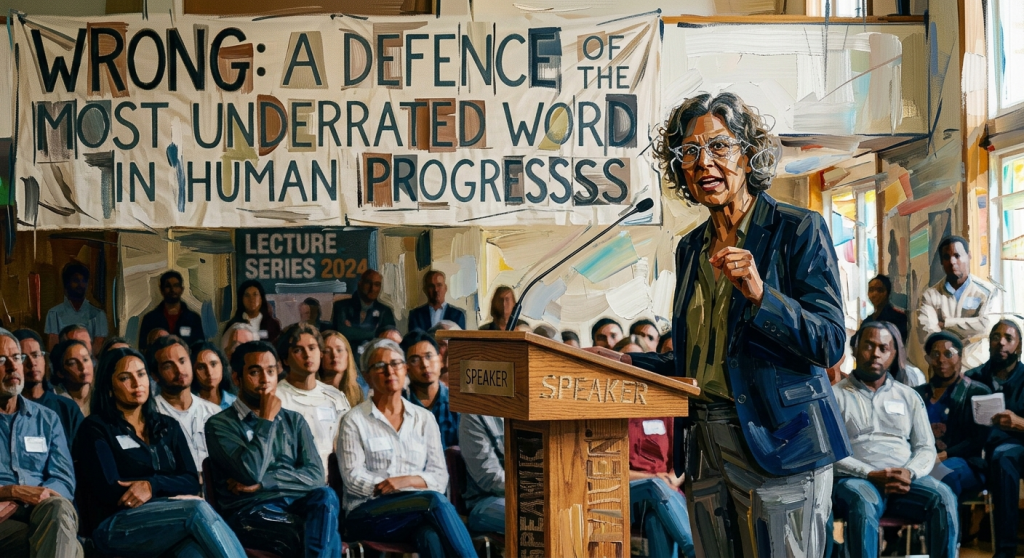
I want to be right. I am right.
We all say it, with our screenshots, our citations, our tribes, our algorithms. In the age of digital certainty, everyone carries receipts. Everyone has a thread. Everyone has a podcast. Everyone has an audience that confirms what they already believe. And because everyone is right, someone else must be wrong.
The consequence is predictable. We have built a culture of cancellation rather than a culture of correction. The logic is ruthlessly simple: I am right. Therefore you are wrong. Therefore you must be silenced.
Wrong needs to be in vogue again. Not because truth does not matter, but because truth is usually discovered through error. The greatest advances in human knowledge have rarely emerged from people who already possess the correct answer. They emerge from people brave enough to propose an answer that later turns out to be incomplete, flawed, or entirely wrong. Brave enough to put the idea in the room. Brave enough to be corrected. Brave enough to let the idea survive or die on its own merits.
This is a case for the accused. This is a defence of Wrong.
Science Is Humanity’s Greatest Error-Correction Machine
The philosopher of science Karl Popper argued that science advances not by proving theories right but by attempting to prove them wrong. A theory survives only until a better explanation emerges. Every accepted truth is therefore provisional, waiting for new evidence and fresh scrutiny. In this sense, being wrong is not the opposite of science.
Being wrong is science.
Wrong But Seminal
A fascinating paper by Jeffrey Seeman and Stuart Cantrill introduced the concept of “Wrong but Seminal” research. Their argument is profound: some scientific papers are wrong in their conclusions, yet they become enormously influential because they stimulate better questions, better experiments and eventually better answers. A wrong idea can generate more scientific progress than a hundred safe, forgettable, correct ones. The authors describe how early scientists misunderstood the structure of ferrocene, a newly discovered molecule. Their interpretation was wrong. Yet that very mistake attracted attention, triggered debate and motivated researchers to investigate further. The result was a breakthrough in organometallic chemistry. The original idea was wrong. Its impact was revolutionary.
Galileo: The Man Who Was Wrong About Being Right
We celebrate Galileo Galilei because he challenged the belief that Earth sat at the centre of the universe. But Galileo himself was not entirely correct. He defended heliocentrism, largely right, but incorrectly explained ocean tides and made several astronomical claims that later required revision. History does not remember him because he was perfectly right. History remembers him because he was willing to challenge prevailing assumptions. Progress emerged not from certainty but from contestation. Galileo’s errors did not invalidate his contribution. They were part of it.
Semmelweis: When Society Cancels the Person Who Is Correct
Sometimes the cancel culture of a given era gets it precisely backwards. In the mid-1800s, Ignaz Semmelweis observed that doctors who washed their hands dramatically reduced maternal deaths during childbirth. His colleagues rejected the idea. The dominant medical establishment ridiculed him. Many physicians were offended by the implication that they themselves were causing deaths. Semmelweis lacked a complete explanation, germ theory had not yet been developed. He had the right answer but incomplete evidence. The medical establishment preferred being right over finding the truth. Thousands died unnecessarily because institutions defended certainty instead of investigating anomalies.
Semmelweis reminds us: The opposite problem exists too. Sometimes what we cancel today becomes tomorrow’s accepted wisdom. The cost of cancelling Semmelweis was paid in human lives.
Darwin Did Not Need to Be Perfectly Right. He Needed to Be Sufficiently Right
When Charles Darwin proposed evolution by natural selection, many details of his theory were incomplete. Darwin had no understanding of genetics. He did not know how traits were inherited. His explanation of heredity turned out to be largely wrong. Yet the broader framework transformed biology entirely. The later discoveries of Gregor Mendel and modern genetics corrected Darwin’s errors while strengthening his central insight. One generation proposed. The next refined. The next corrected. The next expanded. This is how truth is built, not by a single genius arriving with a complete answer, but by successive approximations, each building on what the previous generation dared to attempt.
Einstein Absorbed Newton. He Did Not Cancel Him.
For over two centuries, the laws developed by Isaac Newton appeared almost perfect. They explained planetary motion, gravity and mechanics with extraordinary precision. Then came Albert Einstein, who showed Newton’s theory was incomplete, wrong at certain scales and under certain conditions. Newton remains remarkably useful for everyday engineering. What changed was not that Newton became foolish. What changed was that humanity found a better explanation. Science did not cancel Newton. Science absorbed Newton. That distinction matters enormously.
The goal of knowledge is not destruction. The goal is refinement.
Fleming’s Mistake Became Penicillin
One of the greatest medical discoveries in history emerged from what looked like a laboratory mistake. In 1928, Alexander Fleming noticed that mould contamination had killed bacteria in one of his petri dishes. Many scientists would have discarded the experiment. Fleming became curious. A mistake became data. An accident became an observation. An observation became penicillin. Penicillin transformed medicine and saved hundreds of millions of lives.
Innovation often begins where perfection ends.
Error Avoidance Versus Error Management
Modern organizational psychology confirms what scientific history teaches. Researchers distinguish between two types of workplace cultures and the difference in outcomes is striking.
In Error Avoidance Cultures:
Mistakes are punished
People hide failures
Employees protect themselves rather than the work
Learning slows to a crawl
In Error Management Cultures:
Mistakes are discussed openly
Teams analyse failures rather than assign blame
Knowledge spreads faster
Innovation increases
Harvard professor Amy Edmondson found that the best-performing teams often reported more mistakes than average teams. Not because they made more mistakes. Because they admitted them. The difference is crucial. Learning requires visibility. You cannot improve what you refuse to acknowledge.
The Psychology of Needing to Be Right
Why are humans so attached to being right? Psychologists call it confirmation bias, the tendency to search for evidence that supports our beliefs and ignore evidence that challenges them. Nobel Prize-winning psychologist Daniel Kahneman demonstrated that human beings are not naturally objective thinkers. We are intuitive storytellers. We become emotionally attached to our opinions because opinions are often tied to identity. The moment disagreement feels like a personal attack, learning stops. Being wrong becomes psychologically painful. Yet intellectual growth requires exactly that discomfort. Every meaningful learning experience contains a moment where reality contradicts what we previously believed. Without that moment, there is no growth. Only stagnation dressed up as conviction.
Democracy, Dialogue and the Death of Discovery
This lesson extends far beyond science. It applies to politics. To religion. To race. To gender. To families. To social media. To the comments section under this post. The healthiest societies are not those where everyone agrees. They are societies where disagreement can occur without destruction. Democracy itself is built upon the assumption that no individual, party or ideology possesses a monopoly on truth. The purpose of debate is not victory. The purpose of debate is collective discovery.
When disagreement becomes cancellation, everyone loses. People stop speaking honestly. Questions disappear. Curiosity declines. Orthodoxy grows. History shows that intellectual conformity rarely produces breakthroughs. Diversity of thought does.
The most dangerous phrase in any society is not: ‘I was wrong.’
It is: ‘I already know.’
A New Social Contract
Perhaps we need a new social contract. One that replaces the logic of cancellation with the logic of discovery. One where:
Not: You are wrong, therefore you are cancelled.
But: You are wrong, therefore let us investigate together.
Not: I must win.
But: We must learn.
Not: I already know.
But: What am I missing?
The strongest thinkers are rarely those who proclaim certainty. They are the ones who remain curious. Every major scientific revolution began when someone admitted that existing explanations were insufficient. Every major innovation began when someone explored a possibility that others dismissed. Every meaningful relationship survives because people learn how to say: I was mistaken.
Wrong Is Not a Scarlet Letter
Wrong is the tuition fee of learning.
Wrong is the engine of discovery.
Wrong is the workshop of innovation.
Wrong is the birthplace of wisdom.
A civilization advances when its people become less committed to being right and more committed to finding what is true. The future does not belong to those who never make mistakes. It belongs to those who learn from them fastest.
Being wrong is not the problem. Staying wrong is.
Science, democracy, markets, relationships and personal growth are all systems designed not to eliminate error, but to detect, correct and learn from it. The societies and individuals that flourish are not those who avoid mistakes. They are those who become world-class at revising their beliefs when reality presents better evidence.
So the next time someone says you are wrong, pause before you reach for the receipts.
Ask instead: What if they have a point?
That question has started more revolutions than any certainty ever did.
A Prayer :
God grants us Believers who Doubts.
God grants us Thinkers who Doubts.
Amen.
======================
Dr. Mzamo Masito
Between Thoughts – Intellectual Musings
Where the uncomfortable questions get a seat at the table.
 Between Thoughts -Intellectual Musings
Leave a comment